Wednesday, January 10, 2018

Book Club: Reading List for 2018

Text: Book Club: Reading List for 2018


How many books do you want to read this year? How many books did you read last year?

Last year, according to my Goodreads account, I read 107 books which included biography, fiction, non-fiction, young adult, children’s, science fiction, fantasy, horror, comic books, and others. I kept track of all my books (even those I read with my children) to have a complete record. This year I am challenging myself to read the same number of books (100) as last year. 

There are twelve specific books I want to read during 2018, in addition to those that I pick up at the library on our weekly trip with the kids.


I received this book last year for Christmas and it sat among my 'to read' books all year.  I am determined it will be completed by the time Christmas comes again.


I purchased this edition many years ago to discover more about the men who lived during one of my favorite time periods in history.  I have read many other non-fiction and fiction books that provide accounts of the Tudor time and I have many more left to read on my shelves.

3) A Study in Sable by Mercedes Lackey


At one point in my life, I enjoyed reading almost all of Lackey's books.  I would purchase them as soon as they were published (sometimes waiting for paperback) and I have read and reread many of her novels.  Of late, I have drifted away from her books and I hope that this helps recapture the enjoyment I garnered from them when I was in college.

4) The King's Confidante by Jean Plaidy


This is one of the many fictional books of the Tudor Time period that I wish to read. I have read others in the same time period by Plaidy and enjoyed them. 

5) Star Wars: Phasma by Delilah S. Dawson 


I enjoyed reading some of the other more recent Star Wars books and I hope that this will continue that trend.

6) You're Already Amazing by Holley Gerth


I find that like many individuals I tend to judge myself harshly.  I am hopeful that this book will help me see that I am "already awesome."

7) God Loves You by Dr. David Jeremiah


8) A Life Beyond Amazing by Dr. David Jeremiah


My husband introduced me to the work of Dr. David Jeremiah a little over a year ago.  I have found Turning Point and his other works to be encouraging and I am eagerly awaiting reading these two books.

9) Choosing Gratitude by Nancy Leigh DeMoss


In addition to some of the other books I have chosen that might fit in the 'self-help' category, I selected this one amongst those recommended by friends.

10) Doctor Turner's Casebook based on the BBC Hit Drama Call the Midwife


I don't know exactly when I discovered the TV series Call the Midwife, but I am really glad that it has become one of the few shows I eagerly look forward to each Christmas and Spring.  I have read the books by Jennifer Worth (which provided the basis for the show) and I am looking forward to reminiscing about some of my favorite characters and episodes with this 2017 Christmas gift.


This was also a 2017 Christmas gift.  I have read all the books in the Mitford Series and I am looking forward to trying out some of the recipes made famous by Karon's characters.

12) The Pickwick Papers by Charles Dickens


Over the years during high school and college, I read most of Dickens' books  There are still a few that sit unread on my shelf and this year I am determined to cross another off my 'to read' list.

Have you read any of the books on my list?  Do any of these sound interesting to you?  Please let me know in the comments if you set reading goals for yourself (or your family) each year.

2018 Reading Challenge

2018 Reading Challenge
Kristen has read 0 books toward her goal of 100 books.
hide

Looking for a new homeschool curriculum?  SchoolhouseTeachers.com offers homeschooling families the chance to add a wealth of resources (including many eBooks!), electives, and new course options to their curriculum lineup for the second semester - and at a super-affordable price!


Monday, January 8, 2018

An All-in-One Curriculum: A SchoolhouseTeachers.com Yearly Membership Review


This post contains affiliate links. For more information, please see my Terms of Use and Disclosure Policy page. Thank you.
SchoolhouseTeachers.com Logo
Sensory activity
Sensory Activity from Small World Sensory Science

A Yearly Membership to SchoolhouseTeachers.com provides homeschooling families with over 300 courses, PK through 12th grade, "grounded in a Biblical worldview." My family is very excited to be able to review the Yearly Membership, in particular the preschool classes, from SchoolhouseTeachers.com. Parents and children can pick from subjects such as art, foreign languages, mathematics, history, and science to name just a few. Once you have reviewed the courses and made your selection, you can use their schedule builder to prepare for the year.  There are no textbooks to buy; you can download all the course PDF files or queue the videos to screen and start learning at your own pace.

Besides having quite helpful tabs that allow one to browse by grade and subject, there is also a course directory that breaks down every course by subject for easy comparison.

Our youngest children (aged 2 and 4) are those that we are planning to homeschool but I also love that I am able to access materials for our high school son to review with him as needed.  And since he is attending a public school, we can provide him access to a variety of Bible courses to complement his secular education.

SchoolhouseTeachers.com Bible courses

I have been able to include lessons from several Preschool classes (Small World Sensory Science, ABC: What Will I Be?, Schoolhouse Spelling, and Preschool Playground: Numbers, Patterns, and Cognitive Skills) in our daily activities as well as examine the Preschool Playground part of SchoolhouseTeachers.com.

Preschool Playground provides resources for studying the Bible; Language Arts; Numbers, Patterns, and Cognitive Skills; Manners and Healthy Habits; Arts, Crafts, and Music; Science; Social Studies; and Multi-Subjects resources such as Getting Around videos on the World Book Early World of Learning site and a World eBook Tough Trucks.  The Getting Started page provides information for parents on how to set up binders to store and organize your lessons and ideas for homeschooling your preschooler.  As a former teacher, I am very pleased to see that they are recommending a very similar set up to the one I used while I was teaching high school. That is, keep a master parent binder separated by topic and a child binder with the child's daily work (changed each day as your child completes the work).

preschool playground

There is a Scope and Sequence document which provides you with the age appropriate objectives for your preschooler.  I find this to be valuable because it helps one see how each subject is really connected.  For example, learning shapes falls under language arts and arts and crafts.  It can also be applied to discussing patterns with your preschooler. When your child has completed the work you have chosen for them, there are colorful certificates of achievement you can print for writing the letters of the alphabet and counting all the way to 10, among others.

There are also articles for parents to help encourage you on your journey to homeschool your preschooler. In “Preschool Education” by Juliebeth Lamb, tips are provided for organizing your home and setting a schedule. Donna Conner writes about “Preschooling with One” and offers this piece of great advice: “I think I wouldn’t be as concerned with messes.  They’re only messes, and your child is only that age once in his life – once in your life!”

Early World Learning World Book resource

In World Book: Early World of Learning, there are a number of activities for younger children to complete (both online and offline).  For example, there are series of Print and Do Activities that can be used as part of Preschool Playground.  There are matching pages, color by number, and location worksheets as well as activities for shapes, sizes, and time -- to name a few. There are also videos to view with your youngster.  My only complaint is that the videos are extremely short (some only 15 seconds).  As soon as the video starts, it is over (which my four-year-old doesn’t really like). 

World Book Online resources

In 2017, my preschooler and I started using the lessons in ABC: What Will I Be?  We completed B is for Baker and recently completed our study of C is for Construction Worker. Each letter in the course focuses upon different jobs and includes book suggestions and a series of five activities for the week.  For C is for Construction Worker, activities including building a skyscraper, acting out the work completed by equipment (for example, spin like a cement mixer), and working on writing the letter C.  Both my four-year-old and my two-year-old thoroughly enjoyed the activities and I love being able to have things that both can do together. 

practicing writing letter cPracticing writing letter c


Beyond being able to use World Book with younger children, it also provides a number of other excellent resources.  While I have been writing a history curriculum for SchoolhouseTeachers.com, I have used the World Book Advanced to provide future students with articles to read on the United States and its history, such as biographies of presidents and leading citizens.


World Book Online

There is also a World Book Kids that provides many resources including such science lessons as "Do plants like salt?" where children will test out if plants can survive with or without salt.  The lesson includes materials needed, procedures and discussion, and links to online articles explaining topics in the experiment.

And if your family really enjoys eBooks, there is a great selection of educational ones as well as classic stories like J. M. Barrie's Peter Pan, Jane Austen's Sense and Sensibility, and non-fiction such as Edward Gibbon's History of the Decline and Fall of the Roman Empire. For younger children studying animals, there is a series of Animal Lives and Animals of the World eBooks.  Those interested in mythology, legends, and folklore will find tales from places like Ancient Greece, the early Americas, and Ancient Egypt, among others.

There are so many great resources to SchoolhouseTeachers.com.  Part of the video collection available for members are the following Drive Thru History videos: American History and Ancient History. Accompanying the videos are worksheets that your child can answer during the viewing or afterwards for a review.  We have started watching these together as a family. As a student of history, I always enjoy videos best where the presenter's interest in the topic is evident and Dave Stotts' enjoyment of the subject matter is evident. 

Drive Thru History

Please be sure to take a look at other reviews for SchoolhouseTeachers.com.  There are many wonderful aspects to the site for the entire family.  I am looking forward to continuing to use SchoolhouseTeachers.com for my family's homeschooling needs as well as checking out some of the other resources I have recently discovered like the Monthly Menu (I am always on the look out for new dinner ideas for my picky eaters.).


 Join SchoolhouseTeachers.com today!


New members can start their homeschooling journey at SchoolhouseTeachers.com! 


Please be sure to visit the rest of the crew's reviews!

Online Classes


Tuesday, January 2, 2018

Book Club: Review of My People, The Amish: The True Story of an Amish Father and Son

book cover of My People, The Amish

Disclaimer: I received a FREE copy of this book from the publisher in exchange for my honest opinion. I was not required to write a positive review nor was I compensated in any other way. This post contains affiliate links. For more information, please see my Terms of Use and Disclosure Policy page. Thank you.

My People, The Amish: The True Story of an Amish Father and Son by Joe Keim was a very enjoyable read for me. I received an early review copy in return for my honest opinion and I would recommend this book to those individuals who are interested in the life and culture of the Amish, the life of people working through their own journey to a relationship with Jesus Christ, and those who have struggles with their own families. 


Living within a few hours of Lancaster, Pennsylvania, I found Keim’s book interesting fro the start. I have been visiting the area, “Amish Country,” since a sixth grade field trip and found the Amish fascinating to learn about and my opinions of their culture matured with me. Many people find them ‘quaint,’ but the very things that promote this stereotype seem to be the beliefs and aspects of their life that people who leave the Amish struggle with – whether for religious reasons or just because they want the English lifestyle. 


girl's room at Amish Farm and House in Lancaster, PA
Girl's Room at the Amish Farm and House, Lancaster, PA

Keim’s journey in My People, The Amish, as he describes his childhood, youth, and adulthood, is moving as he finds a close relationship with Jesus and starts the MAP Ministry (Mission to Amish People). 
book cover of My People, The Amish

Many of Keim’s stories about his families can also be applicable for our own lives. One example is how he and his wife, Esther, relate to their own children, Jonathan and Rachel, raise them to be godly individuals, and pray over them and their families. 

Another great aspect of the My People, The Amish, is the use of multiple Bible quotations throughout as Keim recounts his journey. 

My only complaint is the structural organization as parts of the past, life living within the Amish community in Ohio, are told as they relate to more recent events in the life of Keim. At times it is a little confusing but not to the point that it is a huge distraction. 

Keim’s message of encouragement to never give up is a wonderful one that is needed in today’s world.


Thursday, December 28, 2017

Learning about the Alphabet: A is for Alligator

Text: Learning about the Letter A: A is for Alligator; photo of an alligator; A Mom's Quest to Teach Logo

This post contains affiliate links. For more information, please see my Terms of Use and Disclosure Policy page. Thank you.

Over the course of twenty-six posts, I will introduce my own simple lessons for the letters of the alphabet.  I will provide enough ideas and suggestions for a week's worth of activities.  

For the letter A, we focused upon alligators.  We colored pictures, read books, and completed crafts to help us learn about these amazing animals.

Alligators are a type of animal that belong to the class of reptiles (which includes snakes, lizards, turtles, and the tuatara) and belong to the order of Crocodilians (along with crocodiles, caimans, and gharials).  Depending on the age of your child, you can create a flow chart to show them how they are connected to other animals.

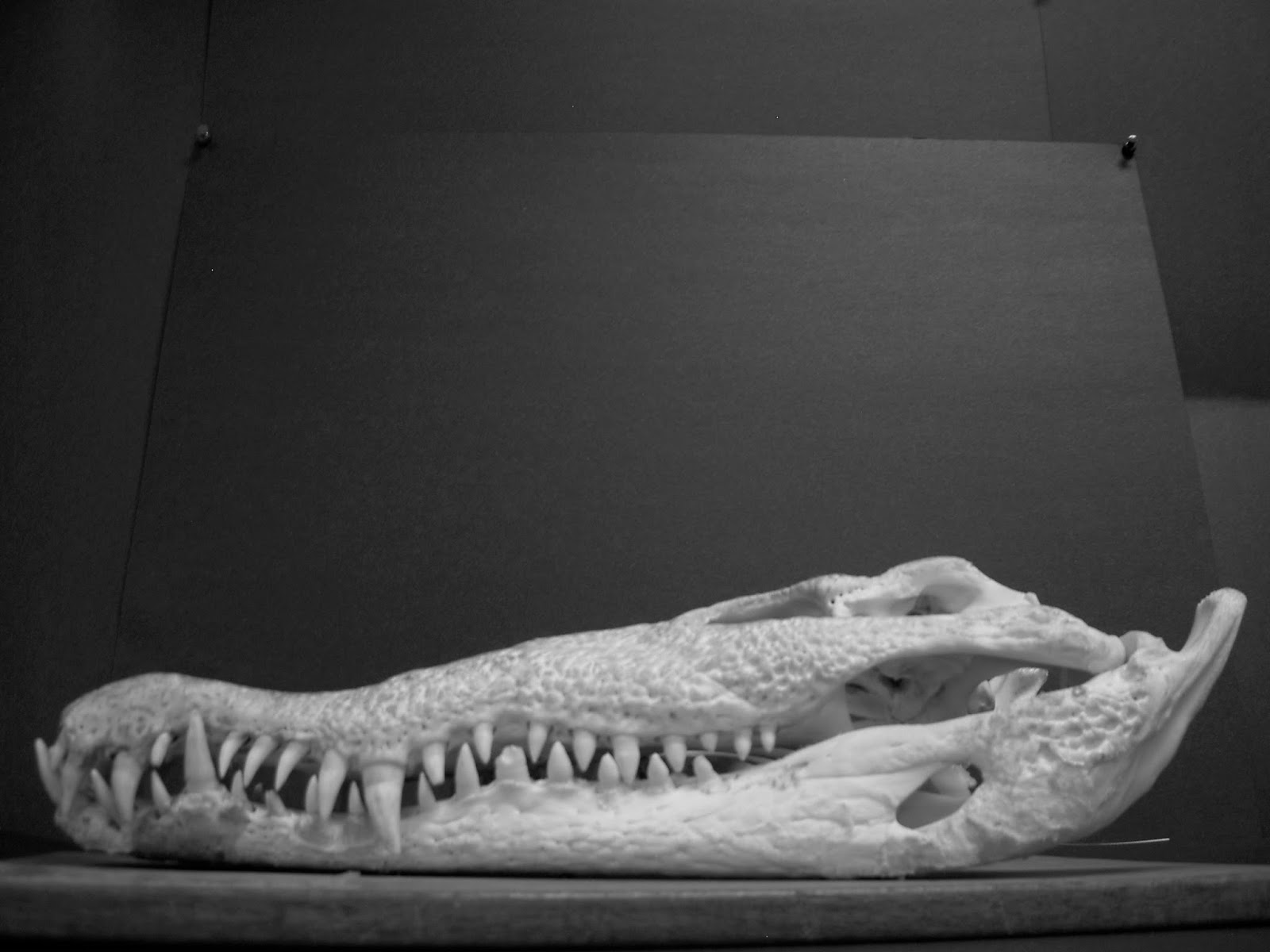
Alligators have short, wide snouts while crocodiles have slender, pointy snouts.  The other major difference is when an alligator's mouth is closed its fourth lower tooth is usually hidden, while a crocodile's fourth lower tooth is visible when its mouth is closed.  You can have your child make an alligator mouth with their hands.

Alligator Skull (fourth lower tooth hidden)

Crocodile Skull (fourth lower teeth visible)

An alligator's body is covered in scales made of keratin (the same protein that makes up our own fingernails and hair). So every time you are touching your finger nails, you are feeling what an alligator (or any reptile) feels like - smooth and dry (not slimy at all!).

Like other reptiles, alligators are cold-blooded.  They must regulate their own body temperature by either basking in the sun to warm up or moving into the cool waters to cool down.

An alligator's eyes and nostrils are located on the top of its head allowing them to sit with just those poking out of the water so they can keep the rest of their body hidden from predators or prey.  Look at different pictures of alligators and other animals to compare where their eyes are ears are located.  You can talk about the differences with your child.  For example, a rabbit's eyes are located on the side of its head letting it see almost all the way around them to keep away from predators.

Crocodilians make a variety of sounds from soft hissing to loud bellows.  Baby crocodilians will make a high pitched noise from inside the egg to let their mom (who stays with the nest) know they are ready to hatch. Using its egg tooth (a hard spot of the tip of its snout) the crocodilian will break free from the egg.  The mother will assist the hatching crocodilians by removing nesting material and then continuing to protect her young for several years.  Talk about the following questions with your child: How does a baby human let his or her parents know it needs help?  How long do humans stay with their families? How long do other reptiles stay with their mothers? In almost all cases, reptiles lay their eggs and leave them; there are some exceptions like the python.

Alligators will prey on most any animal such as insects, amphibians, birds, mammals, fish, and other reptiles. If your child is older, you can talk about food chains (an example could be plant material - insects - amphibians - raccoon - alligator).

Vocabulary

alligator
crocodile
reptile
crocodilian
turtle
lizard
tuatara
cold-blooded
warm-blooded
predator
prey
mammals
amphibians
keratin
egg

Alligator and Crocodile Vocabulary 

Coloring Sheets

Super Coloring Alligator Pages 
This site features realistic and cartoon alligators for your little ones to color.

Mom Junction's Top 25 Free Printable Alligator Coloring Pages
There is a variety of coloring pages and some activity suggestions to go along with each page.


Alligator Projects 

A is for Alligator


Alligator Craft 


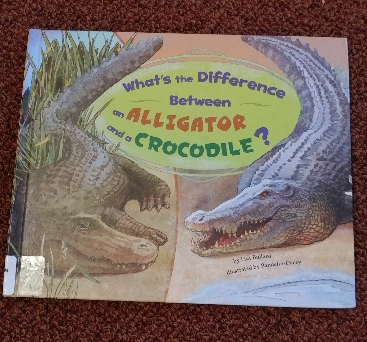
Books 

Featured Shape

Have your child work on drawing a triangle this week.  If you take a look at the snout of an alligator, it closely resembles a triangle.

You can build a triangle with craft sticks, cut out scraps of construction paper in triangle shapes, look for signs around town shaped like a triangle, and examine the musical instrument. 

Activities 

My Pinterest Lessons - Letters Board. 

If you complete any of the crafts, please let me know in the comments. I would love to see them.  

Clay Play 

I purchased a tray from the Dollar Store and gathered together various materials that my children could use with the Play Doh. They created a home and food for the tiny alligator and lizard toys provided with no prompting.

The items I included this time were: a roller and cutter from a Play Doh kit, straws, buttons, plastic lids, rocks, plastic rock, toy alligators, and Play Doh.


Other A Topics 
Apples

Fun Handprint Art's Apple Counting Activity for Johnny Appleseed Day (September 26) 
This is a fun way to count apples involving paint or stamp pads.

123 Homeschool for Me's Apple Seed Counting Activity and From ABCS to ACTS's Printable Apple Seed Counting Activity  
A great activity to practice counting and if your children love dice like mine do, then this is perfect for them.

Airplanes

Play and Learn with Dana's Letter A Airplane Craft 

This is a great craft to introduce the lowercase letter a.

Homeschool Preschool's Printable Airplane Activities 
This packet has lots of fun letter A and airplane activities for your toddlers.


Resources 

Smithsonian's National Zoo and Conservation Biology Institute's American Alligator page 


Friday, December 22, 2017

Crafts: C is for Construction


This post contains affiliate links. For more information please see my Terms of Use and Disclosure Policy page. Thank you.

We had previously completed a lesson from SchoolhouseTeachers.com that focused upon Construction and as we make our way through the alphabet, I wanted to create a C is for Construction craft with my two littles.


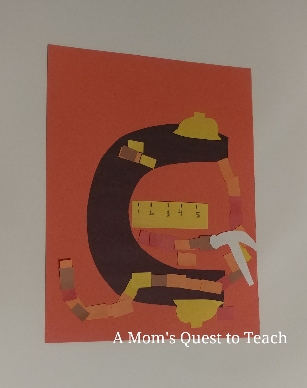
The idea was to provide them with construction related images to glue onto the letter C such as a hard hat, a hammer, a ruler, and bricks.  In the true spirit of creation, my children designed their very own original C pictures. Even though they weren't really want I had in mind, the finished products are fantastic.

Materials


Steps

1. Gather all materials. If you children are proficient with scissors, they can cut out the letter C and other materials needed for their pictures.


2.  Glue the letter C onto the construction paper.


3. Allow your child to glue on the construction related images.  I simply drew a few items (a hard hat, a hammer, a ruler) and then cut out many rectangles for bricks for them to use.  If you wish, they can draw the images or you can print out pictures on the computer.


4. Display the artwork. 

my son's picture 


Using construction paper in our crafts (both those that are construction-themed and those that are not) is one of our favorite ways to create art. We have made giraffes and Endermen in the past.