A Mom's Quest to Teach is a regular column covering elements of teaching and learning (with an eye towards homeschooling), parenting, crafting, and all of the discoveries, joys, and daily roller coaster rides that occur while being a mom.
I received COMPLIMENTARY copies of these books from Timberdoodle in exchange for my honest opinion. I was not
required to write a positive review, nor was I compensated in any other way.
This post contains affiliate links. For more information, please see my Terms
of Use and Disclosure Policy page. Thank you.
Science can be both an exciting and a challenging subject to teach in one's homeschool. As parents, you get to curate your child's curriculum while you learn alongside them or share your own knowledge. One of the challenges I find is planning and following through with experiments and hands-on science learning. That is where Science: Lessons and Investigations comes into play.
Two Science Books
We received the second and fourth grade editions of Science: Lessons and Investigations published by Evan-Moor courtesy of Timberdoodle. We started using the books this summer even though we hadn't officially graduated to these two grades yet.
Each book is similar in setup. The chapters have a vocabulary and various vocabulary activities. There are also readings with questions of varying levels, projects, and investigations or experiments to complete.
Grade Two has 14 units on topics such as:
What do plants need to grow?
How do animals help plants?
How do wind and water change the shape of the land?
How do maps show land and bodies of water?
What is matter?
What do scientists study?
Grade Four has 13 units and includes
Teacher pages
Unit concept pages
Explore activities
Reading selections
Concept vocabulary and vocabulary reviews
Concept comprehension
Extended writing prompts
Projects
And an answer key
These books are really geared towards teachers (or parents). To help you teach the lessons, there are written objectives and an explanation as to the learning approach. Permission is also given for photocopying for a single classroom so the book really isn't set up to just hand over to your homeschooler.
For both my children, I have been removing the pages we will complete and they will also be stored in a binder for each child. This way they have what they need and I keep as many of the teacher-oriented pages in the book.
So far with our soon-to-be fourth grader, we have studied plant life structures, animal life structures, human life structures, and erosion and weathering. In the coming weeks, we will be studying patterns in the earth's crust, national disasters, and more. We might try our hand at making a homemade seismograph, investigating waves, and making a shadow puppet theater.
I like how there are a variety of activities within each lesson so I can pick and choose which ones we will do. Having a variety also allows our son to pick and choose from the different questions and investigations. All the materials are listed for the investigations so you can easily prepare ahead of time.
My Thoughts
As the books are written with more of a school setting in mind, we did have to make modifications to some of the lessons. For example, the animal life structure exploration activity was written for a class of students. We needed to adapt it for our two children. And since the book allows for teachers to copy it for their classroom, many of the student pages are printed on the back of teacher pages. So we will have to put it all together in our binders when we complete the lessons.
Depending upon your approach to science, you will want to preview the books as they talk about millions of years and animal adaptation. But since this is your homeschool, you can adapt this science resource to your own needs.
This is a good base for developing a science curriculum for your homeschool. There are many creative ideas for investigation and discussion. Adding in books and field trips, you can really bring excitement to your science lessons this homeschool year.
I'll be sharing more photographs of our projects and the book on my Instagram account this week.
"Science units build upon prior knowledge and experience and allow students to apply their understanding in a creative way. Each unit guides students through exploring the science concept and includes hands on activities to extend learning."
Disclaimer: I received this unit study for free from the author in return for my honest opinion. All thoughts and opinions are my own. This post also contains affiliate links. For more information, please see my Terms of Use and Disclosure Policy. Thank you.
There are a variety of different options for homeschooling families who wish to learn information together. One such option is using unit studies that are written for students in kindergarten through 12th grade. Our family reviewed the Natural Disasters K-12 Unit Study from Love at Home Education. It contains 6 main units and 4 mini-units. Each of the main units is spread out over the course of one week so the entire Natural Disasters K-12 Unit Study could take about 10 weeks depending on if you supplement with additional books, videos, and activities. I am glad that I am able to share this K-12 Curriculum Review with my readers.
What Do You Receive?
You can order either just the PDF or the PDF and a Print Copy (bound). Natural Disasters K-12 Unit Study consists of 7 units for a total of 129 pages. There are six main units and one mini-units set of lessons.
Six Units
The Earth's Layers
Earthquakes
Volcanoes
Tornadoes
Hurricanes
Storms
Mini-Unit on
Landslides
Avalanches
Glaciers
Droughts
Each of the six main units has five days' worth of information and activities for your homeschool. Besides learning new vocabulary, children will be able to share their artistic side with clay figures and painting, use food to help recreate different aspects of the earth, and view suggested videos from YouTube. With the variety of activities provided, you can easily adapt each day's lesson to meet the needs of your homeschooling family.
One of their favorite activities was painting the earth and the layers.
How Our Family Used the Natural Disasters Unit Study
After talking about the first several sets of vocabulary with the kids, we looked at photos from trips that their father
and I took to Penn's Cave, Woodward Cave, and Lincoln Caverns.
As the review period did not consist of 10 weeks, I chose from among the variety of units, lesson ideas, activities, and work for our family to study. We started with the first unit—Earth and Its Layers—so we could have a firm understanding of the basics and then moved onto other units. We then spent time reviewing the different vocabulary from all of the units in addition to talking about volcanoes. We also spent some time going over earthquakes and storms.
We went through the five days as suggested for the first unit and studied the earth and its layers including the inner and outer core, the mantle, and the crust. We also spent some time collecting rocks because what homeschooling child doesn't have a rock collection?
I chose to only spend one day discussing earthquakes for now (we had just read a few books about them) and moved onto volcanoes. Our children had great fun combining colors to create the perfect color of ash and magma for paintings. We also watched some videos on volcanoes and reviewed the vocabulary each day.
Painting their favorite volcanoes.
Reviewing vocabulary while we waited for the paintings to dry.
I love how the volcano is shown with a cross section because it makes it look like an angry creature.
Storms
We also talked about storms – thunderstorms, blizzards, and hailstorms – and painted one of the storms. While painting with the water color paints, our children narrated their painting. Our four-year-old daughter explained how the platypus was stuck in the blizzard. It was a baby platypus who was purple. Our five-year-old son painted all three storms in one painting.
What Did We Like
Our children loved the fact that they could paint, play with food, and explore different topics in a variety of ways. I loved all of the different options for using the unit study as part of our homeschool curriculum.
With each unit within the K-12 Curriculum divided into separate days, I was able to easily plan out our days. It made it easy to see approximately how long the entire unit study would take our family if we did the activities each day.
The way Natural Disasters is designed also allows for children to explore the topics they enjoyed in more depth. For example, when studying earthquakes, the unit study suggests watching some YouTube videos on them. If children are really interested, there is a considerable amount of media available to view (depending upon their age and maturity). Our kids were really into the volcano unit so we spent some time watching several videos on volcanoes including the one from SciShow Kids.
Natural Disasters also allows children to become scientists through exploration of theories and hypothesis. For example, there is discussion of theories in regards to faults and the opportunity to speculate what would happen if there was an earthquake along the San Andreas Fault. I remember watching the 1974 movie Earthquake which speculated what would happen in the Los Angeles area if an earthquake occurred.
There is also the option to write about the cause and effect of earthquakes based upon a child's age and writing abilities. From writing and drawing the sequence of events to writing a proper 5-paragraph essay for a homeschooled high school student, there are tips as to what may be appropriate for your family.
One of my favorite parts of the whole unit study is the suggestion to make an Earthquake Emergency Kit (or if you don't live in an Earthquake zone, just a regular emergency kit). I think this is a great way to have a discussion with the family about being prepared. It could also extend into an opportunity to give back by having your family prepare emergency kits to donate to a shelter, church, or other location based upon need.
In the Future and Observations
I can see us revisiting the Natural Disasters K-12 Unit Study when the children get older so we can study the topics in more depth. Homeschooling materials like this allow families to build upon what they have learned in the past as their children move through their educational careers.
As our children get older, we could use the the vocabulary words as part of their spelling words. In fact, depending upon what area of science our teen takes in the future, I will be able to reuse the vocabulary cards with him.
My only negative observation is in regards to the font chosen for the vocabulary cards. My younger children had difficulty reading some of the letters and words. If I was going to make one recommendation, it would be to use a plainer font for the vocab words.
Two of the vocabulary cards.
Do you want to learn more about Love at Home Education?
Love at Home Education offers secular and religious curriculum for PK through 12th grade. There are faith-based unit studies, ones on presidents, and ones on the human body.
While trying to decide what curriculum materials I wanted to use for my five-year-old for his first official year of homeschooling as a kindergartener, I was drawn to the Learning About Science Collection of WriteBonnieRose. I was already familiar with some of her other products, so I jumped at the chance when when the opportunity arose to review the very same collection I was already interested in. Learning About Science Collection, Level 1 is geared towards 1st through 3rd grade students but I hoped it would be adaptable for my 5-year-old. And it is! Reviewing this collection with our son has been fun and exciting so far and I look forward to using the entire collection during the course of our homeschool year.
There are seven books in the Level 1 collection that study "how plants grow, common fruits and vegetables, animal habitats, senses and body systems, life cycles, the earth's layers, earthquakes, volcanoes, states of matter, and more." The books can be personalized through the coloring of the illustrations included within. In total, there are 172 pages to introduce your child to a variety of fun science-related facts and lessons.
The books are as follows:
Familiar Plants and How They Grow
Fruits and Vegetables Around the World
Animal Habitats of the World
Our Senses & Systems & How They Work
Learning About Life Cycles
Earth: Layers, Earthquakes, and Volcanoes
Exploring States of Matter
How We Used the Learning About Science Collection Books
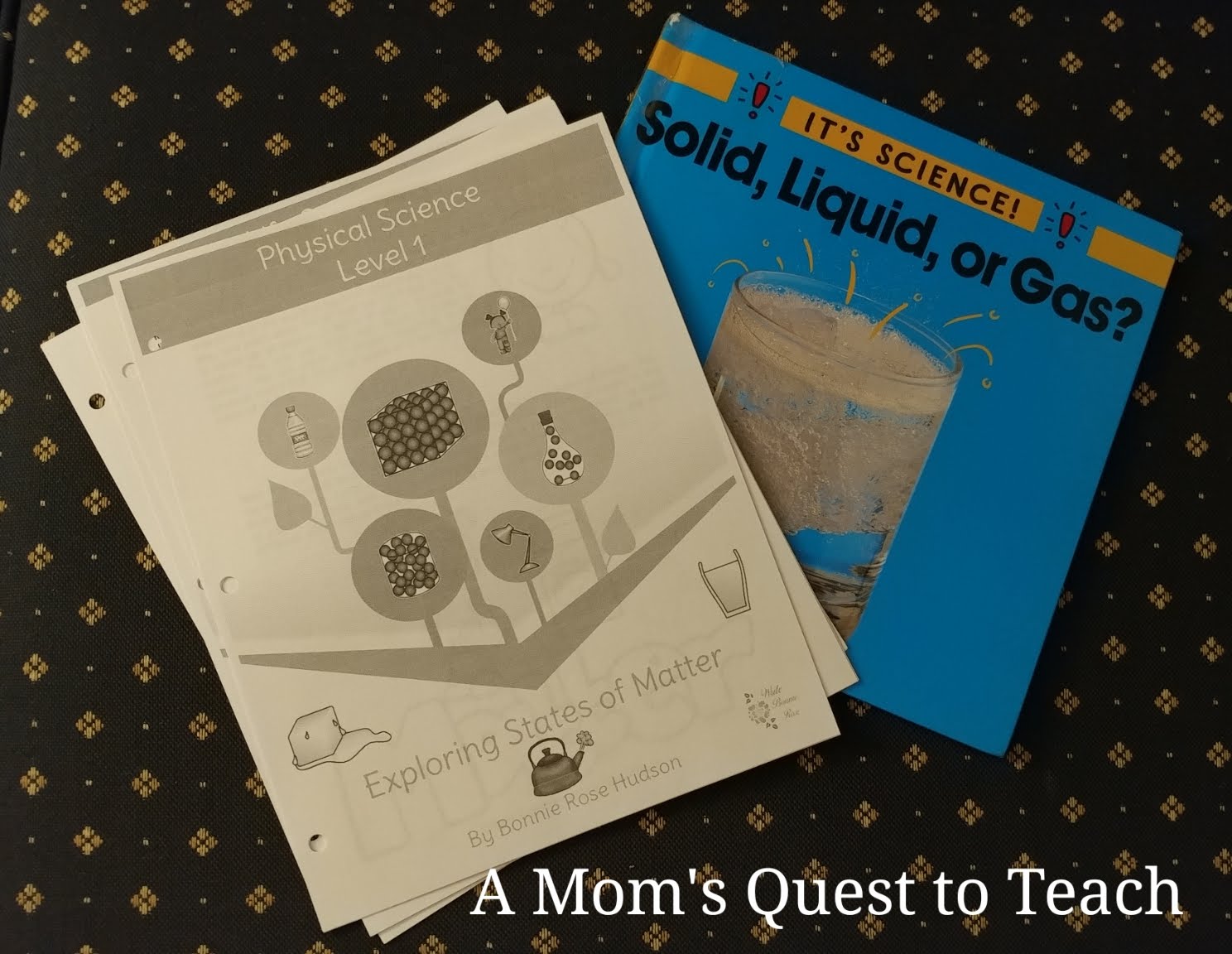
Physical Science Level 1: Exploring States of Matter
We worked our way through the entirety of one of the science books and parts of two others. The first one we viewed was Physical Science Level 1: Exploring States of Matter. It was a shorter booklet containing twelve pages with four main topics: matter, solids, liquids, and gas. We worked on one or two pages each day by reading the material, coloring in the pictures, and then discussing the material contained on the pages. During the evening our five-year-old son also discussed what he learned after dinner with the entire family. I also picked up a book from the library on the material so we would have a few concrete experiments to do. However, the pages are written in such a way that it wouldn't be difficult to figure out what you could do on your own with your children.
I couldn't resist checking out some books from the library!
Both our children wanted to work on the books.
The other two books we are studying right now include: Life Science Level 1: Our Senses & Systems & How They Work and Life Science Level 1: Animal Habitats of the World.
Life Science Level 1: Our Senses & Systems & How They Work
For Life Science Level 1: Our Senses & Systems & How They Work, each of the five senses is discussed on one individual page with facts, questions for discussion, tracing work for words and pictures to color in (if you wish). In addition to the five senses, the book also contains pages on the following systems:
Circulatory System
Digestive and Respiratory Systems
Urinary System
Nervous System
Muscular System
Skeletal System
My mom worked on this book with our son and said it was very easy-to-read and explain to him. She liked the inclusion of questions that helped her discuss the topic with our son.
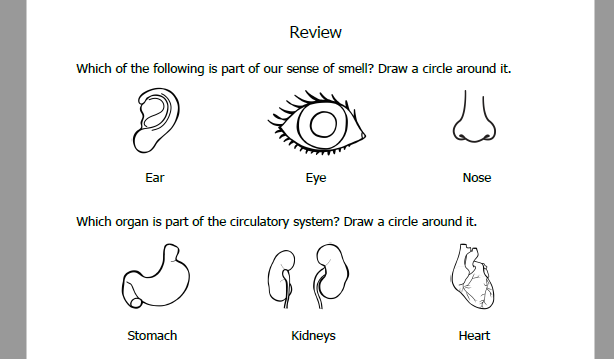
There is also a two-page review on five senses and the body systems. The review questions ask your child to circle the correct choice to answer the question. An answer key is included in the book.
Two of the Review Questions from Our Senses & Systems & How They Work
Life Science Level 1: Animal Habitats of the World
Our daughter wanted to use realistic colors for the giraffe.
As a former Zoo Educator, I am really excited to use the Animal Habitats of the World book with our children. There are over 15 habitats discussed – each with at least one page to introduce the habitats and additional pages that highlight a few of the animals that live in that particular habitat. So far, our children have worked on the introduction page that defines habitat and then the pages that followed on the African Savanna. Our three-year-old daughter, five-year-old son, and I sat together one afternoon and I read the first several pages. After I answered some of the questions – like providing a deeper explanation of a savanna – we colored the pages together. Our daughter was set on coloring the animals and scenes accurately while our son was determined to color them "weird colors" in his words. (I think with the next set we will be looking at photographs of the animals prior to coloring in the pages.)
We are taking this book slowly because I am incorporating library books, our own books, and other activities into our study of Animal Habitats of the World. For example, I gathered together some photographs, vocabulary words, and books for us to read. We can read more about the individual animals that live in the habitats – like penguins in Antarctica or grassland wildlife in general.
Options for Using Learning About Science Collection
There are many options for how to use the books for your family. You could have a set printed out for yourself and for your child. Or you could print one set for your child then read the PDFs on an e-reader or tablet like I did. While you're reading the material aloud, your child could be coloring in the pictures or you can have your child read the material themselves. Provided along with the Learning About Science Collection, Level 1 is a document entitled Learning About Science Collection Level 1. In this PDF, Bonnie Rose Hudson states that "whether you are studying life science, earth science, or physical science, one message comes through over and over again. God loves you." She then provides a collection of helpful creation science websites along with websites for each of the different books. The user is also reminded that we need to use the websites with our own discretion. All of the sites provide a Creation viewpoint of science. As I stated earlier, you could use the Learning About Science Collection for your science curriculum for your younger children or as a supplement – it really is up to you! With the topics very well organized, it is quite easy to use them in your homeschool.
What We Like
The font in all the packets is very clear and easy to read. The images are eye-catching, cute, and easy to color – even for younger children. Even though our son at age 5 is on the younger end of the spectrum, he is able to understand everything that is written in the level one material.
We can use the books as a starting point to learn more about a topic or subject.
We could also use the books as a review if we have already studied a subject.
Combination of reading, writing, and coloring is just right for our kindergartner.
We were able to do some basic experiments corresponding to the topics discussed.
I pulled out a lot of materials from when I was a Zoo Educator to share with our children.
Ease of printing – no complicated instructions!
Variety of animals presented in Animal Habitats of the World from hedgehogs and zebras to yaks and rabbits.
Variety of plants illustrated in Familiar Plants & How They Grow.
Labeling of a flower and different seeds illustrated in Familiar Plants & How they Grow.
Other members of the Homeschool Review Crew are reviewing other Learning About Science Collection levels including:
Level 2 – including information about food chains, hibernation, clouds, the solar system, and more
Level 3 – (comes in both a print and cursive version) including information about plants, weather, rocks and minerals, landforms, and more
I think our family will definitely be checking out the other levels as our children get older.
If you like to find out more, please visit the following:
.png "A Mom's Quest to Teach: Science Lessons and Investigations: A Review of Two Grades")
%20(1).png "A Mom's Quest to Teach: Science Lessons and Investigations: A Review of Two Grades")
.png "A Mom's Quest to Teach: Science Lessons and Investigations: A Review of Two Grades")
.png "A Mom's Quest to Teach: Science Lessons and Investigations: A Review of Two Grades")