Showing posts with label History. Show all posts

Sunday, March 31, 2024

History in Your Homeschool: A Review of Discover! Social Studies 6

A Mom's Quest to Teach: History in Your Homeschool: A Review of Discover! Social Studies 6; cover of books

I received a COMPLIMENTARY copy of this curriculum from the Timberdoodle in exchange for my honest opinion. I was not required to write a positive review, nor was I compensated in any other way. This post contains affiliate links. Please see my Terms of Use and Disclosure Policy page for more information. Thank you.

How do you teach history in your homeschool? There are so many great ways to incorporate the study of the past. No matter what your child's learning style, I have found that Discover! Social Studies 6 offers you lessons, ideas, and more to help meet your child's needs and abilities. 


What is the Discover! Social Studies series? 

It is included in the 2023 non-religious 6th-grade curriculum kit from Timberdoodle. But just because it is in the non-religious kit doesn't mean that there is no talk of religion. Religion is interwoven in all societies you will be studying about. When studying Ancient Egypt, there is a lesson on the religious practices, which introduces the polytheistic nature of their religion and mummification. In the chapter on Ancient Israel, your child will read about the Tabernacle, Moses, Passover, and a few other key details of the Hebrew religion. 

Each chapter has several lessons and a chapter review. When looking at Chapter 5: Ancient India, your child will study: 

  • Harappan Civilization (one of the earliest Ancient Indian civilizations; it was highly advanced but disappeared for unknown reasons)
  • Ancient Indian Caste System (Aryans and the Vedas are introduced; a chart depicting the castes and their locations, as well as their Hindu names, is included) 
  • Buddhism in Ancient India (information about Siddhartha and a comparison of Buddhism, Christianity, and Hinduism in a Venn Diagram is included)
  • Language in Ancient India (a look at the languages and spread of different languages)
  • Mauryan Empire (learn about the great leaders like Ashoka and Chandragupta Maurya) 

A Mom's Quest to Teach: History in Your Homeschool: A Review of Discover! Social Studies 6; inside the book


What topics are included in Discover! Social Studies 6? 

The focus of Discover! Social Studies 6 is the study of ancient civilizations. Your child starts by learning about the themes of World History and how they will apply that to ancient civilizations. Then, it moves forward to learning about the characteristics of civilizations by looking at Sumer and Mesopotamia.

Chapters include the following civilizations: 

  • Ancient Egypt 
  • Ancient Israel
  • Ancient India 
  • Ancient China 
  • Ancient Greece
  • Ancient Rome
  • Mesoamerica (Olmec, Mayan, Aztec) 
  • Ancient Africa (Aksum, Ghana, Mali, Songhai, Shona) 

A Mom's Quest to Teach: History in Your Homeschool: A Review of Discover! Social Studies 6; inside book


History in Your Homeschool: Bringing it to Life 


In addition to readings and questions that promote critical thinking, there are real-world applications and activities that help bring history to life. From simple activities such as burying an object in the backyard so your child can see what it is like to be an archaeologist to exploring the movement of languages through the world, "in the real world" sections provide your child with a unique way to study history. This application allows your child to study things that might interest them outside of the history curriculum such as architecture, art, or military strategy.

Other activities include creating a timeline to show the kingdoms of Ancient Egypt, explaining how Passover is celebrated, and researching different mountains to compare their similarities and differences. Each lesson also has academic vocabulary to study and a review of the material studied. When they are finished with each chapter, there is an assessment available in the teacher's guide that can be a test.


A Mom's Quest to Teach: History in Your Homeschool: A Review of Discover! Social Studies 6; inside book

Our Thoughts on Discover! Social Studies 6 


As a former world history teacher, I was very happy to see how this curriculum is laid out. The introductory chapter was well thought out and allowed for great conversations about civilizations and how we can study history in general. Except for the chapter assessment and confirming a few answers, I haven't really used the Instructor Guide too much. 

I have enjoyed discussing the ancient civilizations with my fifth grader that I used to teach to ninth graders. It's amazing how homeschooling allows one to teach such a wide variety of topics. So while this curriculum is written for sixth grade, you could use it with a younger or older child depending upon their skills or what area of history you wish to pursue. 

When I asked our son his opinion, he said, "I like it." He does struggle sometimes with answering the questions in detail but when that occurs, we usually talk about the answer instead of just focusing on writing it down. So there are lots of ways you can use this in your homeschool. 

Discover! Social Studies 6 allows families to bring history into their homeschool in a more structured way. So if your homeschool and children thrive on structure, I recommend you check out this curriculum. 

Are you looking for more resources from Timberdoodle? 

Tuesday, November 7, 2023

Holidays: Veterans Day – Honoring and Remember Our Heroes

A Mom's Quest to Teach: Holidays: Veterans Day – Honoring and Remember Our Heroes; background photo of American flag

This post contains affiliate links. Please see my Terms of Use and Disclosure Policy page for more information. Thank you.

Learning about holidays is an important part of homeschooling. We can spend as much or as little time on learning about the history and celebrating cultural, historical, Biblical, national, and state holidays. In the past, we have spent time using My Father's World to study Thanksgiving, completed Christmas-themed activities with Homeschool Complete, and learned about Memorial Day through readings and lap-book activities. Veterans Day is another essential holiday to learn about in our homeschool. 

History of Veterans Day 


We honor the Veterans of our Nation on November 11 every year. The date originates from the armistice between the Allied Nations and Germany during World War I. Hostilities ceased on the eleventh hour of the eleventh day of the eleventh month in 1918. So even though the official treaty to end World War I was not signed until June 28, 1919, November 11, 1918, is considered the date that brought the end to the war to end all wars.

In 1919, President Woodrow Wilson proclaimed that November 11 would be Armistice Day, when Americans would honor those who had fallen and share their gratitude for those who helped achieve the victory. In the early years, November 11 was only a day to honor those who had served in World War I, but with time, it would change to honor American veterans in all wars. In fact, President Eisenhower issued the first Veterans Day Proclamation on October 8, 1954: 

"On that day, let us solemnly remember the sacrifices of all those who fought so valiantly, on the seas, in the air, and on foreign shores, to preserve our heritage of freedom, and let us reconsecrate ourselves to the task of promoting an enduring peace so that their efforts shall not have been in vain." Proclamation 3071—Veteran's Day, 1954

Over the years, the holiday has been moved to the Monday nearest to November 11 to allow for an extended three-day weekend, but it eventually was moved back to being observed on November 11. Although state and federal offices still close on the Monday or Friday when the holiday falls on the weekend. 


A Mom's Quest to Teach: Holidays: Veterans Day – Honoring and Remember Our Heroes; clip art silouette of soldiers saluting

Activities for Your Homeschool  


There are many ways in which you can celebrate and honor Veterans Day. From lessons, poems, and readings to community service and visiting historic sites, there are many options depending on the age of your children. There are even more options if you or a member of your family are a Veteran. For example, the National Park Service offers special admission for Veterans with their Military Pass. And for everyone else, you can visit parks free on several holidays, including Veterans Day. 

Many towns and other locations hold ceremonies with wreath laying at monuments, speeches, and parades. There is a Veterans Day National Ceremony held every year at Arlington National Cemetery that starts with the laying of a wreath at the Tomb of the Unknown Soldier. The Fleet Reserve Association in Annapolis, Maryland, will hold a special ceremony in 2023 with CDR La'Shanda R. Hawkins, the U.S. Coast Guard's first African-American woman helicopter pilot. The Killeen Veterans Day Parade, held in Killeen, Texas, is recognized by the Department of Veterans Affairs as a regional site to celebrate Veterans Day.  Look in your local newspaper, town website, or Veterans News to see what events will be held in your area. 

Other ideas for your homeschool: 
  • Read "In Flanders Fields" and make poppies. 
  • Observe a moment of silence on November 11th at 11 a.m. 
  • Send a thank you card, letter, or care package to a veteran. 
  • Talk to a veteran about their experiences. 
  • Research the history of Veterans Day or a past war. 
  • Pray for peace. 
  • Visit a local veterans memorial. 

How will you celebrate Veterans Day this year? 

To the men and women in uniform, past present and future, God bless you and thank you!


Saturday, September 2, 2023

History Through Music: The Impact of Stephen Collins Foster and Others

A Mom's Quest to Teach: History Through Music: The Impact of Stephen Collins Foster and Others

This post contains affiliate links. Please see my Terms of Use and Disclosure Policy page for more information. Thank you.

"Old Songs! New Songs! Ev'ry kind of song. I noted them down as I read them along." 

Stephen Collins Foster – well-known for songs such as "Beautiful Dreamer," "Camptown Races," and "Oh! Susanna" – published over 200 songs from the 1840s-1860s that would be hits of the day. Foster, born on July 4, 1826, is often called the "father of American music," but sadly, his life is still shrouded in a bit of mystery as there are conflicting reports about his lifestyle. 

Foster spent his early life in and around Pittsburgh, PA, and was considered a "problem child" by his family. There are gaps in what we know about different periods of his life. It is known that he had financial problems but no specifics as to why. 

He became famous by the 1860s, as his songs were very popular, both in the United States and abroad. While living in 1864 New York, he died, supposedly penniless, before the end of the American Civil War (an event that provided material for some of his songs). Even today, controversy follows Foster and his minstrel songs. There are numerous legends and stories shared about him. 

Whatever is said of Foster – whether he was a loving, kind soul or possibly an alcoholic – his impact on popular and folk music is very important. Foster is a key part of American musical culture. You may not know the original arrangements of his songs as time has brought changes to them. 

"I come from Alabama wid a banjo on my knee...."

From one of his songs – "The Song of All Songs" – published in 1863, we are introduced to a compilation of titles and phrases from popular songs of the day. This novelty song is very interesting to read through and gives a starting point to learn more about additional works of the day.

Let's look at several songs mentioned in "The Song of All Songs."

"Abraham's Daughter"


The music and words of this popular minstrel song were written by Septimus Winner. They provide the basis for a song about joining up to fight in the American Civil War. Winner was probably influenced by the colorful Zouave uniforms of the 114th PA regiment volunteers.

Winner was a loyal Unionist and supporter of General George McClellan. He even wrote a controversial song after President Lincoln removed McClellan from his position – "Give Us Back Our Old Commander: Little Mac, the People's Pride." He was a professional songwriter, and at least one of his songs is still known and sung today—"Der Deitcher's Dog" or "Where, Oh Where Has My Little Dog Gone?" 

"Abraham's Daughter" was popular on the minstrel stage. There were printed versions which included dialects attributed to the southern slave states. There were many parodies of the song throughout the country. 


"Weeping Sad and Lonely"


A sentimental song with words written by Charles C. Sawyer and music by Henry Tucker is mentioned using the chorus line of "When this cruel war is over" in "The Song of Songs." The song was popular in both the North and the South during the American Civil War, as peace was something everyone sought. The Cleveland Leader stated the "words touch the popular heart" of the people.

A Mom's Quest to Teach: History Through Music: The Impact of Stephen Collins Foster and Others with music notes on blackboard in background


In reality, this song could be sung during any wartime. Many a young man knelt before his loved one before he left for training or to join the men on the battlefield. Homeschoolers could list all the wars in which the United States was involved. Compare the start and end dates and discuss how long it would take for the cruel war to end.   

Although "Weeping Sad and Lonely" was very popular, critics did not understand why. However, if you have a family member who went to war, you may understand why it was so popular. 

"We Are Coming Father Abra'am"

"We leave our plows and workshops, our wives and children dear"

Another song about joining up to fight in the American Civil War says "We are coming, Father Abraham, six hundred thousand more!" The poem of James Sloan Gibbons – a response to Lincoln's call for additional troops – was set to the music. Gibbons was a well-known abolitionist, an associate of Garrison, the Grimke Sisters, and others. His poem was set to music by the Hutchison Family Singers, Stephen Foster, and Luther Orlando Emerson.


This "song of songs" is five stanzas with a short chorus. It contains the names of over fifty songs and phrases from songs to study in order to learn more about the music of the time. Will you find a song that speaks to you? 


References and Resources


Library of Congress: Stephen Collins Foster Biography

Library of Congress: Collection of audio files and sheet music of Stephen Foster


Wednesday, August 30, 2023

Wordless Wednesday: Patches from Canada

A Mom's Quest to Teach: Wordless Wednesday: Patches from Canada


My Grandmom, Uncle, and Mom collected patches from a variety of locations. Today, I would like to share some of the ones collected from Canada. 


A Mom's Quest to Teach: Wordless Wednesday: Patches from Canada - Montreal Patch

A Mom's Quest to Teach: Wordless Wednesday: Patches from Canada  - Quebec Patch


Wednesday, August 9, 2023

Wordless Wednesday: Patches from Florida

 A Mom's Quest to Teach: Wordless Wednesday: Patches


My Grandmom, Uncle, and Mom collected patches from a variety of locations. Today, I would like to share some of the ones collected from Florida. 


A Mom's Quest to Teach logo; Florida patch with alligator

A Mom's Quest to Teach: Wordless Wednesday: Patch of Castillo de San Marcos National Park Florida

Friday, June 3, 2022

Blogging Through the Alphabet: A is for Arlington

A Mom's Quest to Teach logo:  Blogging Through the Alphabet: A is for Arlington on background of civil war cannons


This post contains affiliate links. For more information, please see my Terms of Use and Disclosure Policy page. Thank you.

Today, Arlington National Cemetery is known as a place of reverence and respect, as it is the resting place of approximately 400,000 men and women. One can walk among the graves of soldiers from the Revolutionary War, the Spanish-American War, World War I, and all the way to today's conflicts. Or you can visit the grave of President John F. Kennedy, the memorial to the Space Shuttle Challenger, the graves of numerous five-star generals and admirals, Tuskegee Airmen, and many other notable men and women. But did you know that the land the cemetery sits upon once belonged to the stepson of President George Washington?


Property Inherited in 1802 

George Washington Parke Custis built a mansion and "shrine" to honor his father. The original plans were to have it named "Mount Washington" (similar to Mount Vernon) but it was eventually named Arlington. Custis had been adopted by President Washington when his own father died in 1781. The mansion's construction started in 1802 and when finished after 14 years it looked like it had been on that Virginia land forever.  

The property and mansion passed to Custis' only surviving child Mary Custis Lee in 1857. She was well-educated, a painter, and an avid rose-gardener. 

Mary Custis Lee married Lieutenant Robert E. Lee on June 30, 1831, in the family parlor of Arlington House. She loved her family home and ended up staying more frequently at Arlington House than wherever Lee was stationed during his military career. In fact, six of their seven children were born at Arlington. 

Following in her mother's footsteps, Mary was a devout Episcopalian. She held family prayers, attended services either at Christ Church in Alexandria or the Arlington Chapel and continued the tradition of teaching the enslaved children Sunday School lessons and reading and writing. 

When Mary's husband decided to fight for his home state in April of 1861, she wouldn't be able to stay at her beloved home of Arlington – where Robert and Mary had lived for 30 years. During the American Civil War, Mary and her children stayed at the homes of various family and friends as Lee traveled with the Confederate Army. 

During the War

After Mary and the family left, the property was soon taken over by Union soldiers. They set up tents and built fortifications. Trees were felled to clear the way for potential artillery. In addition to the Union soldiers stationed there, Freedman's Village would be built for recently freed slaves, numbering about 1,500. Sadly, many items were taken from Arlington House, including mementos of the Washington family. 

Eventually, the grounds of Arlington would start to be used as a burial ground. Montgomery Meigs, the Quarter Master General of the U.S. Army, was looking for somewhere to bury the steady flow of casualties of the American Civil War. Even though Meigs had been a friend of Lee, he was also very vindictive and believed that all Southerners who joined the Confederacy were traitors.

An unauthorized burial of  Private William Christman, of the 67th Pennsylvania Infantry, occurred in May of 1864. Eventually, Arlington was approved by the Secretary of War. Meigs wanted the bodies buried close to Arlington House so they wouldn't be disturbed. He even had 26 bodies interred in the middle of Mary's beloved rose garden. He wanted to make sure that the Lees could never live in their home again.

The cemetery started as a place for unidentified soldiers or for those whose families couldn't afford funerals. There would be changes made and, in time, many more soldiers would be buried at Arlington. 


A Mom's Quest to Teach:  Blogging Through the Alphabet: A is for Arlington with photograph of Arlington House


Returning the Land 

During the Civil War, the property passed from the hands of the Lees to the federal government when Mary was unable to pay the taxes in person. After the end of the Civil War, the Lees attempted to regain their home. Robert E. Lee did not make it well known, but he was actively pursuing getting Arlington back as late as three months before his death.

Mary petitioned Congress to examine the federal claim to Arlington, but she was defeated. Several months before her death, Mary toured Arlington one last time via carriage. It did not look very much like her beloved home as Meigs had been expanding the cemetery and building on the land. 

In 1882, the Supreme Court found the American government illegally seized the land. It had been purchased by the Union government for nonpayment of taxes, but Mary had sent the money for the taxes (it was refused because she sent a representative and did not go in person herself). It was returned to Mary's oldest son, George Washington Custis Lee. But by this point, there were 20,000 individuals buried there, an Army fort, and Freedman's Village. What would happen to these things and people?

George Washington Custis Lee sold the land back to the federal government for $150,000. The land officially changed hands from the Lees to the federal government with no questions now. 

Presently, there are as many as 6,000 interments every year with 3 to 4 million visitors to Arlington National Cemetery. If Mary Custis Lee were able to visit her beloved family home today, I wonder what she would have to say about the continued changes to her home. I pray that she would be at peace now, knowing how important her family home is to America.

Read More 

Arlington National Cemetery 

How Arlington National Cemetery Came to Be 

Arlington House, The Robert E. Memorial 


Wednesday, October 14, 2020

Teaching History During a School Break

Text: Teaching History During a School Break; background clip art of crowns and hearts; A Mom's Quest to Teach Logo

This post contains affiliate links. For more information, please see my Terms of Use and Disclosure Policy page. Thank you.

No matter how you approach schooling or homeschooling, you might decide that you want to continue studying one or more subject areas during a school break. Perhaps you feel the need to continue with your lessons over a homeschool break because your kids really love learning. Maybe the learning needs to continue to catch up on certain subjects or plans. Whatever your reason, teaching history during a school break can be quite easy and fun. 

Over the Summer 


The most obvious break in school routine – whether you homeschool or not – is summer break. Many homeschooling families take breaks during the summer so that their children will have a similar time off as their friends who attend public or private schools. For many, they also want to be able to spend the time outdoors – perhaps working on the farm or homestead – or visiting nearby sites and attractions. Of course, some homeschooling families school during the summer and take breaks at other times of the year because the summer is too hot to be outdoors.

Visit Places of Historic Interest


What is the easiest way to continue with your history studies during a summer break? Field trips! When you plan a vacation, see if there is some way to incorporate a visit to a historical site. In some locations, it might be a lot easier to plan these side-trips (if visiting historical sites is not the focus of your vacation). For example, when visiting Charleston, SC, it was very easy for my husband and me to visit numerous historical sites, including Fort Sumter, Boone Hall, etc. The town is rich in history from the pre-Colonial era to modern-day history. But what about if you are visiting a beach town or a resort? Well, maybe the history might not be so obvious, but most towns have historical markers, and some even have historical societies that will open their doors for research. If it is a rainy day, why not see if there are any museums or historical societies you can visit for an afternoon? 


Text: A Mom's Quest to Teach; Teaching History During a School Break; photo of barrels in a museum in Charlestowne Landing


Holiday & Seasonal Celebrations 


One of the ways to easily incorporate history during the various holiday and seasonal celebrations is to study the history behind each holiday. There are many places you can go to for resources, including one of my favorites – SchoolhouseTeachers.com. You can see all of their offerings for Seasonal Resources and find just what you need to plan in advance – or if you are like me – find things for the holiday the day before.

You can find Adventures with Books where the lesson designers have listed books on themes like Pumpkins and provided activities to do in conjunction with the reading of those books, lessons to teach art with a holiday theme, or even Everyday Games with seasonal themes. We downloaded quite a few of the Fall ones to complete with our children. 

worksheets and games from SchoolhouseTeachers.com


Use Resources Available to Teach about the Holidays


Another great part of having a membership to SchoolhouseTeachers.com is their Christmas Corner. I am able to share a great number of Christmas-themed programs with our children. For example, last year we watched The Candy Maker's Christmas, which tells the tale of candy canes. There is a worksheet that accompanies the video we could fill out if wanted to and there are other lessons on SchoolhouseTeachers.com about candy canes, too. We can spend the entire month of December using resources from SchoolhouseTeachers.com that help us study the history of Christmas. 

My Teaching Library also offers great seasonal resources, and while these may not focus upon the history of the seasons or holidays, you can easily find worksheets, lapbooks, and notebooking pages that you can use supplement your homeschool lessons. I like that there are notebooking pages that let the children write down what they are learning and experiencing during the holiday season. 


worksheets; wordsearch from My Teaching Library - skeletons, pumpkin, Halloween-theme
Within these downloadable packets were several pages
that focused upon the holidays during the month of October. 

Halloween-themed writing pages from My Teaching Library

Kindergarten Halloween-themed worksheets from My Teaching Library


Go to the Movies 


Whether you visit a real movie theater or just watch movies at home, you can spend time during your homeschooling break watching documentaries or movies based upon real events. There are so many to choose from that you can probably find a movie for almost every area of history you might be studying in your homeschool. 

One of my favorite things to do with historical movies is to spend time comparing and contrasting the real events with those depicted in the movie. You can very easily watch the movie (or movies) during your break and then incorporate the lessons during your normal homeschooling schedule. For example, watch one or more movies about Queen Elizabeth and then read her speeches, read the works of her contemporaries, and compare them to the events depicted on the silver screen. 

Other Posts You Might Enjoy 


Engaging History: Bringing History to Life Series 

Engaging History: Renaissance 


Engaging History: Middle Ages

Engaging History: Modern America

Engaging History: American Civil War

Text: Engaging History: American Civil War; A Mom's Quest to Teach; photo of canon at Fort Sumter


Friday, September 25, 2020

How Do You Pick a History Curriculum?

Text: How Do You Pick a History Curriculum? logo of A Mom's Quest to Teach; background of leaves

This post contains affiliate links. For more information, please see my Terms of Use and Disclosure Policy page. Thank you.

Tips from A Mom's Quest to Teach for picking the best history curriculum for your homeschool and family.


What is your goal when it comes to teaching history in your homeschool? And what is your philosophical approach to teaching in your homeschool? Do you teach all of your children at the same time around the dining room or kitchen table or does each child work independently on curriculum that best suits their learning style?

Text: A Mom's Quest to Teach: How do you pick a history curriculum? images of owl clip art; Exploring gov't and Our Star-Spangled Story textbooks; Knights Lap-pakAs someone who has always loved history, there are a wide variety of history curriculum and materials that I love. From Home School in the Woods (which allows you to use hands-on materials to meet the needs and interests of your homeschooling students) to Notgrass History (which takes a more expected approach with textbooks, supplemental literature to read, and a variety of activities and questions provided both in the workbook and textbook), there are so many great options. You can also find a great number of history, social studies, and geography courses at SchoolhouseTeachers.com where you can pick and choose what works for your homeschooling child and family.

Ask Some Questions 


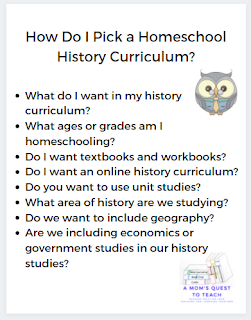
What are you looking for in your history curriculum? Do you want it all printed out and ready to open and go? Are you looking for lesson plans that are easy to follow but still give you more flexibility than a textbook? Do you want unit studies? What about lessons that tie into your other subjects like literature and science?

Download a worksheet to record your answer to these questions.

some of the text: How do I pick a homeschool history curriculum? What do I want in my history curriculum?


What Area of History Are You Studying? 


Of course, some of your decisions may be guided by what area or time period of history you wish to study in your homeschool. Are you studying United States History, World History, Ancient History, geography, government, economics, or a combination of some of them?

If you are interested in taking a geographical approach, Let's Go Geography may be a great resource for your elementary-aged students. I also find it is very easy to incorporate other history resources into this curriculum. You can truly tailor it to meet the needs of your homeschool family.

Let's Go Geography Year 2 course image featuring USA, Mexico, Honduras, etc.


If you are homeschooling a high school student, you might want to incorporate government or economics into their schedule. Last year, our teen used Exploring Government from Notgrass History to study the United States government. I really felt this was an excellent curriculum that opened up the door to good discussions. We also used the Student Review Pack with our teen to help assess his knowledge at the end of the different chapters and units. This year, we have incorporated economics and business courses into his schedule using Money 101 and Business Plan Creation from SchoolhouseTeachers.com. These are all very important areas of study that fall under social studies or history.

This year with our second grader I decided that we would further study American History using Our Star-Spangled Story Curriculum Package (and literature package) from Notgrass History. I made this decision after downloading and looking at the samples they provide on their site. It is truly a beautiful set of textbooks for teaching about the founding and history of America. We are using one student workbook right now with our son, but in the future, I may purchase an additional workbook if our daughter also uses the curriculum.

Our Star-Spangled Story book cover

A Star-Spangled Timeline book cover

Final Thoughts 


Every homeschooling family is different. And what works for your family this year may not work for you next year. Perhaps reading books and watching fun, educational videos like Drive Thru History® worked while your children were younger, but now that they are older they wish to work independently and online. Even after you pick a history curriculum, don't be afraid to make changes or modifications—if you need to—for your homeschool and your children. Sometimes, you need to make changes to keep history alive and interesting and that is okay. Providing your children with an environment conducive to learning and helping them to enjoy their schooling should take precedence in your homeschool over any sense of "getting it just right."


Wednesday, June 17, 2020

Studying History Through Connecting Past Events to Today: A Review of The Mayflower at Cape Cod

Text: Studying History Through Connecting Past Events to Today: A Review of The Mayflower at Cape Cod; background image of seashore

Disclaimer: I received a FREE copy of this product through the HOMESCHOOL REVIEW CREW in exchange for my honest review. I was not required to write a positive review nor was I compensated in any other way.

Our family enjoys studying history so anytime we have the chance to review a new history resource we are happy to do so. For the past several weeks our teen has been helping me review The Mayflower at Cape Cod - Stories, activities, and research that connect 1620 with life today by Rebecca Locklear. It is a seven-unit resource aimed at grades 6-12 which looks at what happened during the five weeks that the Mayflower was anchored off Cape Cod in 1620.

cover of The Mayflower at Cape Code: Stories, activities, and research that connect 1620 with life today

What Is the Resource?


text: Studying History Through Connecting the Past Events to Today: A Review of The Mayflower at Cape Cod; Cross-Disciplinary Educational Resource for grades 6-12; book cover; ship clip art; logo of A Mom's Quest to TeachDepending upon how you would like to purchase The Mayflower at Cape Cod - Stories, activities, and research that connect 1620 with life today, you can order a print copy or a digital copy. We received the book digitally for the purpose of our review. The PDF is 74 pages long including the cover, table of contents, lessons, appendices, sources, index, and acknowledgments.

Each of the seven lessons opens with an objective and continues onto a reading, several activities, and research topics based upon the lesson. There are a number of photographs, maps, and sketches spread throughout each lesson.

There are 70 activities and 80 research topics which span a variety of topics and methods for learning the material.  So depending upon your children's interests and strengths you can pick different activities for each lesson. For example, you could cook with seafood and cranberries in Lesson 5 when reading about Native culture and discussing the different local and seasonal food if your children love to be in the kitchen. Or if your children are artistic, they could create leaf art as outlined in the activities for Lesson 3. One of the objectives for Lesson 3 is to analyze the survival situation and identify trees so this fits in perfectly.

Activity chart that lists lessons and which learning topics they met

leaf art
Leaf art by our son


The appendix offers a handy chronology of events on Cape Code, statistics about the Mayflower (like the ship being dismantled in 1624), answers to the questions, and game cards you will need for the lessons.

How Did We Use the History Homeschooling Resource?


Our teen had recently completed his World History course for the homeschool year so I asked him to complete activities and research projects from the lessons to jump-start our next homeschool year. I emailed him the PDF and asked him to read one to two lessons a week. As we are nearing our summer break, I required significantly fewer assignments than if this was in the middle of our homeschool year. For each lesson, I requested that he would pick one or two activities and research topics to complete. He then could email them to me or present them to me (as in the case of the artwork I asked him to complete).

The one objective of the first lesson was of interest to our son: "To recognize that history is told by the side of the victor and to be aware of both sides." He enjoys reading about the American Civil War and World War II, so he was able to apply the lesson of examining the first encounter between the Natives and the English to his prior knowledge of other events. And much like expected, he chose to complete the activity discussing who had more responsibility in winning World War II: Great Britain or the United States. In a short essay, he discussed the various Allied powers and their impact on defeating Hitler. In conclusion, he wrote: "All in all, I think the U.S. helped teeter the Allies' power over the Axis, causing the Nazis to be defeated."

I was pleasantly surprised that for another lesson he completed a poetry activity where he wrote an acrostic poem using the word Thanksgiving. It was nice to read his poem about God never failing after the lesson dealt so heavily with the negative impact of Europeans on the Natives (disease, war, slavery, etc.).

As I believe primary documents, like the Mayflower Compact, are very important to read and study, I requested our son complete the art activity to complete a stamp commemorating the signing of the Compact. We have a small collection of stamps, so it was nice to tie in these lessons with the stamp collection of my grandfather.

postage stamp drawing
Our son prefers to draw in just black & white – hence the lack of color.


What Did We Think?


The resource is very well organized. There are a great number of activities and research topics that the lessons could take weeks to complete if a homeschooling family completed everything. Some of the activities are better suited to small groups rather than one student (like our son) such as the corn game, cultural game, or greeting game.

There are very heavy topics in The Mayflower at Cape Cod including cultural appropriation, environmental ethics, stereotyping, immunization, epidemics, and slavery. I think parents should preview the entire resource before deciding if it is appropriate for their children in grades 6-8. I think once children reach 9th grade, they might have a maturity to be able to have healthy discussions about these topics. For example, one of the research topics asks students to reflect upon "Why did Europeans in the 1600s feel they had the right to settle America? Interpret their justification for taking Native lands, including the designation of being 'unpeopled' and 'devoid of all civil inhabitants.'" This is not an easy topic to discuss so I think parents should carefully go through the entire work.

Lesson 7 objectives
Beginning layout of the lesson showing objective and the lesson starting with the story


I think our son was able to really think about the events surrounding the Mayflower being at Cape Cod and how we need to be careful to view and interpret history. One thing as a family we try to stress is the importance of examining the past through the eyes of those who lived it by using primary sources and be thoughtful students of history. My hope is that by reading more about different events, like the English arriving at Cape Cod, our son will become a more astute student and adult.

Would You Like to Know More?


Rebecca Locklear offers many resources through her website including a newsletter to which you can subscribe for blog and book news (click here to sign up). You can read more about the connection she sees between history and drama and can order her books and materials for your homeschool.

Rebecca Locklear photograph
Rebecca Locklear


In addition to reviewing The Mayflower at Cape Cod - Stories, activities, and research that connect 1620 with life today, the Homeschool Review Crew also had the chance to review Exploring the U.S. Life-Saving Service 1878-1915: 17 Student Workshops with 120 Activities by Rebecca Locklear. Be sure to check out the reviews to see how they used these two resources in their homeschool.

Homeschool Review Crew Click Here logo


Friday, April 17, 2020

Book Club: Dear Mr. Washington

A Mom's Quest to Teach Logo; Dear Mr. Washington book cover; clip art of Washington

This post contains affiliate links. For more information, please see my Terms of Use and Disclosure Policy page. Thank you.

If you are looking for a fun book to read to your children about George Washington, the painting of his most famous portrait by Gilbert Stuart, and manners, look no further than Dear Mr. Washington written by Lynn Cullen and illustrated by Nancy Carpenter.

The story tells the fictional account of how George Washington smiled for his portrait sitting by Gilbert Stuart. Three of Stuart's children and the dog and cat act poorly while Washington visits for his painting causing great aggravation to Stuart and his wife. Washington sends a book of manners to the children. Dear Mr. Washington contains several of these rules (ten to be exact). The book that Dear Mr. Washington references is Rules of Civility & Decent Behavior in Company and Conversation, which Washington copied out himself as a boy.

Rules According to George Washington

book cover of Dear Mr. Washington; drawing of Washington; text: How did one of Washington's most famous portraits get painted?

Reviewing the rules provides a great opportunity to review rules and good manners with your own children.

1. Not showing off
2. Not running
3. Do not stuff your mouth
4. Do not chew your nails
5. Do not try to know others' business
6. Do not laugh at another's misfortune

You can read the entire book by George Washington on Gutenberg.org or purchase a copy for your family. If you want to hand a few out in your house, please find three here.

Over the years, our family has studied George Washington a number of times, created a hat fit for the General, and visited Washington Crossing State Park. If you want to learn more about George Washington, I also wrote a Blogging Through the Alphabet post.

book cover of Dear Mr. Washington

Timeline


A great way to learn more about someone is to create a timeline of important events in their life. Depending upon the age of your children, they may want to include more or less details. I created a very simple template to create a timeline of the life of George Washington or even the painter, Gilbert Stuart. Click Here!

Create a Portrait 


Have your children create a portrait of a member of the family, a pet, or their favorite plush just like Gilbert Stuart created of George Washington. Perhaps they won't have as many distractions as there were in the book!

painting of George Washington from wpclipart.com