Showing posts with label kindergarten curriculum. Show all posts

Monday, August 3, 2020

Studying God's Creation from A to Z: A Review of My Father's World Kindergarten Curriculum

Text: A Mom's Quest to Teach: Studying God's Creation from A to Z: A Review of My Father's World Kindergarten Curriculum; A Mom's Quest to Teach logo; image of God's Creation from A to Z Teacher manual

Disclaimer: I received a FREE copy of this product through the HOMESCHOOL REVIEW CREW in exchange for my honest review. I was not required to write a positive review nor was I compensated in any other way.

For the past several weeks, our daughter and I have been using the Christian homeschool kindergarten curriculum from My Father's World – God's Creation from A to Z – to learn about the world around us. We spent the first two weeks discussing the creation found in Genesis of the Bible and then moved on to studying different topics based upon the letters of the alphabet.

Before our kindergarten curriculum kit was mailed, I had the opportunity to speak with customer service to ensure that we would have everything we need in our kit. God's Creation from A to Z Deluxe Package incorporates everything you need for language arts, mathematics, Bible study, character development, and even science. My brief chat with customer service was wonderful and my kit arrived in the mail a short while later. My daughter was so excited to get started! It is always nice to connect with a company that is helpful and caring.

children's books in box
So many great books in this kit!

opening box of books; How to Make an Apple Pie and see the world
As we took out each book and material, our daughter wanted to read it and examine it. 

What Is the Focus of God's Creation from A to Z?


As you may have guessed, this kindergarten curriculum approaches a year-long study using the letters of the alphabet as well as the creation of the world. Your child will start with a two-week introduction talking about the first seven days in the Bible – creating their own picture book and poster to demonstrate the events and then move onto the weeks which focus upon the different letters.

Creation 2 day craft
Each day when studying about the creation, our daughter created a new page for her book.

7 days creation craft


The following 26 hands-on units are packed full of a variety of lessons, stories, and ideas to help you teach your kindergartener about the world around them. The step-by-step instructions make it very easy to implement the lesson plans.

Some of the Topics Covered 


    text: A Mom's Quest to Teach: Studying God's Creation from A to Z: A Review of My Father's World Kindergarten Curriculum; image of A Mom's Quest to Teach logo; cover of God's Amazing World student book
  • Creation 
  • Turtle
  • Five senses 
  • Dinosaurs 
  • Goats (farm animals) 
  • Christmas (two weeks set aside) 
  • Penguins 
  • Zebras (wild animals) 
  • Frogs and Butterflies (to study life cycles) 
  • Vegetables 
  • Yellow (all colors) 
  • Fruit of the Spirit 

For each new week, the curriculum is laid out in a chart in the spiral-bound Teacher's Manual. This provides an easy-at-a-glance overview of the different activities you and your child will be doing during the week. For example, in week 21, your child will learn about the letter K with kangaroo being the focus word. The Biblical Concept Flashcard for this week reads, "I am safe in God." Some of the activities as laid out in the opening page of the week include making a kangaroo pencil holder our of an empty juice can, finding the home of kangaroos on the globe, and reading Katy No-Pocket. You can check these off as you complete them.

Week 5: Leaf lesson plan


I found great flexibility in using God's Creation from A to Z with our daughter. For some weeks, we completed many of the activities listed for reading, language arts, math, and science but for others, we skipped some of them including many of the snack ideas. But even though I didn't use everything as outlined, I love all the options that the curriculum provides. If your child is really interested in the moon, you can read additional books as suggested like Goodnight Moon, talk about gravity, make a model of the moon's surface, and even bake a moon cake. Each week comes with a variety of additional ideas to help parents fill out the week for their kindergartners.

calendar of July and 100 chart

Typical Week for Us - Look at Week 5: Leaf


Each day, I would present our daughter with the calendar and number chart to fill in. After this, we would move on to another activity as outlined in the Teacher Manual. One day, we collected leaves outside and traced them for painting and made leaf rubbings.

tracing leaf

leaf rubbings

leaf painting


We also read the pages on the leaf in God's Amazing World and tried to match up the geometric shapes with the different leaves pictured. On another day, our daughter read A Tree is Nice to us and made a leaf-shaped badge with the Biblical Concept written on it: "I will live and grow in Jesus." We also used the Cuisenaire Rods Alphabet Book's letter L page as well as built a three-dimensional structure with the rods that are part of the kit. During this week, we also listened to the song 'Read Your Bible, Pray Every Day' and read several verses from the New Testament from John 15, 1 John 5, and others. 

leaf page in God's Amazing World


Putting It All Together 


For the first several weeks of using God's Creation from A to Z from My Father's World, parents are instructed to read For the Children's Sake by Susan Schaeffer Macauley, which is included in the kit. This book provides a wonderful look at what education can be when it is based upon Christian teaching and understanding. There are practical advice and wonderful suggestions that will help homeschooling parents (both new ones and veterans) formulate a plan and method for homeschooling. And the advice for homeschooling parents does not stop there – included in the Teacher's Manual are encouragement and advice as well as thoughts from Marie, the author. How wonderful to read the reminder that in 1 Timothy 5:10 a woman's good deeds include "bringing up children." When it seems like parenting is a never-ending task, it is nice to be reminded it is an important and godly task.

children's books part of My Father's World God's Creation from A to Z Deluxe Kit


There are so many wonderful components that are part of this kindergarten curriculum from My Father's World. Through the Teacher's Manual, it is very easy to incorporate the Cuisenaire rods, the student sheets, the classical CD, the many children's picture books, and the activities. During week 3, when we were studying the letter s and the sun, everything seemed to fit together so naturally and flow from one activity to the next. We spent time painting, reading, writing, listening to a poem by Robert Louis Stevenson, and listening to the Nutcracker Suite. What a great assortment of activities for our daughter to experience! There was no guesswork for me as to what to do.

books and activities relating to Sun lesson from God's Creation from A to Z


What Do We Think? 


Our daughter and I were amazed at the quality of God's Creation from A to Z kindergarten curriculum kit from the moment it arrived. I am still in awe each day when I take out our materials and prepare for the homeschool lessons for that day. There are so many wonderful resources and ideas provided for homeschooling parents. For example, I am gathering the materials for Week 8: Turtle and I am reminded of a poem from my own childhood (The Little Turtle). I love the snack suggestion of creating a turtle with bread and peanut butter as well as the pages in God's Amazing World on turtles. I am so glad that it teaches about a turtle's shell and skeleton as well as a brief introduction to a turtle's egg-laying practices.

I have really enjoyed reading For the Children's Sake. I feel like sometimes I could underline entire pages as I want to remember many points the author makes. I never really felt that my homeschool style was similar to that of Charlotte Mason but now I see that I share many of the same viewpoints as her through this introduction.

I am amazed at all the books being included in the deluxe package. What a joy to not have to worry about whether or not we own a certain book or if our small library has a copy (inter-library loan is not available right now). I can go to our bookshelf and pick out which one we need for the week. If you want to see a video of some of the books that were part of the kit, please check out my Instagram post.

children's books part of My Father's World kindergarten deluxe kit

One of the books I was really excited to see was the Cuisenaire Rods Alphabet Book. We owned a small pack of the rods prior to receiving this kit and I was at a loss as to how to use them beyond counting. I love all the different ideas presented in the book. Our daughter can work on problem-solving like when it asks her to build the letter I using rods of all different colors or to build the letter I using only one color. She can also have fun as she builds the different shapes.

cuisenaire rods

cuisenaire rods - alphabet rods
Our daughter couldn't wait to start using the rods and the book. 

Our daughter has really been enjoying God's Creation from A to Z. She loves the variety of activities. She was so excited to paint the sun (she painted three different ones in yellow, orange, and red) and to read the different books. Another thing she loves doing is reading the Biblical Concept Cards and hanging them on our door. We have also been hanging the badges she creates each week alongside them. They are great visual reminders – for everyone – of what she is learning and what we should all remember.

Biblical Concept Cards and badges


I would recommend God's Creation from A to Z to any homeschooling parent looking for a solid kindergarten curriculum for their child. The customer service was great and the package is fantastic. The student worksheets provide our daughter with the opportunity to practice her writing of numbers and letters as well as give her a chance to be creative when she is drawing her own animals, objects, and things that start with that week's letter. She practices her scissor skills and reading skills as well as learns new things about the world around her. This is a great homeschooling experience for young children just starting their formal educational journey.

apple counting activity


Do You Want to Learn More?


My Father's World logo


Other members of the Homeschool Review Crew also had the opportunity to review products from My Father's World. Please be sure to read their reviews, too!

Homeschool Review Crew Click Here Logo

Tuesday, April 21, 2020

A Review of Focus on Fives from BJU Press Homeschool

Text: A Review of Focus on Fives from BJU Press Homeschool: Kindergarten at Home; product images; logo of BJU Press Homeschool & A Mom's Quest to Teach

Disclaimer: I received a FREE copy of this product through the HOMESCHOOL REVIEW CREW in exchange for my honest review. I was not required to write a positive review nor was I compensated in any other way.

Our daughter has been eager to join in with the homeschooling studies of her older brothers ever since we started homeschooling. She wants to do the same activities as her six-year-old brother yet she is only just mastering some of the skills he already has acquired. When the opportunity to review BJU Press Focus on Fives presented itself, I jumped at it. I knew our daughter would be so excited to have a homeschooling program that was designed for her age and skill level. Because BJU Press Homeschool is the publisher, I knew I did not need to worry about any questionable content and that the material would be of high quality. This is excellent Christian Kindergarten Homeschool Curriculum for families.


What Did We Receive?


We received in two separate boxes the Focus on Fives Subject Kit (fourth edition) which contains the following materials:

  • Focus on Fives K5 Teacher's Edition: 6 separate spiral-bound books that outline the objectives, lessons, crafts, snack ideas, extended activities, and more. 
book cover of Teacher's Edition Unit 1

  • Focus on Fives K5 Worktext: A full-color paperback book with pages that are easy to tear out. Each lesson seems to reference at least one page. The book is designed so that the pages will tear out easily. There is also a supplement section in the back of the book with a kindergarten diploma, lesson cutouts, and checkups. 
cover of Worktext and two pages from the workbook; text: A bright colorful cover for the Worktext with Hopscotch, Hopper, Dottie, and Bonnie; Sometimes the lessons require children to write while other lessons require children to cut and match pictures (which are in the back of the book)

  • Reading Books for K5: There are 34 paper books total that are landscape-oriented. The books progress from simple picture books with no text to books with increasingly challenging reading required.
book from collection - inside The Bed

book from collection; Naps; Reading Reward certificate from back of book

  • Phonics Practice for K5: This full-color workbook has a variety of exercises that align with the different lessons. For example, Lesson 103 has worksheets that focus upon 'wh' and asks your child to circle the pictures that begin with that sound. It also contains the Phonics Stories that you will need for some lessons. 
  • K5 Phonics and Review Cards: You receive a stack of pre-cut cards. Some of these are meant to be taken home by children using this curriculum in a schooling setting to help them review.
Focus on Fives Phonics cards

  • K5 Write Now! Handwriting: This book is printed in black and white with a paper cover. On some days, our daughter likes to color in the picture that is on the page.  
Focus on Fives Write Now! cover and inside the workbook; Text: Write Now! Workbook has a paper cover and is in printed in black & white; Sometimes the lessons require only half a page to be completed

  • K5 Phonics Flip Charts 
  • Focus on Fives Teaching Visuals Flip Chart: This is a spiral-bound book. The pages can be removed or left in the book.
I have been able to keep everything in one of the two boxes in which everything was shipped by standing all the books upright within the box. I added a few envelopes to hold the materials as well as paperclips and rubber bands to hold all the cards together. 

How Are We Using Focus on Fives in our Homeschool? 


There are a total of 180 lessons spread across seven units in Focus on Fives and we are averaging about three-quarters to one-and-a-half lessons a day in our homeschool. On average, we have been completing a little bit more than one scheduled week's worth in one week.
number 5 graphic; cover of Phonics workbook; Bonnie Phonics card

The Teacher's Edition is written for use within a classroom but homeschool parents can easily adapt it in their own homes with one or two children. Everything is so very clear and detailed that—even if you are brand new to homeschooling and have never used a teacher's manual before—you should feel confident in using Focus on Five with your kindergartener. I started by reading through the six goals, the Biblical worldview themes, examining the lesson features, going over the instructional materials, the goals of the reading books and the reading book lesson features, and the lesson plan overview. This information is all presented in the introduction prior to the first lesson plan. (There is also additional information in the introduction that I skimmed over because they did not apply to me since I am using Focus on Fives in my homeschool and not in a classroom with learners of different abilities.)

To prepare, I went through and pulled the necessary pages from the Worktext, Phonics Practice, and Write Now! workbooks and paperclipped them with the lessons in the Teacher's Edition along with any Phonics Charts and Cards that were necessary. For those lessons where I wanted to incorporate materials from the back of the Teacher's Edition (instructional materials and creative writing sheets that you will need to copy for your child), I copied them and placed them with the lessons, too.

Materials needed for Dalmatian Sort
One of the activities that requires you to photocopy needed pages from the back of the Teacher's Guide.

Playing Dalmatian Sort
Our daughter had to match the objects to the letter that they start with on the dalmatian. 


There are so many options for you to make the lessons fit the needs of your children!


I think the easiest way to demonstrate how Focus on Fives works – especially in our homeschool – is to walk you through one lesson, Lesson 10: Surprise

At the start of the lesson, we reviewed previous information that we talked about, including the words "it" and "I" and the letters "i" and "t". We then used the Worktext worksheets which were Review for You pages.

page from Focus on Fives workbook

This lesson also included the reading of the second book: Surprise! Before reading the book, I asked our daughter the questions written in the Teacher's Edition (What do you see? What do you think the surprise will be?) and then we progressed into the book. There are seven pages in the Teacher's Edition with questions to ask during the reading of the book along with comprehension questions. (I love how the questions, answers, and pages from the book are directly printed in the Teacher's Edition.)

page from Teacher's Edition and children's book
The student's book here is laid on top of the Teacher's Edition.

The final activity for this lesson that we completed was the page from the Write Now! workbook where our daughter colored a picture of a bird and wrote the word "it". There are additional activities including a snack suggestion and an arts and crafts activity.

page from Write Now! workbook of a bird


So how long does each lesson take? Everything depends on how many of the various activities you include in each lesson. To maintain our daughter's attention I usually split each lesson into more than one part throughout the day. We may spend 20 to 30 minutes at a time. For example, we may complete one worksheet from the Worktext book and then go over different words that start with the letter 's'. If I have everything set up, we may finish up with a craft. Later in the day (even after dinner on a few occasions), we may complete the writing exercise from the Write Now! workbook. Sometimes, I even save those for the next day.

What Did We Think? 


We have the had the chance to really start a formal homeschool education with our daughter. Up till this point she has been using various materials as a preschooler but not set curriculum. I think that BJU Press Focus on Fives has been a fantastic resource to introduce her to more formal homeschooling. It allows us flexibility to meet her needs – she loves arts and crafts, to move around during her homeschooling, to work while sitting on the couch with me rather than at a table, and to be physically active while she learns.

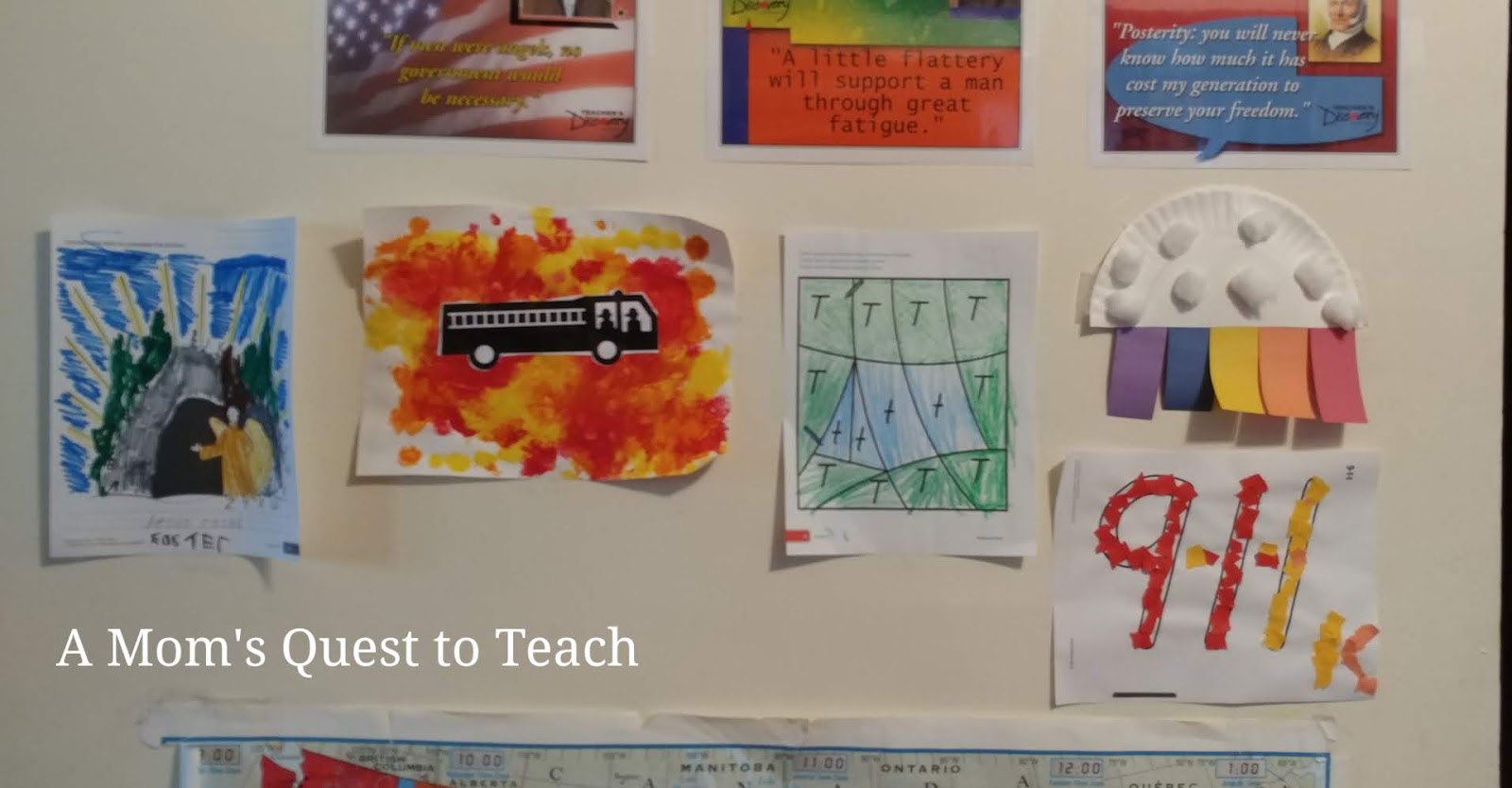
Easter page; fire truck; tent; cloud with rainbow; 9-1-1 craft
We have been hanging up some of her artwork and lesson pages on the wall along with our social studies materials.
completing worksheet
The flexibility of using this curriculum allows our daughter to complete work while sitting in my lap.

Our daughter really couldn't decide on a favorite part of the lessons. She loves having the books that she could read and share with the rest of the family. Being able to write her name on them when she completed them was a great bonus. The extended activities that allowed her to be creative and get up and move were also important to her as she loves art projects and being physically active. I love that she gets a variety of activities in each lesson that helps build her writing and reading skills while teaching her about the world around her.

completing worksheet from write now!
Even with simple worksheets, she can be creative and color the spaces with the letter 'i' in whatever manner she chooses.

What Do We Have to Look Forward To? 


One of the things I am looking forward to is being able to take our family to visit some of the places we are learning about in Focus on Fives such as a fire station, post office, police station, and more. If this were a normal homeschooling season, we would have planned a trip to visit the places during each appropriate week but we will have to save those trips for the future.

I am really looking forward to using Focus on Fives for the rest of the homeschool year with our daughter. Just flipping through Teacher's Editions, I can see so many awesome lessons. In Unit 2, we will discuss the parts of the Bible, about libraries, nursery rhymes, and more about books and writing. In Unit 3, our daughter and I will talk about animals in the Bible (like sheep, donkeys, and lions), contrast the differences between a family farm and a commercial farm, and talk about how to take care of pets. In Units 4 and 5, we will study places, r-blends, how God answers prayers, the Pledge of Allegiance, and short and long i, o, and u words. A look at the Untied States White House is one of the many lessons in Unit 6. Finally, Unit 7 contains a review as well as lessons for various Holidays. I discovered the Easter lesson right before Easter so we were able to include one of the activities. (You can see the Angel in front of the empty tomb worksheet in the display of various projects from Focus on Fives in one of the above photographs.) I look forward to completing the Memorial Day lessons at the end of May.

In the near future, I will be greatly anticipating the next set of lessons we will be working on after finishing up the week about Postal Workers. It was fun to talk about the history of the postal service and teach our daughter about how to address envelopes. But I think the final week of Unit 1 will be very important, too. We will take a look at ways to keep healthy, ways to stay healthy, and talk about how to distinguish fantasy from realistic fiction along with many other language arts activities.

Do I recommend the BJU Press Five on Fives curriculum? YES! I have been really pleased with the entire package and love the flexibility it is affording us in our homeschool. I can see our daughter growing as a new homeschool student who is studying kindergarten at home.

all the products for BJU Press Focus on Fives kit


What else will be coming? If you want to incorporate videos into your lesson, you only have to wait till the summer for the opportunity. There will be the opportunity to choose Focus on Fives Online with Books on July 1, 2020. There are 160 videos (lessons are 60 minutes in length) taught by Mrs. Rebekah Rulapaugh. If you want to see a sample, you can view one on the BJU Press Homeschool site.


Would You Like to Know More?


BJU Press Homeschool Logo


Our daughter wasn't the only child reviewing Focus on Fives from the Homeschool Review Crew. Please be sure to check out the other reviews!

Homeschool Review Crew Click Here logo


Wednesday, March 27, 2019

Learning to Read: A Review of Classical Phonics with the First Start Reading Program


Each day our five-year-old son brings me the Teacher Guide of the First Start Reading Program and First Start Reading Book A published by Memoria Press and asks to work on his homeschool lessons. I would say this deserves a resounding recommendation from him as he has enthusiastically worked on these lessons and reads through Classical Phonics which is geared towards kindergarten and first grade students.

What Am I Reviewing? 


  • Classical Phonics, Second Edition 
  • Teacher Guide for First Start Reading Program 
  • Books A-E for First Start Reading Program 
  • First Start Reading Book E Teacher Guide 

Classical Phonics: A Child's Guide to Word Mastery 


Cheryl Lowe writes in the preface to the 2010 edition: "Word Mastery is in fact a little gem, a well-organized and methodical presentation of phonics." There are changes from the original publication (1913) which include graphic and illustration changes, reduction of the number of words per page, and reorganization of words to make it easier for kids. Classical Phonics can be used to supplement any phonics programs and is a good fit for the First Start Reading Program from Memoria Press

There are four parts to the spiral-bound book (the fact that it is spiral-bound helps it to lie flat on a table or desk). The introductions to the units for the teacher or parent provide the goal of the unit and an explanation of what will be taught in that unit. For example, the Introduction to Unit 3 states that consonant blends will continue to be taught, final blends in short-vowel words will be covered first, initial blends are organized into three categories (s, l, and r blends), and examples of what the book is addressing are provided.

At the end of the 139-page book Classical Phonics, there are suggestions for the teacher which should be read prior to giving the book to children per the 1913 publication recommendations. There are also phonics and spelling rules and lists of common words provided on the final pages.

Our daughter looking through Classical Phonics while her brother works on writing the letter H.

Part One introduces the letters in a similar format to the First Start Reading Book A which is helpful for our son to review what he has learned. There are also additional words listed that demonstrate different uses of the vowel or consonant. For the letter T, the images are the same as Book A but include the words with T as the terminal (letter at the end of the world like mat and sat) as well as the initial sound (like tan and ten). 

I do wish that the Teacher Guide for Books A-D would be more specific as to when to use Classical Phonics. For example, during lesson 14, when reviewing the sound 'ft' students are referred to page 57 of Classical Phonics where there is a list of 6 other 'ft' words (in addition to six other final consonant blends). One way I intend to use Classical Phonics in addition to the ways suggested, is to use the lists for spelling words for our son. 


First Start Reading Program Books 


Each book lists the table of contents of the particular book at the front of the book. Here is a brief overview of what each book teaches. 


First Start Reading Book A covers ten letters/sounds, thirty-six common words, as well as punctuation, articles, capitalizing at the beginning of sentences, plural nouns, and more. The 68 pages include a word mastery review with the word families of am, an, at, and ap, pages for students to read words and then write down the words as you dictate them.


First Start Reading Book B is a little over 70 pages long with 26 lessons, a review, and an assessment. There is more of an emphasis on stories to read using the words introduced than just sentences and the question mark is introduced in Lesson 17. The letters and sounds that are addressed in Book B include short I, G, L, O, B, and D.


First Start Reading Book C is the longest with over 100 pages, ten letters and sounds, a variety of common words, and the introduction of quotation marks and paragraphs. The lessons on individual letters still follow the same format of an image to color in, a box for the student to draw something that starts with or has the sound of the letter (as in the case of the letter X), and space to practice writing the lowercase and uppercase letters. The stories are longer and some of the sentences continue onto the next line.


First Start Reading Book D examines the long vowel sounds, digraphs of sh, th, ch, and wh, final consonant blends, and s-, r-, and l-blends. The lessons in Book D cover more pages than the previous books. For example, Lesson 4 (the silent e) has the introductory coloring page, tracing and writing page, additional writing, illustrating page, and assessment pages.


First Start Reading Book E completes the series by discussing long vowels, soft c and g, and the three sounds of y. There is an introduction to each sound, the writing of words and sentences to read. There is also a short story to read as well as questions in the Teacher Guide. Included in Book E (similar to the other books) is a spot for dictation words and an assessment page for children. This is a perfect book to build up to with your children. 


How We Are Using the First Start Reading Program


Our five-year-old son is working through Book A as part of his regular language arts instruction in our homeschool. We plan on continuing to work through Books B-E and anticipate completing them by December 2019. As we operate on a more relaxed schedule with our two younger children, there are some days where we complete two lessons and others where we skip doing a lesson that day. Taking into consideration our homeschooling style, the First Start Reading program may take us about a year or more to complete. 

Prior to teaching each lesson, I review the information in the Teacher Guide. Then we work through the lesson as presented using our small white board, Book A, and the Teacher Guide. The lessons are progressive in that they build upon previous letters and words learned.

Having learned the letters A, T, M, S, F, and R in previous lessons, Lesson 14 asks students to blend together A and T to form AT. They then blend together M and AT, S and AT, R, and AT, F, and AT to make mat, sat, rat, and fat. Our son then traced the sentence "I am tan" and a few other sentences. After the lesson, our son practiced the letter H and then for Lesson 16 learned about apostrophes and formed two new words using the letter H (hat and ham).

We use our small whiteboard on a regular basis with the lessons.


Students are not just working with one letter after another. As they progress through the lessons, they learn letters and sounds and then create words and sentences. 

Our five-year-old son really enjoys drawing and coloring the pictures that accompany each lesson. He has been consistently working on proper writing along with pronouncing the vowels and consonants. And even though our three-year-old is not using the workbook, she is joining in on the lessons to recognize letters and listen to the pronunciations. 


What We Like 


I really liked the phonics overview in the 330-page Teacher Guide. Teaching phonics and the early skills required in language arts has always been one of my fears in homeschooling our younger children. I read through the first several pages of the Teacher Guide multiple times to help me get a hold of the philosophy and teaching methods of First Start Reading.

The Teacher Guide is written for both teachers and homeschooling families. Most of the information presented is geared towards a classroom setting. For example, the guide tells you to "walk around the room and put a star on each student's best letter."

Optional lessons that reference Classical Phonics. 

There are optional lessons which cover consonant blends and the four h-consonant teams. These lessons will be covered in Book D but are included early to help too much information from being presented at the end of Kindergarten. These optional lessons reference Classical Phonics on a number of occasions.

There is also a page addressing the proper pencil grip as well as three pages at the end of the Teacher Guide to display to help children hold their pencils correctly.

In general, each lesson is covered on two pages in the Teacher Guide while some of the reviews and assessments are on more than two pages. There is also room on the pages to make notes before, while, or after teaching the lesson.

One fault: the Appendix of the Teacher Guide for Books A-D is printed double-sided which means I can't just pull out the pages to hang up as recommended. These pages consist of early lessons that teach proper pencil holding and reviewing left from right, discuss hanging the mitten, writing poster, and other pages up in your classroom. If they were printed single-sided, I could easily remove them from the book and hang them up for our son. Without easy access to a photocopier or scanner, I can't hang up all the vowel posters, writing posters, etc. 


Do you wish to learn more about Memoria Press and their products? 


If you wish to learn about other products from Memoria Press, be sure to check out the other reviews. Members of the The Old Schoolhouse Magazine Homeschool Review Crew also reviewed poetry curriculum and Latin curriculum.