Showing posts with label Colonial America. Show all posts

Thursday, July 12, 2018

J is for Jamestown (Blogging through the Alphabet)

Jamestown Settlement

There are many interesting places to study and visit in relation to Colonial America. This week I chose to focus upon Jamestown for Blogging through the Alphabet. The town (and the nearby river) were named for King James I of England.

Facts about Jamestown
  • Narrow sandbar connected Jamestown to the mainland
  • Land was swampy 
  • Poor drinking water
  • Mosquitoes brought malaria 
  • First workers' strike in British America – Polish glass-makers demand same rights as Englishmen 
  • In 1619, men outnumber women 8:1 
  • House of Burgesses is formed to make laws 
Things started out well in the settlement of Jamestown but – during the summer and fall – Indian attacks, bad drinking water, disease, and poor diet led to great problems. If it wasn't for Captain John Smith, the settlement of Jamestown might not have survived. He took over the control of the colony when he was 28 and things were difficult in the settlement. 

"If any would not work, neither should he eat." – John Smith 


He sought aid from the Native Americans – the Powhatans – learning their language and the way in which they hunted and fished. Because of his honesty and fairness, he was respected by the Powhatans. He traded English goods with them for food like corn for the settlement. Smith also convinced the settlers to stop looking for gold and silver as he found no evidence of mines.
John Smith Quote

An accident occurred (gunpowder exploded in Smith's boat while he was sleeping) and Smith needed to return to England in the fall of 1609. Before he left, he wrote there were ten weeks' provisions for the settlement. He anticipated this would get the settlers through the winter and that the Native Americans would continue to supply corn. 

There were chickens and goats (and pigs on nearby Hog Island) as well as an abundant amount of wildlife in the woods (deer, squirrels and rabbits). People should be able to find frogs, fish, and oysters in the river. Things seemed to be going well for the settlement. New people arrived at Jamestown and a new baby was born – Virginia Laydon. 

But the Starving Time was coming. 


Why were the years 1609-1610 so difficult? Why did the Starving Time occur? The Powhatan wouldn't trade with Jamestown. The settlement was under siege. War broke out. The settlers could not leave to hunt or fish. They only had access to the supplies and food within the stockade. It was written people ate dogs, cats, mice, and rats. Even boots and shoes!
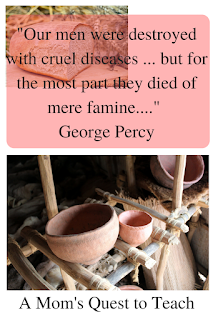
George Percy QuoteIn May 1610, two English ships tied up to the docks of Jamestown. In October 1609 when Smith left there were 500 settlers. Now there were only 60 left alive. Buildings had been burnt to help provide warmth. They wanted to leave. 

Lord de la Warr, the new governor, made the colonists start Jamestown again. And it prospered even under difficult conditions. More settlers arrived – artisans, laborers, women. And even though things were different, there were still many deaths due to the swampy land that led to diseases. 

Eventually the settlers in and around Jamestown would find a way to make great profits – tobacco. The leaves made the settlers rich after they figured out the best way to run their plantations. They employed indentured servants and slaves to help work the tobacco plantations. 


A Turning Point – 1618-1619 


The settlers set up their own law-making body – the House of Burgesses – which meant they were making laws for themselves. Land reforms also made it easier for settlers to obtain private property. The tobacco plantations began to use Africans in addition to indentured servants. (Whether the Africans were slaves or indentured servants is still up for debate.)

There would be periods of success and failure for Jamestown up until the 1670s when the town burned to the ground during Bacon's Rebellion. You can still visit the area where the National Park Service has several interesting places to study and see.

Building Jamestown

Resources 


Colonial National Historic Park 
Jamestown Rediscovery: Historic Jamestowne 


Jamestown Settlement and Tobacco plant

images from: 
Pottery: © Mlhead | Dreamstime Stock Photos & Stock Free Images
Fort: Pixabay 
Tobacco plant: Openclipart 
Other images from U.S. History Images 

I linked up with the following blog(s):


Thursday, April 26, 2018

Engaging History: Colonial and Revolutionary War Era America

Valley Forge National Military Park, Revolutionary War

History BooksThis post contains affiliate links. For more information please see my Terms of Use and Disclosure Policy page. Thank you.

History has always been one of my favorite subjects. Now that we have reached Day Four of the 5 Days of...Homeschool Blog Hop, I will provide activities, journal-writing opportunities and questions, ways to include geography, music, and literature in your lessons, and projects for your children to complete to help bring Colonial and Revolutionary War period of American history alive. I urge parents to preview books, movies, and other resources and references prior to sharing with your children. Only you, as the parent, know what your children are ready to read or view in a movie.


A time period of American History that offers a lot of resources is that of Colonial and Revolutionary War Era America. But what if you don't live near the many historic sites and battlefields along the East Coast? There are still many opportunities to study Colonial America and the Revolutionary War with your family.

There are several books that can aid you on your journey to introduce how people lived in Colonial America and during the American Revolution.

Children's Books, history books, Colonial America,

From the If You Lived Series
...If You Lived At the Time of the American Revolution by Kay Moore and illustrated by Daniel O'Leary
...If You Lived in Colonial Times by Ann McGovern and illustrated by June Otani

From the Adventures in Colonial America Series:
Seventh and Walnut: Life in Colonial Philadelphia by James E. Knight
Boston Tea Party: Rebellion in the Colonies by James E. Knight


American Revolution Activities

  • Discuss the different names given to the American Revolution including the War of Independence, Revolutionary War, and American War of Independence. 
  • Label a map of the early United States colonies. In order to better understand how the colonies were separated, shade the New England colonies blue, shade the Middle Colonies yellow, and shade the Southern colonies green. 
  • Research the clothing and accessories of the time period. Design, sew, or create your own Colonial period clothing. 
  • Research the uniforms of the soldiers. Create your own uniform as either an American soldier or British soldier. 
  • In a journal, write about something you would be willing to give up or boycott to express your displeasure. Think beyond giving up your least favorite vegetable. 
  • Create your own New England primer for yourself or your younger siblings. Teach them the alphabet using it. 
  • Visit one of the many historic sites such as Historic Jamestowne, Yorktown Battlefield, or see the historic sites in Boston. And of course if you are studying the American Revolution, be sure to visit Philadelphia and the Independence National Historical Park

Independence Hall Philadelphia PA
  • Create a chart to compare and contrast the differences between the Loyalists and the Patriots during the War. 
  • Read the Declaration of Independence. If possible visit plan a visit to the National Archives Museum in Washington DC. 
  • During the American Revolution, if possible, nothing was wasted by the citizens. They made do reusing or re-purposing all they owned due to the boycotts and lack of trade. Do you think your family would be able to spend a week trimming down the amount of waste in your own home? Reuse or re-purpose clothing that is outgrown, find a use for leftovers, or use dishes and flatware rather than disposable ones. What else could you do? 
  • Make your own George Washington craft with your younger children. 
  • Read about Patrick Henry and perhaps try your hand at memorizing his "Give Me Liberty or Give Me Death" speech.  
  • Read through some of the sayings from Poor Richard's Almanac and illustrate them together as a family to hang up in your home. 

Ben Franklin, Poor Richard's Almanac


Resources and References 


Patrick Henry Memorial Foundation at Red Hill

Colonial Williamsburg Colonial Dress Codes

Museum of the American Revolution in Philadelphia, PA

Mount Vernon - The Home of the Washingtons

Franklin Institute


George Washington


A Mom's Quest to Teach Posts 


Trips: Washington Crossing State Park

George Washington's Birthday Craft

Drive Thru History Adventures - A Homeschool History Curriculum


Monday, March 26, 2018

A Review of Three Selections from the Award-Winning Author Carole P. Roman

culture, geography, Hungary, American West, Colonial America, Book Reviews, History, hsreivews, children's books

This post contains affiliate links. For more information, please see my Terms of Use and Disclosure Policy page. Thank you.

My family are huge fans of history, so children's books that focus upon history, culture, and geography like those from the Carole P. Roman books and collections are perfect for expanding knowledge about far away places or times. I was very happy to review three books by Carole P. Roman from the Carole P. Roman books and collections that would introduce our children to the culture of Hungary and the histories of Colonial America and the American West.

We reviewed the following three books:

If You Were Me and Lived in...Hungary: A Child's Introduction to Cultures Around the World

If You Were Me and Lived in...Colonial America: An Introduction to Civilizations Throughout Time 
            illustrated by Sarah Wright

If You Were Me and Lived in...the American West: An Introduction to Civilizations Throughout Time
            illustrated by Paula Tabor

culture, geography, Hungary, American West, Colonial America, Book Reviews, History, hsreivews, children's books

If You Were Me and Lived in...Hungary: A Child's Introduction to Cultures Around the World, introduced our children to the sights and sounds of modern day Hungary. We learned about the capital, Budapest, names for different members of the family, vacation spots, food, holidays, sports, and even the inventor of the Rubik's cube.

I think one of my favorite parts of the book was that there was a pronunciation guide not only in the back of the book but also with the naming of each Hungarian word on each page. For example, while discussing food at your grandma's house, the pronunciation for Nagyi (Na-dges) or grandma, goulash (goo-lash), and paprika (pap-reek-ca) is all provided within the story's text making it really easy to read aloud to your children.

Our four-year-old son liked learning about the different names of of children living in Hungary - like Lazlo or Erzse-bet. Our two-year-old daughter liked the picture of the children in front of the Hungarian Parliament. I think she really liked the little boy and girl smiling at her.

The book opens many conversation topics - one of which was talking about how our family has enjoyed goulash and other meals that are seasoned with paprika. Another conversation we had was about water polo and handball, both of which we enjoy watching during the Olympics.

culture, geography, Hungary, American West, Colonial America, Book Reviews, History, hsreivews, children's books

Both books in the If You Were Me and Lived in...An Introduction to Civilizations Throughout Time series, were longer than If You Were Me and Lived in...Hungary: A Child's Introduction to Cultures Around the World, so we spread those out to more than one sitting with our two- and four-year olds. A ten- to eleven-year-old history-loving child would have no problem reading through these entire books in one sitting, though.

culture, geography, Hungary, American West, Colonial America, Book Reviews, History, hsreivews, children's books
culture, geography, Hungary, American West, Colonial America, Book Reviews, History, hsreivews, children's booksIf You Were Me and Lived in...Colonial America: An Introduction to Civilizations Throughout Time, introduced our children to the world of pilgrims and settlers who arrived in America on the Mayflower. We learned about their journey to America, how they built their homes (with wood, daub, and wattle), and their daily lives (tending chickens, mending, cooking, or working in the fields).

Our four-year-old son's favorite part was where the little boy made friends with the Native American boy who taught him about fishing, while my two-year-old daughter liked the part where the family faced their first December in America. In fact, she kept finding that picture and saying "Brrr, they are cold."

Personally, I can't wait to re-read this book during November as we talk about Thanksgiving. It will provide a great anchor for lessons about Plymouth and the first Thanksgiving. With the vocabulary provided as well as the brief biographies of historical figures, our family has lots that we can learn from this book by Carole P. Roman.

culture, geography, Hungary, American West, Colonial America, Book Reviews, History, hsreivews, children's books
If You Were Me and Lived in...the American West: An Introduction to Civilizations Throughout Time, our children journey with Carole P. Roman and Paula Tabor as they took us on a journey across America to Oregon.

When we started looking at the book, If You Were Me and Lived in..the American West, my son and I talked about maps of the United States so we could plot the journey of the settlers. In fact, I think that would be the only change I would make to the book - add a map showing the trails - but then again our four-year-old is a map enthusiast so it might just be a feature that only our family would appreciate.

culture, geography, Hungary, American West, Colonial America, Book Reviews, History, hsreivews, children's booksOur four-year-old son's favorite part was learning how the family crossed the rivers they encountered - the Platte and the Columbia Rivers. Our two-year-old daughter's favorite part was hearing about the different foods they brought with them on their journey. And they both liked hearing about the gathering of buffalo chips! I think my favorite part of If You Were Me and Lived in...the American West were the details regarding how each day was spent by the children and parents. Being able to compare our daily activities to those of early settlers is a plus for this history-teacher-turned-homeschool-mom.

All three books present so many opportunities for families to create individualized lessons for their children. For example, I used the vocabulary list from the American West book to introduce my four-year-old to new words. We talked about blacksmiths, bonnets, outhouses, and homesteads among other vocabulary words and practiced writing and spelling them. If our children were older, I would probably have them create their own model of a Conestoga wagon and perhaps even sew their own period-appropriate clothing. Our son did draw his own Conestoga Wagon with a bit of guidance from me after we read the book.

culture, geography, Hungary, American West, Colonial America, Book Reviews, History, hsreivews, children's books
Drawing a picture of a Conestoga Wagon. Coloring in the the patches on the canvas.

I would recommend If You Were Me and Lived in...Hungary: A Child's Introduction to Cultures Around the World to families with children as young as our two-year-old daughter. While children ages seven to nine may be able to read the book independently, younger children can listen or read along with their parents or older siblings and learn about places and cultures around the world. I think this book would be a great place to start when discussing the geography of Europe.

I recommend the If You Were Me and Lived in...An Introduction to Civilizations Throughout Time series of books to families with children four-years to twelve-years-old. These books are more detailed with a plethora of vocabulary, people, places, and events to interest young students of history. They are fantastic additions to any family's library because of their attention to detail. And because they are written from the perspective a child who lived in that time period, your own children feel as if they are right alongside their new friends in the past.

There is only one objection I have in regards to the books (other than the lack of maps but, as I said, we are a map-loving family): each book that we reviewed is told from the perspective of a boy. (Information is provided for the lives of both boys and girls and moms and dads, but – when reading the stories.

Edit: The two history books we reviewed are told from the perspective a boy but there are others in the series (If You Were Me and Lived in...Elizabethan England for example) that are told from a girl's point of view. And after a quick re-read of If You Were Me and Lived in...Hungary, I now see that it is told from the point of view of both children narrating the tale.

culture, geography, Hungary, American West, Colonial America, Book Reviews, History, hsreivews, children's books
Looking through If You Were me and Lived in...the American West before bedtime.

Having enjoyed these three books so much, we will be looking for others in the If You Were Me and Lived in...An Introduction to Civilizations Throughout Time series. For example, we will be looking for If You Were Me and Lived in...Renaissance Italy: And Introduction to Civilizations Throughout Time and If You Were Me and Lived in...Ancient Greece: An Introduction to Civilizations Throughout Time.


To read more about books by Carole P. Roman, please visit this review from 2020.

To learn more about the Carole P. Roman books and collections please visit the following:


culture, geography, Hungary, American West, Colonial America, Book Reviews, History, hsreivews, children's books