Showing posts with label reviews. Show all posts

Wednesday, March 6, 2019

Unit Studies – A Great Way to Learn: A Review of Homeschool Complete Unit Studies


Our two younger children are so excited to learn about history, science, and folk heroes using the Unit Studies (K-6) from Homeschool Complete. We spent the past several weeks studying about U.S. Symbols, the Seasons, and Johnny Appleseed. What I really love about the unit studies from Homeschool Complete is that each one is set up in a similar manner making it very easy to teach our two children.

What Do You Get with a Unit Study?


At the start of each unit there are many suggestions for setting up a daily routine under the heading of "Calendar." Ideas for a daily routine include reciting the pledge to the American Flag, the Christian Flag, and to the Bible; going over the days of the week to discuss the concept of today, yesterday, and tomorrow; learning or reviewing street address, and reading the weekly chapter book.

Each Unit Study incorporates activities from a variety of subject areas including:

  • Language Arts
  • Mathematics
  • Science
  • Social Studies 
  • Physical Education
  • Fine Arts
  • Bible 
  • Character Development 
If you purchase the digital download (like we received), you gain access to your files immediately and can get started on your homeschooling journey using unit studies. You may need to purchase books or request them from your library, as there are several recommended books for each Unit Study and additional literature you could incorporate. As we have a smaller town library, I borrowed what our library had on hand and then looked for other books that would fit the topic to supplement.

After the listing of skills, material, and calendar activities, each lesson goes through different activities within the language arts, math, and other areas. For example, in Johnny Appleseed Unit Study, Lesson 1 has discussion questions for the read aloud (Get Ready for Second Grade, Amber Brown), a worksheet to help work on short vowel sounds, a review of punctuation marks, suggestions to practice skip counting, a math worksheet to fill in missing numbers, and a sponge painting art activity. One could complete all these activities in one day or spread them out over more than one day.


How We Used the Unit Studies


I printed out the Unit Studies so I could put them in a binder. This made it easy for me to highlight ideas and topics. I also made notations for which activities we did not do – so we could go back and complete them when our children are older. We mainly focused upon the U.S. Symbols Unit Study but also worked a bit on the Seasons Unit Study and the one on Johnny Appleseed.

Each day we completed several of the calendar suggestions, including reviewing the day of the week if we had not switched our calendar yet and learning our street address.

Filling out the calendar for the month.

In the U.S. Symbols Unit Study (which is geared for first through third grades) there are four lesson plans covering the Liberty Bell, the American Flag, the Bald Eagle, and the Statue of Liberty. It is written for a five-day school week with one day open for completing activities of your choice. As our children are younger, I spread it out over two weeks (and there are so many great ideas you could take your time working through the unit if you like). In addition to spreading out the unit because our children are younger, I also added lots of books from the library (including many of those on their reading lists).

I went through the lesson plan every evening and decided what activities we would complete the next day. For example, in Lesson 1 of the U.S. Symbols Unit Study, we went over "ew" words, read the vocabulary words, read about the Liberty Bell from the worksheet, reviewed the concept of one-half using the worksheet, and then completed the addition problems on a different piece of paper. We then created the star mobile by painting stars that I had cut out for the kids. In addition to the activities we completed, there were several others that we skipped, such as ones that reviewed alphabetical order, Roman numerals, and an addition game.

We modified the way in which we introduced the "ew" words.

In the U.S. Symbols Unit Study, each lesson was accompanied with a brief reading about the symbol for that day. We were able to read through the facts, read the questions, find and highlight the answers in the reading, and then write the answers on the lines.

There were also art projects including the creation of a star mobile and the making of the Statue of Liberty out of homemade play dough (recipe included).

Our star mobile from the U.S. Symbols Unit Study.

What We Liked


Our family really appreciates the flexibility of the Unit Studies from Homeschool Complete. There are so many great ideas, that we could use the unit studies multiple times as our children get older – working on new skills each time we work through the unit study. For example, we could do the apple experiment from Johnny Appleseed again with different apples or even write up a more formal science report (when our son and daughter are older), rather than just using the observation chart provided.

We also like the fact that each lesson incorporates multiple subject areas. It is so nice to know that we don't have to pull from a variety of resources to teach language arts, math, social studies, and science each day that we are using the unit study. While studying the seasons we were able to go talk about poetry, discuss odd and even numbers, and even get outside for some physical education.

In addition to the three lessons we worked through during the review period, we also received Parks (Grades 1-3) and Pilgrims (Grades K-2). The Parks Unit Study will provide us with the chance to study the geography of the United States while the Pilgrim Unit Study will enable us to study about the founding citizens of the United States in more detail.

The inclusion of the answers keys directly within the lesson plan is also an added bonus. There is no need to flip to the end of a teacher's guide to find the information you need to correct your child while working on the worksheets.
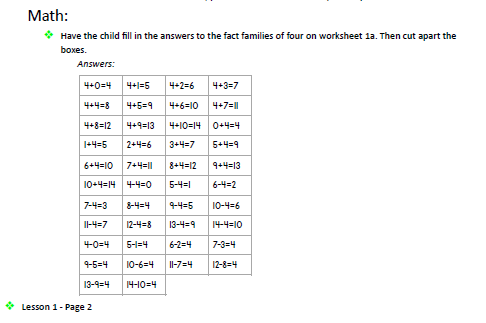
Answer key for one of the lessons in the Pilgrims Unit Study located within the lesson plan.


The worksheet that goes along with the answer page shared above.

The adaptability of the unit studies also appeals to me. For example, in Lesson 4 of U.S. Symbols Unit Study, it says to "dictate the following words and sentence to your child." So, one could use them for a spelling and punctuation lesson. Since our five-year-old son is not ready for a spelling lesson like this, I wrote the words out on paper for him to trace. In this way, we are still discussing the "-ew" words and he is practicing his handwriting.

I think my favorite day of the all of the Unit Studies was that of Lesson 2 from the U.S. Symbols Unit Study. We were able to complete the two worksheets almost in their entirety (saving two of the fractions parts for later), but so many skills were reviewed from counting syllables and discussing synonyms to finding the area of rectangles.

I also loved all of the books that were suggested as part of the U.S. Symbols Unit Study and the others that I was able to incorporate that I found in our library. This is part of the reason why we spent so much time on what is written as a one-week unit study. We had so many great books to read!

Our five-year-old son's favorite part was studying about the Bald Eagle which is not actually bald. And our three-year-old daughter loved reviewing the seasons and months of the year with us during the Seasons Unit Study.


I highly recommend the Unit Studies (K-6) from Homeschool Complete. They have been a joy to use in our homeschool each day. 


Completing the different activities


Looking for more information? 


Check out Homeschool Complete online!

Homeschool Complete offers more than just great Unit Studies. There are several years' worth of all-inclusive curriculum for your family, Reading Curriculum, and resources like manipulatives, journals, and more.


Do you want to try Homeschool Complete? 


Through March 31, 2019 you can save 10% with the code CREW2019 on your orders at Homeschool Complete! 


Don't forget that other members of the Homeschool Review Crew reviewed different products from Homeschool Complete – including semester one of the kindergarten through fourth grade curricula and a variety of the unit studies. Be sure to click the image below to check out more reviews.


Sunday, July 15, 2018

Book Club: Review of 100 Bible Stories for Children

100 Bible for children book

Disclaimer: I received this book for free from the publisher in return for my honest opinion. All thoughts and opinions are my own. For more information please see my Terms of Use and Disclosure Policy. Thank you.

Our family recently had the opportunity to review 100 Bible Stories for Children from Tyndale Kids (a division of Tyndale House Publishers, Inc.). In the hardcover book, one reads about the stories of Joseph, Moses, Joshua, Hannah, and Job, along with others from the Old Testament. The life of Jesus and parables of the New Testament include the Sower and the Lost Son as well as the journey of Peter and Paul after the death and resurrection of Jesus.

image of Shadrach, Meshach, and Abednego

What We Like

  • Beautiful illustrations 
  • Short chapters that are easy to read aloud – they are manageable to read aloud or for older children to read alone 
  • Clear, easy-to-read text
  • Scripture references at the start of each story 
  • A titles list that provide an overview of the story to be read 

Image of Jacob
My son really enjoyed hearing about Jacob and Esau as he has been learning about the brothers in his Sunday School class. He loves being able to read more about the topics he learns from his lessons at church by reading 100 Bible Stories for Children.

I liked the inclusion of some stories that are not always found in children's bibles. In addition to this, I was happy to see the explanation provided in Chapter 25: The Passover Meal so we could discuss the holiday and its origins in Exodus. Another chapter I was pleased with was Chapter 91: The Holy Spirit. So often the Holy Spirit seems to be glossed over in children's religious studies, so I was happy to be able to read the story from 100 Bible Stories for Children as well as show my children the reference from Acts (the specific chapter and verse is provided in the book for parents).

100 Bible Stories for Children is a beautiful book sharing stories from the Old and New Testament. The pages are quite sturdy with clear easy-to-read text and colorful illustrations. Each story is accompanied by Scripture references so you can go to your family Bible to read the story in the non-abridged version.
Reading Genesis from 100 Bible Stories for Children

The visuals included with each story really help bring both the Bible story and the corresponding lesson to life for children (and adults!). For example, accompanying Chapter 51: Daniel and His Friends is a wonderful illustration depicting Shadrach, Meshach, and Abednego in the flaming furnace with an angel of the Lord protecting them. We can almost feel the heat of the furnace as the one soldier of King Nebuchadnezzar shields his face from the flames.

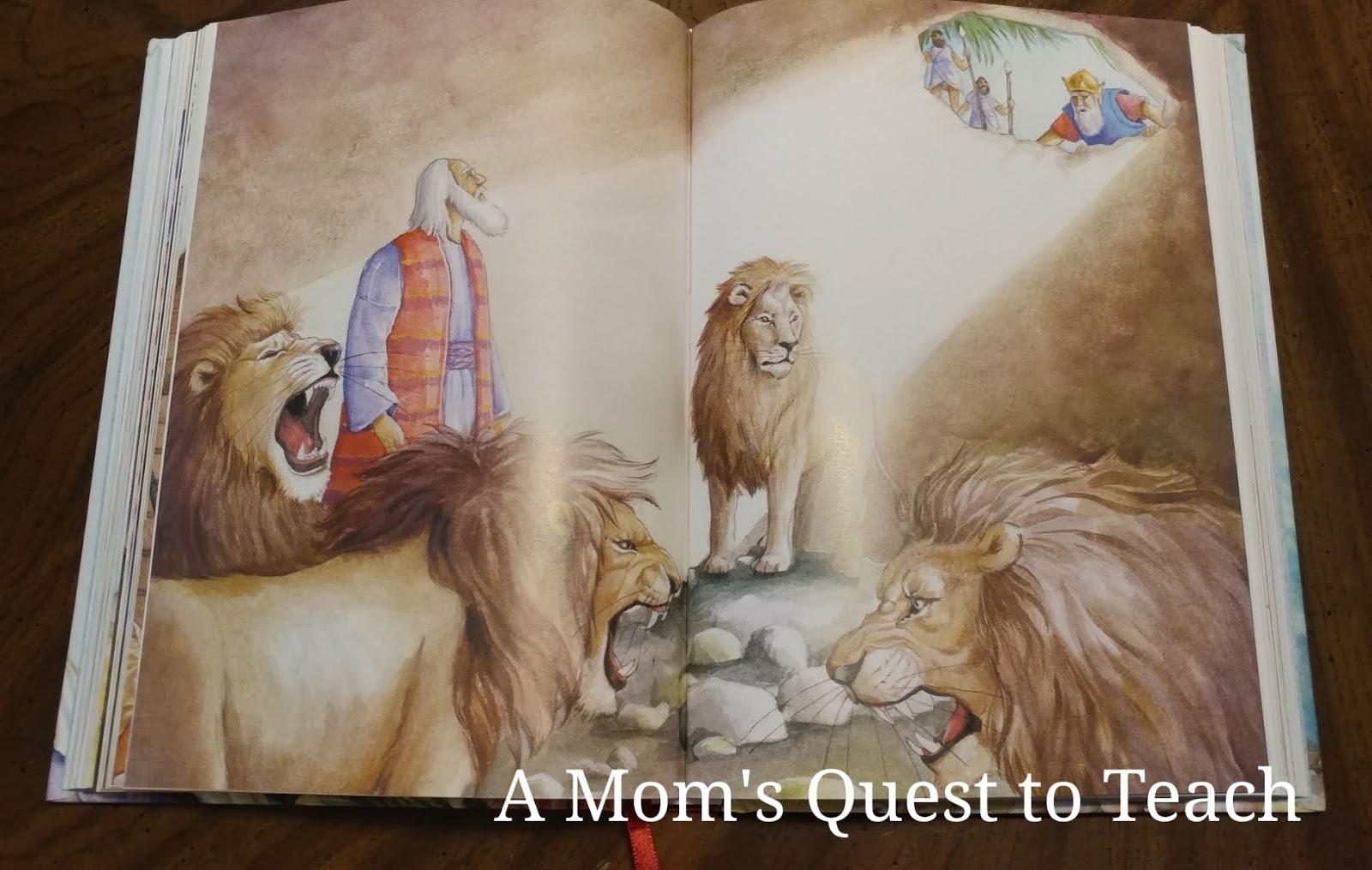
Another great example is the illustration included for Chapter 52: Daniel and the Lions. The art of Daniel standing amidst the lions and King Darius looking in – seeing Daniel untouched – is powerful. It really helps bring home the point that God protected Daniel from these potentially dangerous wild animals – who are snarling in the illustration!

Daniel and the Lions

In addition to the Old Testament illustrations, we also see the Good Shepherd protecting his herd from an hungry wolf, the sadness of Jesus in the garden of Gethsemane, and the acceptance of Stephen in the New Testament. Each of these illustrations accompany well-written text that our five-year-old can read (with assistance), making the book great for our whole family.

How We Will Use 100 Bible Stories for Children 


  • Bedtime story time 
  • Reviewing Bible stories
  • Introduction of Bible stories
  • After watching a Veggie Tale episode, we will find the appropriate story in the book to read 
  • Independent reading time

I would recommend 100 Bible Stories for Children for families who are looking for a children's Bible storybook for ages 5 to 10. Older children could also use it as a refresher or quick read for their Bible studies – especially since it has the scripture references provided for each of the 100 stories. I am sure this will be a valued book on our shelves for years to come.

For more information, please visit Tyndale Kids. There is even a PDF excerpt on the site of this beautiful 320-page book!

Tuesday, May 8, 2018

Reviewing Reading Kingdom: An Online Program with the Tools to Turn Kids into Successful Readers

Using an online program to learn to read.

I received this complimentary product through the Homeschool Review Crew. 

Our four-year-old son has always been interested in reading, so I jumped at the chance to review Reading Kingdom—which is an online grades K-3 reading program using "Phonics-PLUS." Reading Kingdom contains a placement test as well as reading and writing lessons divided into five levels. Each level takes approximately 10-15 weeks to complete depending on the number of sessions completed each day.

As the Reading Kingdom states "to ensure success, a child should use the program at least 4 days a week," we set out to do lessons each day. With the only exception occurring over Easter Weekend, we have been able to use Reading Kingdom with only occasional one day breaks every four days or so. Our son enjoys his 'program' so much that he was disheartened when we took a day off for his sister's birthday party.

During the placement test, parents are told to offer no assistance (which is hard!) but very important to make sure that the adaptive program knows exactly what your child knows and does not know. During the initial placement test, Reading Kingdom goes over how to type capital letters and how you navigate through the program.

In the beginning, our son seemed to struggle because he was learning a new skill—using the keyboard. He had very limited experience using a mouse and almost no experience typing on a keyboard prior to starting the review of Reading Kingdom. He was very disappointed after the first lesson or two but after he learned how to type – and I adjusted the response time to give him more time before the program prompted him with the correct answer, he began to thoroughly enjoy working each day. We have also taken advantage of the "Getting to Know the Mouse and Keyboard" training exercises on several occasions.


Using the keyboard and mouse to learn how to use the Reading Kingdom program.


There are many different ways in which children are taught reading and writing using Reading Kingdom. For example, in Reading and Writing Level One, children are taught new words through Pick the Picture, Detect and Select, and the reading of books. Reading Kingdom provides Sample Lessons which further explain how children are taught in levels 1 through 5.

Reading Kingdom provides four simple questions to see if your child is ready to use their program:
  1. "Can your student regularly sit and carry out school-like activities for 15 minutes at a time?" 
  2. "Does your student consistently speak in sentences?" 
  3. "Can your student match shapes?"
  4. "Can your student hold crayons or magic markers to create drawings?" 


Is your child ready to use the Reading Kingdom to learn how to read.

For more detailed information you can download "How is the Reading Kingdom different from other reading programs?" which provides a thorough explanation of how Reading Kingdom works and why it is better than other programs available. This PDF is available on the page "Why it works" and it goes through the six skills that your child will work on while using Reading Kingdom.

Since reading requires six skills, Reading Kingdom focuses upon all six using Dr. Marion Blank's "Phonics-PLUS" system. The six skills that Reading Kingdom focuses upon are:
  1. Sequencing (letter order)
  2. Writing
  3. Sounds (the program uses activities like 'bit blends' and 'orthographic phonemics' to teach phonology) 
  4. Meaning (semantics; learning the correct meaning of the word from context)
  5. Grammar (syntax) 
  6. Comprehension (text)
These 6 skills will help your child learn to read more easily. Reading Kingdom does not just focus on memorizing words but teaches words that can be used in "meaningful sentences" by your child. Children are taught spelling, pronunciation, meaning, and context before they are presented with a book. At the end of each of our son's lessons, there is a book that uses all the words that they have worked on the previous several days.


How We Use Reading Kingdom


Each day, our four-year-old completes at least one day's lesson of Reading Kingdom online. We start on the screen that lists our son's progress. As you can see from the screen capture, it states how many days per week your child has been using Reading Kingdom, as well as the link to change how your child interacts with the program and the response time.

Dashboard of the Reading Kingdom; how many days per week a child uses the online program


From this screen, you can also click on the individual parts of the level for a further breakdown to see how your child has progressed and the performance as rated by Reading Kingdom.


Lessons overview for the Reading Kingdom in which children learn to read.


One of the activities—Find and Fill—is choosing the correct word that can become the focus word (or "word of the day" as my son calls it). In this instance, our son needed to choose the word that could become 'swim.' He then is asked to type in the correct missing letters.


Picking the correct word for Reading Kingdom.


Another activity—Detect and Select—that our son completes within the Reading Kingdom program requires him to choose the word as it appears in text. In this photograph, the word he had to choose was 'not.' 


Having to pick the correct word in text.


There are also parts of the daily lesson—Pick the Picture—that require our son to correctly select a picture of the focus word and then type it. In this case, the word was "plane." If your child gets stuck on a letter, the program offers prompting to aid them in their spelling.


Selecting the correct picture for the word in Reading Kingdom.

There is also a student report feature which I haven't really used a lot as I feel like all the information is available to me on the dashboard screen. It is something that can be emailed so if you are having them complete the work elsewhere (e.g., at a grandparent's house), you can have the information reported to you without having to log into Reading Kingdom at home.

Report on Microsoft Excel for the Reading Kingdom.

I shared a short video of our son using Reading Kingdom on A Mom's Quest to Teach's Instagram

Great Features / What We Like


  • Ability to adjust the response time necessary 
  • The additional keyboard and mouse training 
  • The variety of ways that the vocabulary is introduced and taught 
  • Each day's lessons are brief—which is perfect for our four-year-old's attention 
  • The Passport book that gets new features every 20,000 points (Our son just loves seeing what will happen each day and eagerly calls over everyone in the house as he opens it.) 
  • It is adaptive—one of the words Reading Kingdom asked our son to spell was 'toys'—since he spelled it correctly on the first slide, the lesson skipped through several slides for the word 'toys.'
  • The words being taught are ones that help build real sentences (Our son has even taken to typing his own sentences on my laptop using the words he has learned.) 
  • If necessary, your child can redo a lesson or skip a lesson or level 
  • Has a unique way for helping children type capital letters—they can tap the shift key prior to the letter rather than holding shift and the letter key (there were a few occasions when there were some problems with the program recognizing the capital letter) 
  • Bright colorful images
  • Cute animation 
  • Clear speaking voice instructing our son what to do 
  • Opportunity to pause during the lesson (for 12 minutes)

A sentence learned while completing an online lesson with the Reading Kingdom.


Few Problems We Had Using the Program 


  • Did not always recognize the use of shift and letter keys to capitalize a letter 
  • There were times when we needed to reload or refresh the page 
  • Sometimes the voice instructions would start prior to the lesson actually starting—refreshing the page fixed this problem 

Final Thoughts 


I highly recommend taking a look at the Reading Kingdom website to learn more information. There is even a 30-day free trial if you want to try the online program for yourself!

We have only used the program on my laptop but Reading Kingdom states it works on any device with an Internet connection—including Windows, Mac, iPad, Android, and Chromebooks. 

We have been very happy with Reading Kingdom and will continue to use it in our home to help our son grow in his reading, writing, and spelling. 


Other Options 


ASD Reading Program Logo

In addition to Reading Kingdom, there is also another program that may be of interest to you: ASD Reading. ASD Reading is a reading program designed for children with Autism Spectrum Disorder (ASD) ages 4-10 who may or may not already be reading. They offer a 30-day free trial if you want to try it for your child.

To Learn More 


Reading Kingdom Logo


To learn more about the Reading Kingdom, please visit the following sites:

Website – Facebook – Twitter – Instagram

To read more reviews of the Reading Kingdom and ASD Reading, please visit the Homeschool Review Crew


Tuesday, May 1, 2018

Reviewing Three Books from Weigl Publishers


Are you looking for interactive literature that includes links to multimedia like videos, audio books, activities, and slideshows? Weigl Publishers offers media-enhanced books as part of their AV2 collection – added value and added visual – and our family had the privilege of reviewing three of their works. Our children and I reviewed the following three books:
  • A Lion's World – part of the "EyeDiscover" Series 
  • There Once Was a Cowpoke Who Swallowed an Ant 
  • Glaciers – part of the "Earth's Water" series from the Lightbox imprint 

Within each book is a digital code that unlocks multimedia content such as audio, video, weblinks, slideshows, and activities. The multimedia content varies from book to book and appears to differ based upon the age level each book is geared towards. There was significantly more multimedia content for Glaciers than there was for A Lion's World and There Once Was a Cowpoke Who Swallowed an Ant.


The AV2 (edit title) collections include several different collections - from the Let's Read Collection to their High Interest Collection - there is sure to be something for your reader. The Let's Read Collection consists of 47 AV2 titles geared towards ages 5 to 7. The Science Collection features books like Glaciers from the Waters Science series and other topics on animals, machines, and the five senses – to name a few. The Social Studies Collection features over 150 titles with videos, embedded weblinks, quizzes, and more to teach children about the 50 states, American celebrations, icons, and more. The High Interest Collection features books to engage reluctant readers. There are a variety of books including those on sports which are sure to grab the interest of any child since they range in topic from field hockey to football to cheer-leading to biking.

Our four-year-old was very eager to check out all the features available for each of the books.

A Lion's World


In A Lion's World, children are introduced to lions in Africa with facts about this magnificent species  of big cat.

For younger children, A Lion's World is a perfect book for an introduction to the study of lions. I could see families reading it together, listening to the story online, and then working on a lion-themed craft similar to the one we made. Both of our children's favorite part of A Lion's World was hearing the lion roar. This really brings the book to life!


I loved our daughter's reaction to the lion. Getting to actually see and hear the lions when reading A Lion's World is a great advantage to using digital books. 


Reading and listening to A Lion's World provided the perfect opportunity for our children to make their own lions and for us to talk more about the big cats. We talked about the difference between male and female lions after looking at the photos and videos in A Lion's World as well as where one can find lions in the wild. If your family wanted, you could see if there were any local zoos which house lions so you could see them in person and compare them to the videos.


There Once Was a Cowpoke Who Swallowed an Ant Written by Helen Ketteman and Illustrated by Will Terry


While reading this story and looking at the book online, our four-year-old stopped several times to share images and pictures with his two-year-old sister.

I enjoyed the fact that the narrator and the cowpoke were read by different voice actors. This helped bring the story to life for our family.


Our son's favorite pages were those with all the animals in the cowpoke's stomach. Both of our children found this to be a silly story to listen to and read aloud. Our daughter's favorite pages were those that reviewed all the animals that the Cowpoke had swallowed.

Glaciers: Earth's Water


At first, I was just going to look at the Glaciers by myself, as it is written for older children than our four-year-old (interest level 3-6 grades) but after reading through A Lion's World and There Once Was a Cowpoke Who Swallowed an Ant, our son wanted to look at the third book, too. As he 'flipped' through the book, he proudly showed me each page and read me the words he already knew. And he was so excited to see the map! That had to be his favorite part when we went online. I think my favorite parts were the videos that accompanied the book  including the one that showed inside the crevices of a glacier.


There are also a number of downloadable activities that accompany Glaciers. These include a chart of Glaciers around the world, an expository paragraph exercise, and a quiz – among other things. They are perfect to supplement the book, videos, and other features of Glaciers.


When using the Glaciers Menu page, you can highlight a feature to see on which pages you can find it. For example, in the image above, the pages with videos are highlighted. So, Glaciers contains four pages with videos in addition to the five pages with printable activities and three pages of weblinks. This makes it very easy for both parents and children to navigate and learn more about the topic. The quiz is both within the book and available as a PDF file to download. Another good feature is that the vocabulary words are in bold print and underlined.

They also offer a Curriculum Correlations download that addresses which National Next Generation Science Standards, Common Core State Standards, and Texas Essential Knowledge and Skills for Science that the Earth's Water series meets. (There are total of 7 books in the Earth's Water series including Glaciers.)


To learn more about Media Enhanced Books from Weigl Publishers please see:


To read additional reviews from the Homeschool Review Crew please see: 


Monday, March 26, 2018

A Review of Three Selections from the Award-Winning Author Carole P. Roman

culture, geography, Hungary, American West, Colonial America, Book Reviews, History, hsreivews, children's books

This post contains affiliate links. For more information, please see my Terms of Use and Disclosure Policy page. Thank you.

My family are huge fans of history, so children's books that focus upon history, culture, and geography like those from the Carole P. Roman books and collections are perfect for expanding knowledge about far away places or times. I was very happy to review three books by Carole P. Roman from the Carole P. Roman books and collections that would introduce our children to the culture of Hungary and the histories of Colonial America and the American West.

We reviewed the following three books:

If You Were Me and Lived in...Hungary: A Child's Introduction to Cultures Around the World

If You Were Me and Lived in...Colonial America: An Introduction to Civilizations Throughout Time 
            illustrated by Sarah Wright

If You Were Me and Lived in...the American West: An Introduction to Civilizations Throughout Time
            illustrated by Paula Tabor

culture, geography, Hungary, American West, Colonial America, Book Reviews, History, hsreivews, children's books

If You Were Me and Lived in...Hungary: A Child's Introduction to Cultures Around the World, introduced our children to the sights and sounds of modern day Hungary. We learned about the capital, Budapest, names for different members of the family, vacation spots, food, holidays, sports, and even the inventor of the Rubik's cube.

I think one of my favorite parts of the book was that there was a pronunciation guide not only in the back of the book but also with the naming of each Hungarian word on each page. For example, while discussing food at your grandma's house, the pronunciation for Nagyi (Na-dges) or grandma, goulash (goo-lash), and paprika (pap-reek-ca) is all provided within the story's text making it really easy to read aloud to your children.

Our four-year-old son liked learning about the different names of of children living in Hungary - like Lazlo or Erzse-bet. Our two-year-old daughter liked the picture of the children in front of the Hungarian Parliament. I think she really liked the little boy and girl smiling at her.

The book opens many conversation topics - one of which was talking about how our family has enjoyed goulash and other meals that are seasoned with paprika. Another conversation we had was about water polo and handball, both of which we enjoy watching during the Olympics.

culture, geography, Hungary, American West, Colonial America, Book Reviews, History, hsreivews, children's books

Both books in the If You Were Me and Lived in...An Introduction to Civilizations Throughout Time series, were longer than If You Were Me and Lived in...Hungary: A Child's Introduction to Cultures Around the World, so we spread those out to more than one sitting with our two- and four-year olds. A ten- to eleven-year-old history-loving child would have no problem reading through these entire books in one sitting, though.

culture, geography, Hungary, American West, Colonial America, Book Reviews, History, hsreivews, children's books
culture, geography, Hungary, American West, Colonial America, Book Reviews, History, hsreivews, children's booksIf You Were Me and Lived in...Colonial America: An Introduction to Civilizations Throughout Time, introduced our children to the world of pilgrims and settlers who arrived in America on the Mayflower. We learned about their journey to America, how they built their homes (with wood, daub, and wattle), and their daily lives (tending chickens, mending, cooking, or working in the fields).

Our four-year-old son's favorite part was where the little boy made friends with the Native American boy who taught him about fishing, while my two-year-old daughter liked the part where the family faced their first December in America. In fact, she kept finding that picture and saying "Brrr, they are cold."

Personally, I can't wait to re-read this book during November as we talk about Thanksgiving. It will provide a great anchor for lessons about Plymouth and the first Thanksgiving. With the vocabulary provided as well as the brief biographies of historical figures, our family has lots that we can learn from this book by Carole P. Roman.

culture, geography, Hungary, American West, Colonial America, Book Reviews, History, hsreivews, children's books
If You Were Me and Lived in...the American West: An Introduction to Civilizations Throughout Time, our children journey with Carole P. Roman and Paula Tabor as they took us on a journey across America to Oregon.

When we started looking at the book, If You Were Me and Lived in..the American West, my son and I talked about maps of the United States so we could plot the journey of the settlers. In fact, I think that would be the only change I would make to the book - add a map showing the trails - but then again our four-year-old is a map enthusiast so it might just be a feature that only our family would appreciate.

culture, geography, Hungary, American West, Colonial America, Book Reviews, History, hsreivews, children's booksOur four-year-old son's favorite part was learning how the family crossed the rivers they encountered - the Platte and the Columbia Rivers. Our two-year-old daughter's favorite part was hearing about the different foods they brought with them on their journey. And they both liked hearing about the gathering of buffalo chips! I think my favorite part of If You Were Me and Lived in...the American West were the details regarding how each day was spent by the children and parents. Being able to compare our daily activities to those of early settlers is a plus for this history-teacher-turned-homeschool-mom.

All three books present so many opportunities for families to create individualized lessons for their children. For example, I used the vocabulary list from the American West book to introduce my four-year-old to new words. We talked about blacksmiths, bonnets, outhouses, and homesteads among other vocabulary words and practiced writing and spelling them. If our children were older, I would probably have them create their own model of a Conestoga wagon and perhaps even sew their own period-appropriate clothing. Our son did draw his own Conestoga Wagon with a bit of guidance from me after we read the book.

culture, geography, Hungary, American West, Colonial America, Book Reviews, History, hsreivews, children's books
Drawing a picture of a Conestoga Wagon. Coloring in the the patches on the canvas.

I would recommend If You Were Me and Lived in...Hungary: A Child's Introduction to Cultures Around the World to families with children as young as our two-year-old daughter. While children ages seven to nine may be able to read the book independently, younger children can listen or read along with their parents or older siblings and learn about places and cultures around the world. I think this book would be a great place to start when discussing the geography of Europe.

I recommend the If You Were Me and Lived in...An Introduction to Civilizations Throughout Time series of books to families with children four-years to twelve-years-old. These books are more detailed with a plethora of vocabulary, people, places, and events to interest young students of history. They are fantastic additions to any family's library because of their attention to detail. And because they are written from the perspective a child who lived in that time period, your own children feel as if they are right alongside their new friends in the past.

There is only one objection I have in regards to the books (other than the lack of maps but, as I said, we are a map-loving family): each book that we reviewed is told from the perspective of a boy. (Information is provided for the lives of both boys and girls and moms and dads, but – when reading the stories.

Edit: The two history books we reviewed are told from the perspective a boy but there are others in the series (If You Were Me and Lived in...Elizabethan England for example) that are told from a girl's point of view. And after a quick re-read of If You Were Me and Lived in...Hungary, I now see that it is told from the point of view of both children narrating the tale.

culture, geography, Hungary, American West, Colonial America, Book Reviews, History, hsreivews, children's books
Looking through If You Were me and Lived in...the American West before bedtime.

Having enjoyed these three books so much, we will be looking for others in the If You Were Me and Lived in...An Introduction to Civilizations Throughout Time series. For example, we will be looking for If You Were Me and Lived in...Renaissance Italy: And Introduction to Civilizations Throughout Time and If You Were Me and Lived in...Ancient Greece: An Introduction to Civilizations Throughout Time.


To read more about books by Carole P. Roman, please visit this review from 2020.

To learn more about the Carole P. Roman books and collections please visit the following:


culture, geography, Hungary, American West, Colonial America, Book Reviews, History, hsreivews, children's books