Showing posts with label handwriting. Show all posts

Friday, August 9, 2024

Review of Speeches and Writings in American History from CursiveLogic

A Mom's Quest to Teach: Review of Speeches and Writings in American History from CursiveLogic; mother looking at child


I received a COMPLIMENTARY copy of this product from Timberdoodle in exchange for my honest opinion. I was not required to write a positive review or be compensated in any other way. This post contains affiliate links. Please see my Terms of Use and Disclosure Policy page for more information. Thank you. 

Do you plan on teaching cursive in your homeschool? Have you included cursive in your homeschool in previous years, but you are looking for a new approach? We were pleased to use and review Speeches and Writings in American History from CursiveLogic this summer in preparation for our sixth-grade year. 

Please note this workbook is actually part of the 2024 Fifth-Grade Curriculum Kit from Timberdoodle, but we will be using it during sixth grade. I love the flexibility of homeschooling! 

Our younger son learned how to write cursive using a different style, but I wanted to offer him the choice to learn a different approach. The goal is to let him find what style of cursive works best for him. Enter CursiveLogic! 

About Speeches and Writings in American History

We have not used any other materials from CursiveLogic prior to Speeches and Writings in American History. I do not feel that was a detriment because there were several pages of practice and review before jumping into the speeches and writings. It starts out with reviewing orange ovals to form the first stroke and moves through connecting the letters, forming loops, and finally, capital letters. 

Before the student moves on to the speeches and writings, they check their posture, paper, pencil, and grip. And finally, "check your form" includes five more sets of questions to ask: 

  • Questions about the shape of the letters,
  • Questions about the size of the letters,
  • Questions about linking,
  • Question about spacing, and
  • A question about slant
The front of the book (which is laminated) has an alphabet reference chart with all 26 letters (lower and upper case), numbers 1-9, and the four types of connected letters. The back of the book has a vocabulary list from the speeches and writings.

handwriting pages


Whose Speeches and Writings in American History Will Your Child Be Writing? 


There are 18 individuals chosen to represent American History from Patrick Henry to Ronald Reagan. Speeches such as George Washington's Farewell Address and Martin Luther King's I Have a Dream are included. Witticisms from Poor Richard's Almanac and Helen Keller's essay on Optimism are also included. There is a wide range of people and periods in Speeches and Writings in American History. 

 A few other individuals are: 

  • Sojourner Truth 
  • Geronimo 
  • Susan B. Anthony 
  • John F. Kennedy 

A Mom's Quest to Teach: Review of Speeches and Writings in American History from CursiveLogic; cover of workbook


How We Used Speeches and Writings in American History in Our Homeschool 


When our 11-year-old started the book, I assigned one page of the review sheets daily. I went over them and checked to see if he needed to make any corrections to his form. After he had completed those review pages, I started to assign the speeches and writings. One day was set aside for reading about the individuals and their writing. Some days, that first day also included the warm-up and vocabulary exercises. Other times, I saved that for a second day. In general, the lessons are designed to take place over four days. 

While each writing section has a spot for the student to check off the following items, I haven't yet used that with our son. 
  • Shape
  • Size
  • Linking
  • Spacing
  • Slant 
  • 3 P's
  • Relaxed Hand
  • Light Pressure 

"Explore American history through cursive writing! Delve into the lives of 18 notable figures, from presidents to activists, honing handwriting skills." 


A Mom's Quest to Teach logo; writing warm-up and vocabulary page


My Thoughts 


I really appreciate having a different way to teach cursive to our son. And the fact that this book can connect to American History is fantastic. We can connect his handwriting lessons to both history and language arts by using these lessons. We could even pull in spelling by using some of the vocabulary words for those lessons, too. 

How did we connect this to our other homeschool lessons? I printed out a copy of the entire poem "Paul Revere's Ride" by Henry Wadsworth Longfellow to read. I have been having him read parts of the poem aloud. Eventually, I might ask him to copy the entire thing in cursive, too. 

There are a few other things in Speeches and Writings in American History that I really like. There is a midline review and a section on flourishes and signatures. One of the things we were talking about before we started the book was the fact that he would be able to pull from his experience with both styles to create his own signature. So, having this information presented in the book itself is wonderful. 

Finally, I like the inclusion of the Gettysburg Address in Lincoln's handwriting. I love primary documents, so we will be looking for more examples of the speeches and writings in this book to incorporate into our homeschool lessons. 

A Mom's Quest to Teach logo; Gettysburg Address in Lincoln's handwriting


Are You Looking For More Homeschooling Products? 

I have several reviews of products from Timberdoodle. Check them out using the following links. 

Monday, June 1, 2020

Improving Math Fact Fluency: A Review of Page A Day Math

text: Improving Math Fact Fluency: A Review of Page A Day Math; logo of Page A Day Math & A Mom's Quest to Teach

Disclaimer: I received a FREE copy of this product through the HOMESCHOOL REVIEW CREW in exchange for my honest review. I was not required to write a positive review nor was I compensated in any other way.

This post contains affiliate links. For more information, please see my Terms of Use and Disclosure Policy page. Thank you.

One of the skills in mathematics that we haven't been focusing upon as much in our homeschool is math facts – and being fluent in math facts. For example, we haven't spent time reciting the addition or subtraction tables. I was thinking about how to incorporate those skills into our homeschool over the coming summer as well as how to introduce multiplication to our son when the opportunity to review products from Page a Day Math arrived. There are so many great products available from Page a Day Math that will help build math fact fluency as well as help your children work on their handwriting skills. While we used a variety of their products that we downloaded digitally, we received the Addition Starter Kit in the mail to use with our younger son.

Addition Starter Kit books from Page A Day Math

Why Is Math Fluency Important?


In order to feel confident in mathematics, students need to be fluent in math facts. When they can quickly add, subtract, multiply, and divide smaller problems, they will be able to carry that information onto more complex problems and situations. We have found good products to help our children work on math fluency. Page a Day Math provides products that make math fun and engaging in addition to helping. It is an incremental math book program where children learn new topics and continue to improve their existing math fact fluency by reviewing previous skills.

Addition Starter Kit Box


What Is Page A Day Math? 


I love the origin story behind Page a Day Math. The creator's daughter was struggling with mathematics at the age of six and her teacher said the young girl was not good at math. While other families may have accepted that statement, they did not. So, her mother made math worksheets and flashcards for her daughter, who soon caught up and did even better with daily practice.  (You can read more of the story here: Our Story.) It is so important that all children realize that they can be a math-proficient person. 

Each series of math books focuses on one specific math operation – addition, subtraction, multiplication, and division. The Pre-K Math Starter Kit is aimed at children ages 3-5 with 10 books (we used the digital version with our daughter). The Addition Starter Kit is for ages 5-7 with 10 books that have 14 days of practice per book (we used the physical set for our son). The Subtraction Starter Kit is for ages 6-8 with 13 books that contain 40 problems per day. The Multiplication Kit is for ages 6-8 with 12 books. They are perfect for first through fourth graders who have already mastered addition and subtraction fact fluency and are ready to move on to multiplication. The Division Kit is for ages 6-9 with 12 books for children who have mastered math fact fluency in addition, subtraction, and multiplication.

In addition to the Math Kits, Page a Day Math also offers Math Flashcards, Math Review Books, Handwriting Books (both print and cursive options), and stickers, temporary tattoos, and bookmarks featuring the five lovable dogs of the Math Squad - Mo, Zo, Bo, Jo, and Flo. We received a sample of the stickers, temporary tattoo, and book in our box and they are great! Our kids were very excited to see them.

stickers and bookmark from Page A Day Math
Our daughter couldn't wait to check out the stickers!

What Are We Using in Our Homeschool?


We are primarily using the Addition Start Kit, for which we received a physical copy, and the digital download of the PreK Math Starter Kit. I have also been including some of the worksheets that we were able to receive digitally:
    Text: Improving Math Fact Fluency: A Review of Page A Day Math; "daily learning involves one page a day providing the perfect balance of incremental and cumulative practice"; image of book cover and math questions
  • Meet the Math Squad! My First Counting Coloring Joke Book 
  • I Can Write My Name 
  • I Can Write in Cursive 
  • Multiplication Starter Kit 
  • Subtraction Starter Kit 
  • Adorable Adjectives 
  • Beautiful Biology 
  • Cool Chemistry 
  • Fun Physics 
  • Places and Spaces 
  • Scenic States 
  • Super Sight Words

As the Starter Kits – both physical and digital – are designed for a student to complete one page a day, we have been doing that since we received them. They are very easy to print out but I also like the books. They are smaller than a normal-sized workbook which makes them easy to hold.

inside book from Page A Day Math with ruler to show size


Most homeschooling days, our younger children start their day by completing their Page a Day worksheets. Because the pages require very little instruction from my part, they can work on them independently while I get their next activity set up or ready. They also do not take very long – maybe 10 to 15 minutes depending on how distracted they get. I have found they are also a great way to start the day because they help build confidence.

What Do We Think?


There are many things that I like about Page A Day Math:

  • The design of the physical books 
  • The variety of the materials available 
  • The inclusion of fun characters (The Math Squad) 
  • The storage system of the physical kit 
  • The ability to print multiple copies of the digital products (for when both children want to color the same picture from the My First Counting Coloring Joke Book)
  • The helpfulness of customer service 
  • The ease of using the worksheets and the physical books – I can hand them over to our children and they can work on them by themselves 

I really love the look of the Addition Starter Kit. Storage can often be a problem with homeschooling materials but not in this case. All the workbooks fit nicely in the box. I have been keeping the current workbook our son is completing in a folder with other printed pages from Page a Day Math.

Math pages inside and outside of folder
Each of our children has their own folder where I keep the printouts and the book that our son is currently working on. 


If you are using only the digital versions, you can print using just black ink like I have been doing or print in color. If you are only printing the actual pages that your children will be completing, and maybe the certificate, you will not need to use much colored ink. I appreciate a digital product that does not require lots of ink when printing. Below you can compare the difference between the certificate I printed out and the one from the book to see how much colored ink is necessary.
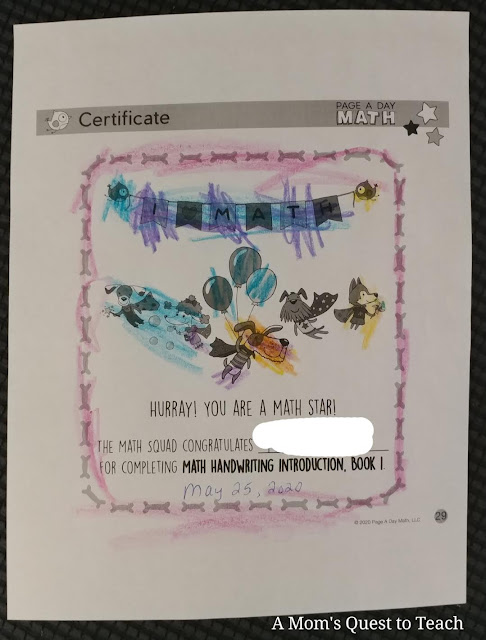
Page A Day certificate

Page A Day Math Certificate


Our almost second grader started using the subtraction sheets from book one of the digital Subtraction Kit while we were waiting for the Addition Starter Kit to arrive. He was a little frustrated because he found the pages that I printed out for him to be too easy. So when the Addition Starter Kit arrived, we looked through the first several books to see where he thought he should start. We did complete the assessment pages that came with the digital Subtraction Kit which indicated he needed more practice with subtraction fact fluency, so we will use Subtraction Book 3 when he finishes working through the addition books. I have noticed that he has been more quickly answering addition questions. So I believe that his math fluency is improving using the books.

Subtraction assessment math questions
One of the Subtraction assessment pages.

Even though our daughter seems to have a firm understanding of kindergarten mathematics, I wanted to use the digital Pre-K Math Starter Kit with her as she needs work on mastering her facts. She can add and subtract but I would like her to work on fluency so she can answer the questions more quickly. She also needs to practice her handwriting skills so I appreciate the way the math books are designed (so that she can practice writing her numbers) and I love the additional handwriting books that we were able to download. I have been printing out pages from I Can Write My Name to help reinforce the letters she is practicing in her other homeschooling assignments.

letter e handwriting page from Page A Day Math
I printed out the pages that matched up to the letters our daughter was working on in her other homeschooling work.

I look forward to completing the workbooks – both the digital and physical ones – with our children. As our son moves through the Addition books, he will work on counting and adding 7, 8, 9, and 10 to numbers 0-10. I also look forward to start using the multiplication digital books with our son after we have spent some time going over the multiplication flashcards that I have printed out.

multiplication cards from Page A Day Math

As our daughter works her way through the Pre-K Math Starter Kit, she will practice tracing more difficult math addition equations as well as trace even and odd numbers. We will also move from just practicing tracing letters to tracing sight words and other words using the variety of digital handwriting workbooks.

We are also slowly introducing cursive handwriting practice to our son. I like how the pages have both upper and lower case letters on them to help him practice.

Handwriting cursive practice pages from Page A Day Math

Page A Day Math worksheets

Do You Want to Learn More? 


Page A Day Math logo


There are so many great products available from Page A Day Math. Be sure to check out the rest of the reviews from the Homeschool Review Crew to see how they used the many products in their homeschool to help support math fact fluency!

Homeschool Review Crew Click Here logo

Tuesday, May 5, 2020

Working on Writing Beautifully: A Review of Perfect Reading, Beautiful Handwriting eBook

logos from A Mom's Quest to Teach; Everyday Education; Perfect Reading cover; text: Working on Writing Beautifully: A Review of Perfect Reading, Beautiful Handwriting eBook

Disclaimer: I received a FREE copy of this product through the HOMESCHOOL REVIEW CREW in exchange for my honest review. I was not required to write a positive review nor was I compensated in any other way.

So many individuals would like to work on writing more clearly. Perhaps even some may want to write beautifully. Our family began using the Perfect Reading, Beautiful Handwriting eBook last month from Everyday Education, LLC.

We received access to a PDF eBook of 218 pages which not only focuses upon phonics but also introduces italic penmanship going from straight to slant to jointed writing. As it is an eBook, I am able to print as many pages as I need for my children to use and practice upon over and over. What a great bonus for a handwriting book! (If you prefer a print book, you can purchase that instead of the eBook.)

There are 60 lessons with a phonics-based approach that can be used across 60 days to teach your young child to read. One of the features of the eBook is that your child will practice writing directly on the page where they see how to form the letter or letters. It can also be used with the Charlotte Mason approach to homeschooling. So there are multiple ways in which you could use Perfect Reading, Beautiful Handwriting eBook in your homeschool.

Within the opening of the book, Janice Campbell provides ideas as to how to use the book and a weekly schedule you can use in your homeschool. The author, Caroline Joy Adams, then presents four specific ways the book can be used:
  1. To teach young children how to read and write
  2. To teach children with reading difficulties to read effectively 
  3. To teach children to have fast, legible, attractive handwriting
  4. To teach yourself beautiful handwriting 
Why use the Italic style of handwriting? The typical style of handwriting taught is not easy for children to master beautifully. Most letters require more than one stroke and the formation of circles. Italic style are written in mostly one stroke (only 6 letters require more than one) and follow a more natural shape of an oval for writing. This helps children master handwriting more easily. A very interesting concept and I can't wait to see if our daughter will do better with this style. (I didn't use this eBook with her during the review period because she just turned five and she sometimes gets very upset or frustrated when writing.)

cover of Perfect Reading & Beautiful Handwriting cover of Perfect Reading & Beautiful Handwriting


text: Working on Writing Beautifully: A Review of Perfect Reading, Beautiful Handwriting eBook; Work on reading skills and practice handwriting with one eBook; book cover of Perfect Reading

In Our Homeschool


I primarily used the Perfect Reading, Beautiful Handwriting eBook with our first grader as we were not using any copywork with him currently. I did not require him to practice writing out the entire alphabet sheets but when we got to the section on short vowels and then blends, I had him write out the sentences and read the sentences aloud.

letter b practice handwriting


Some of the lessons were very useful as we are working on having him try to speak more clearly when it comes to certain letters and words. So for some lessons I had him read aloud the entire sheet (we usually took breaks in between the columns). For the other lessons, I sat with our son and randomly pointed to words on the sheet for him to say aloud for me.

Lesson 10 - Blending with r words and handwriting page


Personally, I used the handwriting sheets that focused upon slanted and jointed writing to practice my own handwriting. I am hopeful that I will be able to better my skill at Bible journaling through practice. I traced the sheets several times with highlighters so I could get used the style of the handwriting and then attempted writing out some Scripture.


Swash capitals handwriting practice

text: Trust in the Lord with all your heart


After that did not end up quite the way I wanted it to, I practiced writing just letters on a separate sheet of paper. I like the way some of them turned out but not all of them. This is through 'user error' not the fault of the book at all. I am very happy to add these pages to my collection of Bible Journaling materials. And because the book is digital, I print the pages out as many times as I need to trace them to get better at copying the style.

practice handwriting letters


I think that Perfect Reading, Beautiful Handwriting eBook would be a good addition for many homeschooling families. As there are multiple ways in which you can use the book, you can incorporate the lessons into your homeschooling day however it suits your family's needs. Lessons range from vowel sounds, blends like th, ch, wh, and others, compound words, contractions, silent letters, endings, and many other topics to help teach reading and writing in your homeschool.

practice handwriting sheets (letter u, x, y, and words); text: From practicing writing individual letters to writing entire words and sentences...there are many ways for students to work on their handwriting

Would You Like to Learn More? 


Everyday Education logo


There are so many great ways in which you could use this eBook in your homeschool. Be sure to check out the rest of the reviews from the Homeschool Review Crew to see how they used the exercises in their homeschool.

Homeschool Review Crew click logo

Monday, October 28, 2019

Working on Handwriting Skills: A Review of Channie's Visual Handwriting & Math Workbooks

logo of Channie's

Now that our four-year-old daughter is unlocking the code to reading, she is eager to start writing. When the opportunity to review products from Channie's Visual Handwriting & Math workbooks became available, she was excited to look over all the workbooks, dry-erase flashcards, and other products. From the four products available to review, we chose Channie's Dry Erase Flashcard for Alphabet & Number and Neat Numbers. Both our daughter and our six-year-old son used these two products to practice their handwriting and math skills.

What is Channie's?

Neat Numbers workbook and alphabet flashcards

Seeking to find something to help her son with his handwriting, Chan Bohacheff created a visual guide. This then developed into products that are known for making learning and teaching both easy and fun. For those struggling with handwriting, there has been quick improvement reported.

Channie's lists four reasons why their visual writing pads are so effective:

  1. The blocks provide for consistent letter size. 
  2. There are double vertical lines to guide proper spacing. 
  3. The middle green shade is there to help with lowercase placement and writing in straight lines. 
  4. They provide the ability to self-correct when writing outside of the lines.
There are so many great products to help your child learn to write more clearly. From learning to print to working on writing in cursive, there are multiple writing tools to help work on those skills with your children. If you are looking to work on math skills, there are 14 different products from one-page-a-day single-digit addition and subtraction that would be great for our son to double- and triple-digit LineUp workbooks for old children.


What Did We Receive to Review?


We received two products to review:

Alphabet & Number flashcards

Neat Numbers workbook

My intention was to use both of these products primarily with our four-year-old daughter. While she was very excited to start writing, she was not happy about needing to trace the letters or numbers. So we would work on the flashcards for a day and then set them aside for a few days so she would not get frustrated that she was not tracing them perfectly. This did allow time for our six-year-old son to use the flashcards to practice his penmanship.

The flashcards are a set of 26 alphabet cards (lowercase on one side with a blue border and uppercase on the reverse side with a green border) and 10 number cards. They are 5.5 inches by 4.5 inches so they fit neatly on a table or desk alongside other workbooks. The alphabet cards have two letters to practice tracing and then space for your child to write the letter themselves. The number cards do not have any to trace – just blank spaces to try writing the number.

The Neat Numbers workbook pad is 80 pages long. The back of the cover has numbers 0-21 printed on it for easy reference and starts right with the number one to practice tracing. The pages are 8.5 inches by 11 inches so you could include them in a folder or binder if you take them out of the pad. They remove easily.

How Did We Use the Flashcards in Our Homeschool?


We started using the letters L, t, and i with our daughter. I asked her to trace them on the flashcards and then she could pick the other cards she wanted to work on each day. On most days, I let her choose which cards she wanted to use because she is still a little too young for me to push formal homeschooling yet.

Letter T Channie's flashcard

Letter P Channie's Flashcard

Letter A flashcard and Letter A Workbook
Prior to being selected for this review I had purchased the My First Letters pad from Channie's.
Our daughter spent some time working on it alongside the flashcards. 


The flashcards were a perfect exercise for our daughter to do while her brother was working on his own work. She could sit there and practice writing with the dry-erase markers and then erase the cards to work on the same letter again if she wanted.

Our six-year-old son also used them. They share their toys and homeschooling materials so it was only natural that he wanted to try his hand with the flashcards.

How Did We Use Neat Numbers in Our Homeschool?


Our daughter practiced writing a few of the numbers and tried her hand at a few of the trace & try pages towards the end. Similar to using the flashcards, she grew frustrated when her tracing was not perfect so we would set aside the Neat Numbers workbook for a few days.

Neat Numbers number 1 tracing

addition page from Neat Numbers


I used the addition and subtraction pages at the end of Neat Numbers for our six-year-old son. After the forty pages that have the student trace numbers 1-20, there are several trace & try pages to teach the basics of addition and subtraction with images like apples, soccer balls, and fish. After these pages, there were horizontal addition and subtraction pages with numbers. Our son completed these over the course of the review period. After the horizontal problems worksheets, there were several worksheets with the problems listed vertically. This was a new way to do addition and subtraction problems for our son. Finally, there were blank pages to practice writing numbers and pages to write our own addition or subtraction problems.

subtraction Neat Numbers worksheet

Subtraction Neat Numbers worksheet

Addition worksheet from Neat Numbers
At first, he was confused by the extra box when the addition problems were set up vertically. So, I highlighted the part where he should write the answer to the math problem.


What Do We Think?


I like the quality of the flashcards. Sometimes when one needs to use dry-erase markers, the cards or pages do not really erase well. That hasn't been the case so far with these cards from Channie's. Our children have been to be able to use the same cards to practice the same letters over and over and they can erase them cleanly.

The flashcards also fit neatly in the box even with taking them out of the small box over and over again each day for practice. This makes it very nice to keep them organized and with our homeschooling materials.

The Neat Numbers workbook is a very nice resource. I like that there are opportunities to practice multiple skills from tracing to addition and subtraction. The pages are of a thick quality so I do not think they will tear easily with erasing.

Our six-year-old son who has been writing for a longer time was not overly fond of having to write in the blocks and having to write in the style that Channie's uses. He enjoyed practicing his letter writing and working on addition and subtraction but often just wrote the letters and numbers his own way.

Our four-year-old daughter was very excited to review products from Channie's that were for her. Even though we had to take breaks in between using the flashcards and Neat Numbers, she did enjoy her time homeschooling. I think she really liked using the flashcards because she was in control of her work since she could write with the dry-erase markers and then erase them to write again.

I would recommend Channie's Visual Handwriting & Math workbooks to families looking for something to help their child write more clearly and those families looking for their children to practice math skills. When our six-year-old is learning cursive, I will take a look at the cursive workbooks to incorporate into our homeschool day.

Do You Want to Learn More? 


Be sure to check out the other reviews because there were two other products that the Crew also reviewed in their homeschool.

Channie's Logo


Channie's Crew Review

Crew disclaimer


Monday, June 10, 2019

Classical Approach to Learning How to Write Sentences: Reviewing Products from Memoria Press

Reviewing: Simply Classical Writing Book One: Step-by-Step Sentences (Bible Story Edition) and Simply Classical Writing Book Two: Step-by-Step Sentences (Bible Story Edition) with Teacher Key, Skill level about 1st-3rd grade


Our family was excited for the opportunity to review products again from Memoria Press. Our son has been using the Simply Classical Writing Book One: Step-by-Step Sentences (Bible Story Edition) for the past several weeks. As part of the review we received three paperback books from Memoria Press:


Each book is designed to provide a full year's worth of instructions when approached at a slower pace. The books are part of the Memoria Press Classical Curriculum adapted for Special Needs. A Classical Christian education is one in which children are trained in the liberal arts and are introduced to the great books and great thinkers of Western tradition. With the slower pace of these books adapted for Special Needs, families can provide a Classical Education for all of their children. However, your child does not need to be classified as special needs in order to benefit from using these slower-paced books.  I would use Simply Classical Writing books with all children. They provide a firm foundation in learning how to write.


In the beginning of the 118-page Book One, there are two pages of Teacher Notes that outline supplies, how to teach the curriculum, an outline explaining day by day activities, and recommendations for special situations.

Each week consists of the following activities: 

  • Read the assigned story
  • Learn the rules
  • Copy and mark decodable sentences
  • Read-Aloud sentences
  • Create a sentence
  • Challenge sentence – students will use their own words to tell something that happened in the story – our almost six-year-old found this to be one of the harder tasks for him 
  • Illustrate and describe the drawing – students draw something talked about in the story and then write a caption for their picture 
The sentences our son copied, wrote, and created were marked using colored pencils according to the instructions: 
  • Green for capital letters at the beginning of the sentence
  • Red for the ending punctuation 
  • Blue for specific names that need to capitalized (in our lessons, these were God, Eden, Adam, and so on) 
In the beginning, we worked on reviewing the rules. You can see how he circled the beginning letter of the sentence.
We had to review what words needed to be circled in blue on more than one occasion. 

Each week's work is spread out over three pages and – depending on your child and their ability – you could take a week to complete the work as suggested or less time. For example, some days we completed one whole weeks' sentences and other days we only worked on one or two parts. In general, we took two days to complete each lesson. 

Our son had some difficulty with the challenge sentence and the illustrate and describe part, so we usually did these two on separate days. As Simply Classical Writing Book One is geared towards ages 6-8, it did not surprise me that our son would need more assistance with some of the work. 


How We Used the Book 


We started using Simply Classical Writing Book One: Step-by-Step Sentences as soon as it arrived. We were both pretty excited to get started.

I decided to break up the rules about sentences (there are four pages) into separate lessons. We started with the first four rules. Then, each day I would introduce one more rule while reviewing the previous ones briefly. Sometimes I wrote them on our small white board and other times we read directly from the book. 


As this is the Bible Story Edition, it is recommended to have an introductory Bible story collection. They teach from A Child's Garden of Bible Stories. As we already have three illustrated collections, I used these books. If a lesson took us more than one day, I even swapped which book we were using to read the story. So while one book might have information regarding Moses as just a baby, hearing the word of God, and then leading his people out of Egypt; another of our books told of the plagues and wandering in the desert. This gave our son lots to pick from when he was writing his own challenge sentence for several lessons (weeks 8-10). 

On the first day, I would read the story to both our children. Then our son and I would work on the lesson together. The next day I would read the story again (or use a different book) and then he would complete the lesson.

When working the challenge sentence and the illustration, he would often have the book in
front of him for reference as you can see at the top of this photograph. 


What I Like 


I like how this seamlessly incorporates Bible reading into our day. It is great to talk about the Bible – such stories as that of Abraham and Sarah, Elijah, Daniel and the Lions, the message delivered to Mary by the Angel, the miracles of Jesus, the parables of Jesus, and His death and resurrection – during our language arts lessons. So while our son gains a firm foundation in sentence writing and learns about nouns, verbs, punctuation, and more; he is also receiving a firm foundation in his faith. 

I also appreciate the binding of the book, the quality of the pages (they can take quite a bit of erasing), and the fact that there is ample room to write in the book on the lines provided. At the end of Week 34, there is an appendix with a certificate for completion and a reproducible template for further practice. I think this is fantastic as it will let us continue to use this format (which works) when we read other books and stories.

Because of the high quality of the pages, I could have asked our son to erase the first sentence where he forgot two words. Instead I decided to show him two editing notations to help him correct his mistake. 

The lessons allow us to discuss how wonderfully God provides for His people.


I also think using Simply Classical Book One: Step-by-Step Sentences has helped our son's handwriting tremendously (see example above). The copy work is serving a dual purpose – he is working on his ability to construct sentences, learning grammar rules, and improving his handwriting.


Looking Forward to Book Two 


We will probably begin to work with Simply Classical Writing Book Two in the new year – January 2020. I think finishing up Book One slowly will enable our son to continue to grow as a writer, give him some free time over the summer, and let us focus on building the foundation for writing good sentences using the classical approach of Memoria Press. 

I previewed Book Two so I would be able to schedule the lessons into our homeschooling planner. I like that Book Two continues with the same basic format as Book One but then includes instructions in grammar and sentence writing that are a little more complex. It looks like there is a lot of natural progression for students as they move from one book to the next.

I have included two photographs from the Student Guide and one photograph from the Teacher's Guide to give you an idea of how the lessons change to introduce more complex topics. Students will learn about nouns, pronouns, verbs, commas, apostrophes, synonyms, antonyms, adjectives, adverbs, and how to start writing paragraphs. Mixed into the lessons on all these important concepts are reviews built in for your child. Book Two also has an appendix with some great items like a week-by-week list of themes, scriptures referenced, and the page in the recommended story Bible. There are also a couple of reproducible pages to help you continue the lessons. I am very excited to start working on this book in the new homeschool year with our son.

Simply Classical Book Two: Step-by-Step Sentences


Teacher's Guide


If you would like learn more about Memoria Press, please visit the following:


Memoria Press gave families the opportunity to review several products including:


I think all these look like excellent products so I can't wait to check out the reviews myself to see what the members of the Homeschool Review Crew think about them.