Showing posts with label Math Practice. Show all posts

Monday, July 27, 2020

CTCMath Review: How the Online Math Curriculum Works in Our Homeschool

Text: CTCMath Review: How the Online Math Curriculum Works in Our Homeschool; background image of numbers

Disclaimer: I received a FREE copy of this product through the HOMESCHOOL REVIEW CREW in exchange for my honest review. I was not required to write a positive review nor was I compensated in any other way.


We have had the joy of using CTCMath in our homeschool for over a year now. Last year we reviewed the online math curriculum with all three of our children – using the kindergarten, first grade, and algebra II levels. This year, we were fortunate that our subscription was extended so we could review the next levels for our younger children (we are still discussing what mathematics our high school senior will be taking this upcoming homeschool year). The 12-month Family membership allows us access to all the grade levels and lessons. So, if one of our children is struggling, we have to find the right lessons to help them succeed.

CTCMath offers clear, spoken explanations for all levels and mathematics topics through their site. Simple and concise diagrams are used to accompany the instructional videos. You can even download and print a summary of the lesson for your children. There are so many great features that even after using the program for more than a year I am still finding new ways to use it.

What Are the Benefits to Using CTCMath in Your Homeschool? 
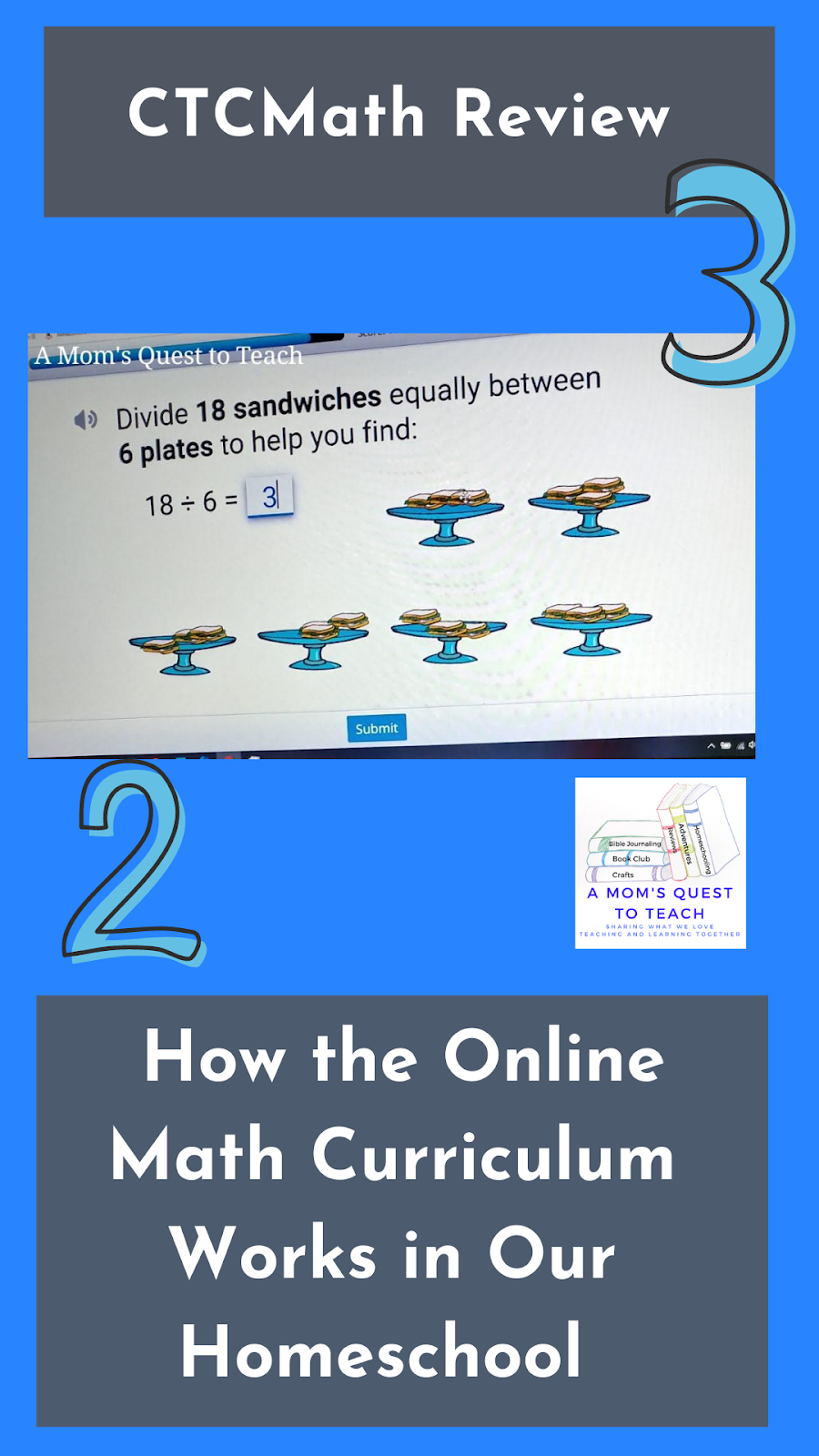

Text: CTCMath Review: How the Online Math Curriculum Works in Our Homeschool; clip art 2 & 3; screen from CTCMath
  • Students can see and hear the information 
  • There are no distractions from other students (unless their brother or sister is nearby) 
  • Your child can stop and remind the video to hear the information again 
  • Your children can use pencil and paper to work out mathematical problems 
  • With interactive questions, your children receive immediate feedback – no waiting for a worksheet, quiz, or test to be graded 
  • You can print out your child's work to review or for your homeschool portfolio 
  • If you have a question, there is a handy parent guide with helpful videos 
  • You can move your child to a different grade level or course whenever you want to
  • Your child can take diagnostic tests whenever you or they feel the need to so you can see where they stand 

How Did We Use CTCMath in our Homeschool? 


Our daughter had already completed the kindergarten level, so we continued to move along with the first-grade lessons. Some of the topics have been a bit more difficult for her (which is understandable as she is only five) so we have been working through the lessons slowly. Here is a sampling of what she has learned about the following in the first grade curriculum: 
  • Adding up to 20 
  • Subtracting up to 10 
  • Recognizing Groups
  • Doubles 
  • Introduction to Division 

United States Curriculum for 1st grade; course schedule under Number, Patterns, and Algebra

In the next few weeks, we will be taking a look at fractions, patterns, and money. I will also incorporate more of the diagnostic tests and weekly revision tasks to ensure she is understanding what she is learning. And if she is having difficulty, then we can go back to the lesson to review the topic again. We can even go back to review kindergarten topics. CTCMath allows you to move between grade levels because you have access to the entire curriculum. 

I can also print the lesson summaries so she can refer to them as she completes the questions. We can also use them to review offline. Most times, she just wants me to open the summary in a separate tab so she can reference it while she is completing her questions.

Chart on how to double numbers from CTCMath


I also really like how division was introduced to our daughter. The videos did a great job of providing multiple examples. Then the questions allowed her to work through the problems so she could really see what division means. For example, she had to move the sandwiches to different platters to create equal piles. She was physically (online) dividing them up.


Introduction to Division screen from CTCMath

Division Question - separating out sandwiches onto plates


Our younger son completed his weekly revision tasks for the first-grade curriculum at the beginning of the review. I then had him start the second-grade curriculum. In the beginning, I decided to set tasks for him to complete. I used the tasks with his older brother last year for Algebra II. You schedule them through the parent account. I quickly went through and set assignments or tasks for him as you can see below.

Tasks from CTCMath


Well...my younger son did not want to complete his assigned task. He prefers to skip around and work on which topic he wants to on that day. So far this hasn't been a problem but he will soon discover that the mathematics concepts build upon each other and he will need to go in order. And if you complete the lesson without clicking on the task, then the task is marked as incomplete. 


2nd grade math grades from CTCMath
You can see by the dates on this report, he jumped around a bit when completing lessons.


This week, I watched our younger son complete a really interesting lesson on adding three numbers. I really liked how the questions presented him with a set of numbers and he had to pick the ones that would add up to a larger number. I appreciated how this was helping him think about mathematics in a different way.

screen from CTCMath "choose 3 numbers that add to 22"


I also decided to print one of the weekly revision tasks for our son to complete offline. He completed the questions at the dining room table and then entered the answers later online. You will need to print these questions in color for some grades because the color of items in the question is sometimes important.

CTCMath Weekly Revision sheets printed out

CTCMath Weekly Revision sheet completed
I failed to change the printer margins so some of the questions were cut off when I printed the pages out.


During the school year, we will have our children complete lessons on CTCMath at least four days a week. Since we are homeschooling, sometimes those days might include a Saturday instead of a 'normal' school day. As it is the summer, I have not required them to work as often as they will in a few weeks. 

One of our children's favorite games on CTCMath is the Times Table Shoot 'Em Up game where they have to complete multiplication problems by shooting the alien ships. This is a timed game which they love playing over and over. There are also two other games – Speed Skills and Swap Pieces – that they do not play as often.

When your child completes the questions and gains 100%, the screen is filled with confetti to celebrate. A very fun way to encourage children!

CTCMath getting 100% on questions - confetti
You can see under the score, that you can generate a report so you can download the questions your child answered. 


And finally, another favorite of our children is changing the color scheme on their accounts. After each day's lessons, both kids will spend about five to ten minutes picking out which colors they want to pair together.

I highly recommend CTCMath. It is an excellent online math curriculum for your entire homeschooling family! 

Do You Want to Learn More about CTCMath? 


CTCMath logo


Please read the rest of the Homeschool Review Crew's reviews!

Homeschool Review Crew Click Here Logo

Thursday, June 18, 2020

Homeschooling Resources: Mathematics

Text: Homeschooling Resources: Math; logo of A Mom's Quest to Teach; background image of mathematics graphics

This post contains affiliate links. For more information, please see my Terms of Use and Disclosure Policy page. Thank you.

One of the subjects that many struggle with is mathematics. Whether you had trouble with the subject yourself or you came to it naturally you may wonder, "Just how will I teach math in my homeschool?" Fortunately, there are many resources from full curriculum products to products that help your children, whether you homeschool or not, practice key skills.

Full Mathematics Curriculum Choices 


text: Homeschooling Resources: Mathematics; Practice important math skills online & offline; background image of graph paperIf you prefer an online curriculum, CTCMath is an excellent choice. We received a free yearly membership to the online math curriculum for our three children as part of the Homeschool Review Crew. Our daughter has completed the kindergarten level while our younger son is finishing up the first-grade work by completing the semester reviews. Our 11th-grade son was using CTCMath for Algebra II. Each lesson is very similar in that there are short videos to teach a concept and then questions online (or offline for the older students) to be completed to show mastery of the concept. One of my favorite parts is that our children can move between courses and topics as they discover work is too easy or too difficult for them to complete. I love the flexibility of CTCMath.

Another place where homeschooling parents can turn to for full math curriculum is SchoolhouseTeachers.com. There are 29 math courses (at the time of the publication of this post) which range from full-year courses like Stretching Higher with Third Grade Math to short courses like Decimal Workshop that focus on specific skills your child will need in their homeschool career. The math courses at SchoolhouseTeachers.com range from courses with video lessons to ones with text-focused courses. So there is flexibility there, as well.

Decimal Workshop graphics for course

Help For Students 


There are numerous online math programs that can help children of all ages focus on specific math skills or just review basic mathematical concepts. Our family has been blessed with reviewing quite a few including (links to my reviews are through the name of the program):

  • Mathseeds - An online program offered through Reading Eggs with workbooks you can purchase if you prefer to work on math offline. 
  • Math Shed - An online resource that allows your children to focus upon number bonds, addition, subtraction, and more.
  • Matific Galaxy - An online resource where children work through different planets reviewing time, money, addition, subtraction, and more. Our children had access to the desktop and app version of Matific Galaxy during our review. 
  • Page A Day Math - A series of workbooks (or worksheets you print if you prefer to order the digital workbooks) that focus upon addition, subtraction, multiplication, and division depending upon which kit you purchase. The goal of Page A Day Math is to improve math fact fluency. 

Our children have enjoyed all four of the programs I mentioned above. I really like that with Mathseeds and Page A Day Math, our children can work on their math skills offline with workbooks. With both Math Shed and Matific Galaxy, our children feel like they are playing games rather than just working on building their math skills.

math worksheets and website practice


What Resources Do You Use in Your Homeschool to Teach Math? 


In addition to the resources I already highlighted, we have used material from IXL, I Know It, Channie's Neat Numbers, The Critical Thinking Co.™, and more to work on mathematics in our homeschool. There are so many options available for homeschooling families which is the beauty of homeschooling – multiple curriculum choices and quite a lot of flexibility in using them.

Wednesday, June 10, 2020

Solving Problems Using Critical Thinking: A Review of Dare to Compare Math: Beginning

A Mom's Quest to Teach logo; text: Solving Problems Using Critical Thinking: A Review of Dare to Compare Math: Beginning; background of numbers

Disclaimer: I received a FREE copy of this product through the HOMESCHOOL REVIEW CREW in exchange for my honest review. I was not required to write a positive review nor was I compensated in any other way.

Critical thinking skills are very important. It may seem a great challenge to find unique ways to help children practice those skills but this does not have to be the case. The Critical Thinking Co.™ offers a wide range of products to help homeschooling parents. From a book that can help preschoolers to second graders evaluate problems to come up with their own solutions to Vocabulary Virtuoso: PSAT-SAT Book 1 which helps students become familiar with vocabulary, there are many products available that can assist homeschooling parents as they educate their children. (We reviewed Vocabulary Virtuoso last year; read my review here.)

We used Dare to Compare Math: Beginning with our soon-to-be second-grade son. I used it as a supplement to his current homeschool math curriculum. Each day I asked him to complete three to four questions on his own. If he needed help, he either asked me or his dad. Most of the time he was able to work through the problems independently. On those where he needed help, it was mostly because we have not done much work with two-digit addition or subtraction or division.

Dare to Compare Math: Beginnings book cover

What Is Dare to Compare Math? 


The format of Dare to Compare Math takes traditional math problems where children need to complete a single calculation and incorporates two or more calculations necessary for children to come to a final answer. Children will compare scores, patterns, cost of meals, fish caught, geometric shapes, and more. The problems are non-routine but accessible.

Children will work through a number of different areas of mathematics including (those in bold are addressed in Dare to Compare Math: Beginning which we reviewed)

    Text: Solving Problems Using Critical Thinking: A Review of Dare to Compare Math: Beginning; book cover of Dare to Compare Math: Beginning; background clip art of addition, multiplication signs
  • Number operations 
  • Counting 
  • Measurement
  • Logic
  • Geometry
  • Graphing
  • Elementary algebraic reasoning
  • Patterns 
  • Fractions 
  • Rates 
  • Ratios
  • Proportional thinking 
  • Percentages 


child work on Dare to Compare Math: Beginning Workbook

A Typical Homeschool Day Using Dare to Compare Math: Beginning 


On most days, I handed over the 96-page paperback book to our son and he worked through three to four problems independently. When he was finished, I would check his work. There were very few cases where he had not worked out the solutions correctly. I did tell him that he was allowed to flip through and try different problems from among the 150 presented. For the first 20 questions or so, he completed one question after another. But then around question 25, he began skipping a few.

child working on Dare to Compare Math: Beginning workbook


If he came to ask me for help, it was very easy to help him. Since most of the questions required him to complete multiple calculations, I could show him how to complete half the problem and then he could continue it on his own. He then could take the information to complete the comparison.

Dare to Compare Math: Beginning workbook page
We worked through the top question here about the knees of cockroaches together.


And what happened when I was confused? There are hints located after the problems in the back of the book. So if I was stuck, I could turn there to give our son some pointers and tips. And finally, we could check the work completed using the solutions which followed the hints.

What Did We Think? 


I really liked that while working on the problems in the workbook, I got to see how my son thinks and solves problems. There were more than a few instances where I started to explain things and he just wrote down the answer. He definitely seems like he can more easily solve math problems in his head than I can.

In the introduction, it states, "The solution process is open-ended, allowing students to create mathematical reasoning and to decide how to quantify to formulate a conclusion" (ii). Open-ended means that our son was able to get to the answer in whichever manner he was best able to do. This can prevent difficulty in math learning (e.g., our oldest struggled in math class when he attended public school because he could not show his work the way his math teachers wanted when he intuitively would try to solve problems via another method).

The fact the solutions do not just give you an answer—but provide you with a method of how to complete the answer—is a great bonus. For example, question number 36 asks children to determine whether each animal shelter has more dogs or cats. They are then given the total number of animals and how many of those animals are dogs. The hint prints the subtraction problem needed to find the number of cats while the solution provides each subtraction problem necessary to find the answer that both Furry Town and Happy Hairy have more cats while Fuzzy Village has more dogs.

Dare to Compare Math: Beginning solutions and hint pages
We could look here for help and the answer to which shelter had more dogs or cats.


What does our son think? Our son enjoys the problems which require you to fill in the blanks (for example, _____ + 4 = 15). He said, "I just love the book." Completing questions in Dare to Compare Math: Beginning for homeschool is not a chore for our son as he enjoys answering the various questions. He thinks it would be helpful for children who need to practice addition, subtraction, geometry, and more.

I think Dare to Compare Math: Beginning would be a great addition to one's homeschooling mathematics curriculum. On those days when you need to push mathematics a little bit more, you can very easily incorporate Dare to Compare Math: Beginning into your day.

Do You Want to Know More? 


The Critical Thinking Co.™ offered the Homeschool Review Crew several different books to review. Please be sure to check out the rest of the reviews! You can also review sample pages for the various books including the one we reviewed: Dare to Compare Math: Beginnings.

The Critical Thinking Co. TM logo


Homeschool Review Crew Click Here Logo

Monday, June 8, 2020

Reinforcing Important Skills: A Review of Math Shed and Spelling Shed

text: Reinforcing Important Skills: A Review of Math Shed and Spelling Shed; A Mom's Quest to Teach logo; cloud background

Disclaimer: I received a FREE copy of this product through the HOMESCHOOL REVIEW CREW in exchange for my honest review. I was not required to write a positive review nor was I compensated in any other way.

Digital learning can be a great way to incorporate the practice of important skills such as math fact fluency and spelling. In our homeschool, when our kids can see learning as a game, they are even more excited about completing their daily tasks. Our family was given a one-year subscription to Spelling Shed and Math Shed to review in our homeschool. We used the program with our younger two children who are in kindergarten and second grade and used both the Spelling Shed and Math Shed platforms to practice different skills.

Text: Reinforcing Important Skills: A Review of Math Shed and Spelling Shed; "online spelling practice and offline activities and worksheets" images of Spelling Shed and Math shed enter screens and play screens

What is Spelling Shed? 


Spelling Shed is an online spelling platform designed by teachers with the goal of making spelling fun. While the practicing of spelling and learning new words is fun, it is also easy for adults – parents and teachers – to manage the platform. There is an entire curriculum available with the site that you can use or you can add your own spelling lists for your children. You can even assign weekly work in the Teacher Hub. 

So families (and schools) can use Spelling Shed either as a curriculum or a supplement to their own curriculum. I looked through the curriculum - which seems very thorough. There are 36 weekly spelling lists which contain one 20-30 minute lesson, resources to deliver the lesson, one spelling practice sheet, and one homework sheet. Since we already had a curriculum we were using, I put our spelling lists into Spelling Shed for our children.

Spelling shed word lists selection page
Our daughter was able to select her spelling list from this page. As you can see she has
worked on some more than others as indicated by the drone and the egg. 

What is Math Shed?


Math Shed provides number skills practice ranging from number bonds, addition, and subtraction to multiplication, division, and negative numbers. Students select which skill they wish to practice and then complete as many questions as they can correctly in 60 seconds. Just like with Spelling Shed, you can assign weekly assignments in the Teacher Hub.

Once your child is logged in and selects Math Shed, they will pick from the planets below to practice their different math skills. Once they pick a planet, they can even further narrow down the skill they wish to practice.

Math Shed selection page
What skill do you want to practice? 


Math Shed times table selection page
Be even more specific – which area in multiplication? 

How Did We Use the Programs in Our Homeschool? 


We used Spelling Shed and Math Shed in two different ways in our homeschool. On some days, both children asked if they could play the games. They enjoyed working together to answer questions, played a modified version of hangman on Spelling Shed, and wanted to collect as many honeypots as they could so they could purchase clothing, backgrounds, and accessories for their avatar.

On other days, I asked each child to spend time completing at least one activity on each program. Depending on if they were eager to go do something other than homeschooling, they spent more or less time completing multiple activities.

For each of our children, I inputted their spelling lists and assigned them tasks to work with those lists. As they worked more and more with the lists, they saw that the characters transformed from larva to drone and to worker bee. Both children liked that they could go back and work on past assignments to practice those spelling lists again. 

What Do We Think? 


I really liked that both of our children enjoyed working with Math Shed and Spelling Shed. They asked to play and sometimes I had to stop them from working on the programs. Anytime that our children willingly complete homeschooling assignments, it makes life easier.

I also enjoyed playing the bonus game, Bee Keeper, with them. It was fun to see if we could identify a variety of words. I think this also helped them think outside the box and learn how to spell new and more difficult words. (The Bee Keeper game did get harder when it was pulling from their spelling lists.)


instructions for Bee Keeper Game on Spelling Shed
One of the bonus games from Spelling Shed.

I think that playing both Spelling Shed and Math Shed have helped both of our children increase their spelling fluency and math fact fluency. When working on his other math assignments, I see our son completing addition and subtraction questions more quickly and accurately. And I think the Spelling Shed has given our daughter encouragement with her reading and writing skills.

Finished page on Spelling Shed with spelling words listed
When children complete the spelling or math, it lists the words or problems and shows if they were correct or not.

I loved that we could include our own spelling lists into Spelling Shed using the Hub Dashboard. This made it very easy to incorporate Spelling Shed into our daily homeschooling routine. It also didn't make it seem like this was just another online program that we were using. It was connected to our children's lessons.

Hub Dashboard for teachers/parents on Ed Shed


I appreciate that our children could use the keyboard to type their answers if they wished or they could use the mouse to click on each letter as they attempted to spell it. This gives them another online resource to help practice keyboarding skills along with their regular homeschool work. And you can turn music, sound effects, and the reading of letters on and off in Spelling Shed. (I love an online resource where you can silence the background music.)

Finally, I also like that there are different levels. Below you can see how the easy levels and hard levels are presented in Spelling Shed. In the easier levels, the words are presented before spelling with fewer letter choices.

showing two screens of Spelling Shed; text: on the easy level, the word is presented and then, after hitting go, our daughter has to pick the correct letters to spell the word.

Spelling Shed spelling screen to spell the word we
Spelling the word we in hard level brings in some extra letter choices.

What Do Our Kids' Think? 


Our daughter's favorite part of Spelling Shed is the spelling of words. She likes counting in Math Shed. She also said she feels clever because the spelling is getting easier for her. She said it is helping her read better because she can read more books.

Our son loves that he can make his own lists in Spelling Shed. (He spends a lot of time looking around on his homeschool online resources to figure things out and find out what he can do.) He said, "I love that you can search for lists that people have made." He also likes the extreme level in Spelling Shed. He has set up his own lists where it requires him to capitalize letters (there is a button on the screen that acts as a shift key). When I asked him about Math Shed, he said, "I like the bonds to ten (number bonds)." He does see improvement in his math fact fluency after using the different parts of Math Shed. 

If you are looking for online programs to assist your children in spelling or mathematics, I recommend you taking a closer look at Spelling Shed and Math Shed. Our son said he would recommend Math Shed to someone if they were really struggling in mathematics. He also thinks Spelling Shed could help children of all ages who have difficulty with spelling. I think Spelling Shed and/or Math Shed might be good fits for your home during the summer break or your homeschool year-round if you want to practice skills. 

Do You Want to Learn More? 


EdShed Logo

Many Homeschool Review Crew families were given the opportunity to use Math Shed and Spelling Shed in their homeschools. Please check out their reviews to see how they used them.

Homeschool Review Crew Click Here logo

Monday, June 1, 2020

Improving Math Fact Fluency: A Review of Page A Day Math

text: Improving Math Fact Fluency: A Review of Page A Day Math; logo of Page A Day Math & A Mom's Quest to Teach

Disclaimer: I received a FREE copy of this product through the HOMESCHOOL REVIEW CREW in exchange for my honest review. I was not required to write a positive review nor was I compensated in any other way.

This post contains affiliate links. For more information, please see my Terms of Use and Disclosure Policy page. Thank you.

One of the skills in mathematics that we haven't been focusing upon as much in our homeschool is math facts – and being fluent in math facts. For example, we haven't spent time reciting the addition or subtraction tables. I was thinking about how to incorporate those skills into our homeschool over the coming summer as well as how to introduce multiplication to our son when the opportunity to review products from Page a Day Math arrived. There are so many great products available from Page a Day Math that will help build math fact fluency as well as help your children work on their handwriting skills. While we used a variety of their products that we downloaded digitally, we received the Addition Starter Kit in the mail to use with our younger son.

Addition Starter Kit books from Page A Day Math

Why Is Math Fluency Important?


In order to feel confident in mathematics, students need to be fluent in math facts. When they can quickly add, subtract, multiply, and divide smaller problems, they will be able to carry that information onto more complex problems and situations. We have found good products to help our children work on math fluency. Page a Day Math provides products that make math fun and engaging in addition to helping. It is an incremental math book program where children learn new topics and continue to improve their existing math fact fluency by reviewing previous skills.

Addition Starter Kit Box


What Is Page A Day Math? 


I love the origin story behind Page a Day Math. The creator's daughter was struggling with mathematics at the age of six and her teacher said the young girl was not good at math. While other families may have accepted that statement, they did not. So, her mother made math worksheets and flashcards for her daughter, who soon caught up and did even better with daily practice.  (You can read more of the story here: Our Story.) It is so important that all children realize that they can be a math-proficient person. 

Each series of math books focuses on one specific math operation – addition, subtraction, multiplication, and division. The Pre-K Math Starter Kit is aimed at children ages 3-5 with 10 books (we used the digital version with our daughter). The Addition Starter Kit is for ages 5-7 with 10 books that have 14 days of practice per book (we used the physical set for our son). The Subtraction Starter Kit is for ages 6-8 with 13 books that contain 40 problems per day. The Multiplication Kit is for ages 6-8 with 12 books. They are perfect for first through fourth graders who have already mastered addition and subtraction fact fluency and are ready to move on to multiplication. The Division Kit is for ages 6-9 with 12 books for children who have mastered math fact fluency in addition, subtraction, and multiplication.

In addition to the Math Kits, Page a Day Math also offers Math Flashcards, Math Review Books, Handwriting Books (both print and cursive options), and stickers, temporary tattoos, and bookmarks featuring the five lovable dogs of the Math Squad - Mo, Zo, Bo, Jo, and Flo. We received a sample of the stickers, temporary tattoo, and book in our box and they are great! Our kids were very excited to see them.

stickers and bookmark from Page A Day Math
Our daughter couldn't wait to check out the stickers!

What Are We Using in Our Homeschool?


We are primarily using the Addition Start Kit, for which we received a physical copy, and the digital download of the PreK Math Starter Kit. I have also been including some of the worksheets that we were able to receive digitally:
    Text: Improving Math Fact Fluency: A Review of Page A Day Math; "daily learning involves one page a day providing the perfect balance of incremental and cumulative practice"; image of book cover and math questions
  • Meet the Math Squad! My First Counting Coloring Joke Book 
  • I Can Write My Name 
  • I Can Write in Cursive 
  • Multiplication Starter Kit 
  • Subtraction Starter Kit 
  • Adorable Adjectives 
  • Beautiful Biology 
  • Cool Chemistry 
  • Fun Physics 
  • Places and Spaces 
  • Scenic States 
  • Super Sight Words

As the Starter Kits – both physical and digital – are designed for a student to complete one page a day, we have been doing that since we received them. They are very easy to print out but I also like the books. They are smaller than a normal-sized workbook which makes them easy to hold.

inside book from Page A Day Math with ruler to show size


Most homeschooling days, our younger children start their day by completing their Page a Day worksheets. Because the pages require very little instruction from my part, they can work on them independently while I get their next activity set up or ready. They also do not take very long – maybe 10 to 15 minutes depending on how distracted they get. I have found they are also a great way to start the day because they help build confidence.

What Do We Think?


There are many things that I like about Page A Day Math:

  • The design of the physical books 
  • The variety of the materials available 
  • The inclusion of fun characters (The Math Squad) 
  • The storage system of the physical kit 
  • The ability to print multiple copies of the digital products (for when both children want to color the same picture from the My First Counting Coloring Joke Book)
  • The helpfulness of customer service 
  • The ease of using the worksheets and the physical books – I can hand them over to our children and they can work on them by themselves 

I really love the look of the Addition Starter Kit. Storage can often be a problem with homeschooling materials but not in this case. All the workbooks fit nicely in the box. I have been keeping the current workbook our son is completing in a folder with other printed pages from Page a Day Math.

Math pages inside and outside of folder
Each of our children has their own folder where I keep the printouts and the book that our son is currently working on. 


If you are using only the digital versions, you can print using just black ink like I have been doing or print in color. If you are only printing the actual pages that your children will be completing, and maybe the certificate, you will not need to use much colored ink. I appreciate a digital product that does not require lots of ink when printing. Below you can compare the difference between the certificate I printed out and the one from the book to see how much colored ink is necessary.

Page A Day certificate

Page A Day Math Certificate


Our almost second grader started using the subtraction sheets from book one of the digital Subtraction Kit while we were waiting for the Addition Starter Kit to arrive. He was a little frustrated because he found the pages that I printed out for him to be too easy. So when the Addition Starter Kit arrived, we looked through the first several books to see where he thought he should start. We did complete the assessment pages that came with the digital Subtraction Kit which indicated he needed more practice with subtraction fact fluency, so we will use Subtraction Book 3 when he finishes working through the addition books. I have noticed that he has been more quickly answering addition questions. So I believe that his math fluency is improving using the books.

Subtraction assessment math questions
One of the Subtraction assessment pages.

Even though our daughter seems to have a firm understanding of kindergarten mathematics, I wanted to use the digital Pre-K Math Starter Kit with her as she needs work on mastering her facts. She can add and subtract but I would like her to work on fluency so she can answer the questions more quickly. She also needs to practice her handwriting skills so I appreciate the way the math books are designed (so that she can practice writing her numbers) and I love the additional handwriting books that we were able to download. I have been printing out pages from I Can Write My Name to help reinforce the letters she is practicing in her other homeschooling assignments.

letter e handwriting page from Page A Day Math
I printed out the pages that matched up to the letters our daughter was working on in her other homeschooling work.

I look forward to completing the workbooks – both the digital and physical ones – with our children. As our son moves through the Addition books, he will work on counting and adding 7, 8, 9, and 10 to numbers 0-10. I also look forward to start using the multiplication digital books with our son after we have spent some time going over the multiplication flashcards that I have printed out.

multiplication cards from Page A Day Math

As our daughter works her way through the Pre-K Math Starter Kit, she will practice tracing more difficult math addition equations as well as trace even and odd numbers. We will also move from just practicing tracing letters to tracing sight words and other words using the variety of digital handwriting workbooks.

We are also slowly introducing cursive handwriting practice to our son. I like how the pages have both upper and lower case letters on them to help him practice.

Handwriting cursive practice pages from Page A Day Math

Page A Day Math worksheets

Do You Want to Learn More? 


Page A Day Math logo


There are so many great products available from Page A Day Math. Be sure to check out the rest of the reviews from the Homeschool Review Crew to see how they used the many products in their homeschool to help support math fact fluency!

Homeschool Review Crew Click Here logo