Showing posts with label Spelling. Show all posts

Wednesday, August 17, 2022

Printables for your Homeschool Classroom

A Mom's Quest to Teach: Printables for your Homeschool Classroom - Super Teacher Worksheets logo; pencil background


Disclosure: I received this complimentary product through the Homeschool Review Crew.

Resources that help us review, refresh, and expand upon our homeschooling subjects are wonderful additions to our homeschool classroom. We have been blessed with a one-year membership to Super Teacher Worksheets, which has a variety of printables for elementary students. Since it is the summertime, we are mostly using the printables to help review and expand right now, but I have plans to use several of their grade-level-specific resources during the entire year.


What are Super Teacher Worksheets? 


Super Teacher Worksheets is an online site that provides its members with over 20,000 printable PDF resources for children in Kindergarten through 5th grade. You can download as many worksheets as you need during your one-year membership. These 20,000+ printables are distributed among the following subject areas: 

  • Mathematics 
  • Reading
  • Writing
  • Phonics
  • Spelling 
  • Social Studies 
  • Science 
  • Holidays/Seasonal Activities 

And if you can't find the worksheet you are looking for...check back or create your own! 

Super Teacher Worksheets adds new resources on a regular basis, so don't forget to check back often during your membership. While many of their worksheets are Common Core-aligned, I haven't found that to make much of a difference other than the information is available for those who want it. 

If you want to make your own worksheets based on your curriculum, you can use their worksheet generator. I decided to create a crossword puzzle for our Roman history lesson to help our son remember the facts to know and the vocabulary from his first lesson. 

And many of their printables are also available with Spanish translations. 


creating a crossword using Roman history themed words and definitions


Using Printables from Super Teacher Worksheets 


One of the first things I did when my membership to Super Teacher Worksheets was renewed was to check out the seasonal printables. I love finding mathematic sheets that will help reinforce our current studies that are themed. And Super Teacher Worksheets sometimes has coloring pages or crafts that we can do with our children. 

After I perused the Holiday printables, I began looking for worksheets that would help our children in areas where they were currently struggling. One of the topics in mathematics that our son needs help with is angles, so I found the various printables relating to identifying and measuring angles and printed those out for us to work on together. 

A Mom's Quest to Teach; two photographs of math worksheets (measuring angles and completing a multiplication color sheet)


I decided to focus on grammar and spelling with our first grader in addition to the coloring sheets I printed for her. I found the Fix the Sentences collection for grades 1 through 4, where children correct the mistakes on the printable PDF worksheets. While we are using them daily, you could also use them all together rather than over the course of the week. I really like that there are different levels, so we can progress through them if our daughter is successful at the first grade level. 


Two photographs of completing Fix It Sentences worksheet with pencil holder clipart


A Mom's Quest to Teach: Printables for your Homeschool Classroom - Super Teacher Worksheets logo; two worksheets


Our Thoughts on the Printables from Super Teacher Worksheets 


One of the great features of Super Teacher Worksheets is that you have access to all the levels of worksheets at one time. You do not need to sign up for a specific grade level. So if your third-grade child is a wiz at mathematics but needs more help spelling, you could pick fourth grade math worksheets but second grade spelling worksheets. 

The worksheet generator was quite easy to use. I only needed to put in the names and facts to create our crossword puzzle. I also discovered they have a generator for classroom newsletters. This would be a neat thing to use with your homeschooled children, so they can create a newsletter for family and friends. I also like that I create as many math worksheets as I need so our children can practice addition, subtraction, and multiplication. You can make division worksheets, too. We just haven't reached that point yet in our curriculum.


Custom Classroom newsletter generator


Another neat feature that I didn't really use was the filing cabinet. You can create folders to save your favorite worksheets, and the worksheets you generate and save will be housed in your filing cabinet. I think this is a great feature if you travel and need your favorite worksheets accessible on different computers. 


Super Teacher Worksheets filing cabinet


While we have only been using Super Teacher Worksheets to supplement our current studies, there are some subjects where you could easily put together a semester or full-year curriculum from the printables on their site. I feel the most intuitive ones to use for a full-year curriculum would be spelling, reading comprehension, and perhaps science if you worked your way through the available printables.

I would recommend Super Teacher Worksheets to homeschooling families who are looking to supplement their curriculum. The printables make it very easy to help your children succeed in areas where they may be struggling. Review, refresh, and reinforce important skills with Super Teacher Worksheets.  

Please be sure to visit the Homeschool Review Crew to see how the other members of the Crew have used Super Teacher Worksheets in their homeschool classroom. 


Homeschool Review Crew Click here for more reviews graphic


Friday, October 8, 2021

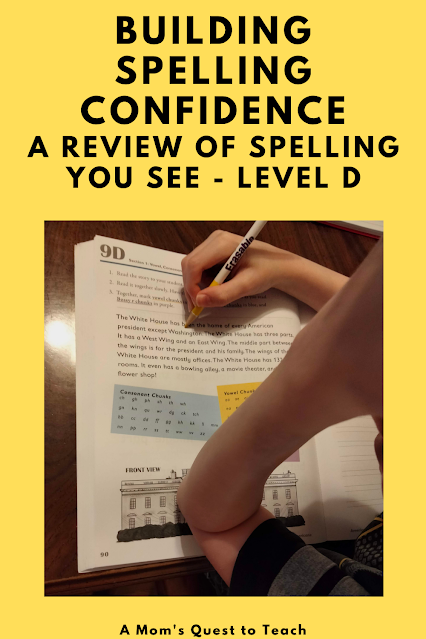
Building Spelling Confidence: A Review of Spelling You See - Level D

A Mom's Quest to Teach:  Building Spelling Confidence: A Review of Spelling You See - Level D with faded photo of the materials

I received Spelling You See - Level D at a 50% discount from Timberdoodle in exchange for my honest opinion. I was not required to write a positive review, nor was I compensated in any other way. This post contains affiliate links. For more information, please see my Terms of Use and Disclosure Policy page. Thank you.

We have tried a few different approaches to helping our younger son master spelling, from creating our own spelling lists using his current literature assignments or science units to picking words he is consistently spelling wrong in homeschool and outside homeschool assignments. Nothing seemed to be sticking with him. 

Over the summer, I researched several different options and looked at Spelling You See again. I had passed over the earlier levels because our son learned how to read and write at an early age. So even with the Readiness Guidelines that Spelling You See provides, I was unsure if I should start with levels A, B, or C. This year Level D seemed to be the perfect fit. We are studying American History. And Level D - Americana seemed to provide a challenge but also allow our son to build his spelling confidence.  

When Timberdoodle offered us the opportunity to purchase the Spelling You See - Level D curriculum at a 50% discount in exchange for a review, it seemed like the perfect time to try this spelling curriculum. And as it is part of the 2021 Third Grade Curriculum Kit at Timberdoodle, it also seemed like a great idea to pick this level for our son. 


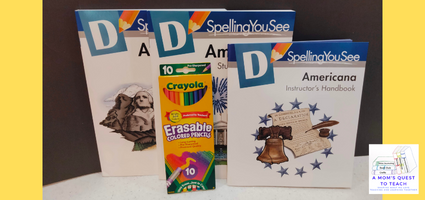
A Mom's Quest to Teach:  Building Spelling Confidence: A Review of Spelling You See - Level D - Spelling books


What Is Spelling You See? 

Spelling You See takes a multi-sensory approach to teaching spelling through writing, reading, speaking, and listening. It was invited by Dr. Karen Holinga, a former teacher, to allow students to build confidence and develop spelling skills at their own pace. There are no spelling lists. Instead, there are reading passages with everyday words for your child to practice their spelling skills. 

What Is Part of the Curriculum from Timberdoodle? 

If you purchase Spelling You See - Level D, you will receive the following items: 

  • Instructor's Handbook 
  • Student Workbook, Part 1 
  • Student Workbook, Part 2
  • Colored Pencils 

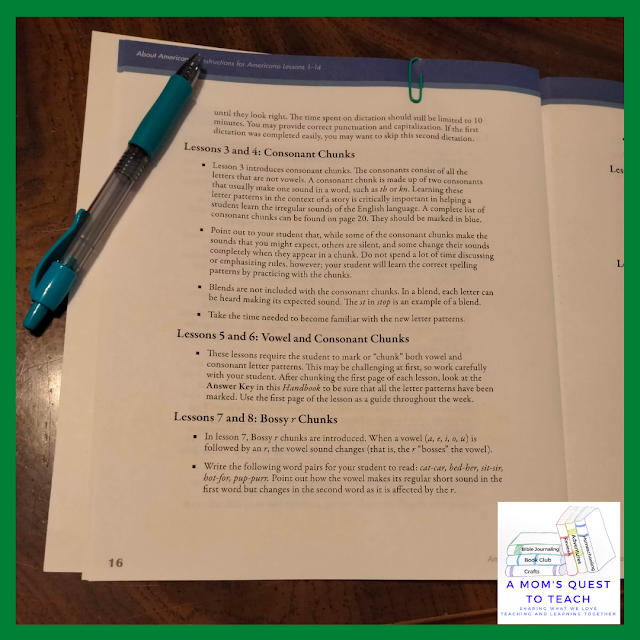
A Mom's Quest to Teach:  Building Spelling Confidence: A Review of Spelling You See - Level D  - Instructor's Manual with pen


Instructor's Handbook 


The slim 52-page Instructor's Handbook provides all the information you need to smoothly run the lessons with Spelling You See. In it, you can read about the philosophy behind Spelling You See, the five developmental stages of spelling, the sequence for Spelling You See, and general information about the level you purchased. 

After the general introduction, the Instructor's Handbook provides instructions for the lessons, which are grouped together based upon chunks: 
  • Vowels 
  • Consonants 
  • Bossy r 
  • Tricky y 
  • Endings 
  • Silent Letters 
The weekly activity guide is explained, which consists of guided reading, chunking, copywork, and two levels of dictation. The material needed for the dictation is printed separately from the answer key for the chunking. If you want to learn more, there is a glossary and bibliography, as well as access to online videos. 


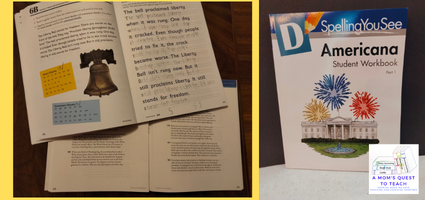
A Mom's Quest to Teach:  Building Spelling Confidence: A Review of Spelling You See - Level D  - Student Workbook with student working


Student Workbooks 


The lessons for your child are split into two workbooks – Part 1 and Part 2. Each part contains 18 lessons for a total of 36 lessons for your homeschool year. The pages are thick and colorful. Each of the paperback books has over 180 pages. Each daily lesson has two pages dedicated to it. The story is on the left-hand side, while the page for your child to write the passage is on the right. For those days when you are doing dictation, you merely cover the left-hand side.

Some of the stories included in Spelling You See - Level D are: 
  • Pilgrims arriving in the New World 
  • The story of Lewis and Clark 
  • Information about the Liberty Bell 
  • Explanation of Poor Richard's Almanac 
  • The usefulness of the buffalo 
  • The gift of the Statue of Liberty 
  • Information about the American Civil War 
  • Biographical information about Paul Revere, Abraham Lincoln, Daniel Boone, Martin Luther King, Jr., Johnny Appleseed, and more 

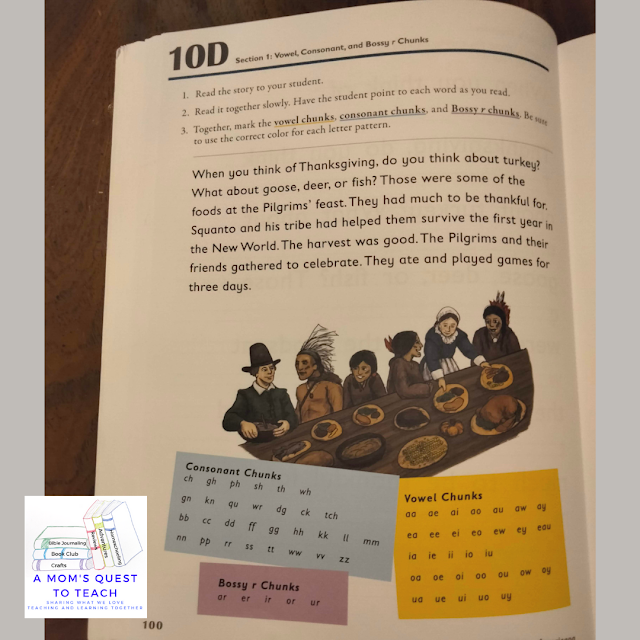
A Mom's Quest to Teach:  Building Spelling Confidence: A Review of Spelling You See - Level D - student workbook showing chunking


How We Use Spelling You See - Level D in Our Homeschool Day 


We work on completing our spelling assignments during the week. So, Monday through Friday, our son completes lessons A through E. If we miss a day, we sometimes complete it during the weekend even though the book does say if you don't finish, you may go ahead to the next set of lessons the next week. So if we didn't finish 9E, we could jump to 10A on Monday. I usually only skip one day of dictation as I feel it is important to practice spelling the words without seeing them at least once. 

Sometimes, we complete the spelling lessons first thing in our homeschool day, as our son likes to get it out of the way. Other times, I need to save it for the end of the homeschool day because he needs me to work through the lessons. But no matter what time we complete our spelling lessons, they have become an integral part of our homeschool day.

Day One starts with reading the story and working together to find all the chunks. These can be vowel chunks (aa, ae, ai, ea, oa, etc.), consonant chunks (ch, gh, wr, etc.), bossy r chunks (ar, er, etc.), or others. These are marked in different colors. The chunking provides hands-on experience with irregular letter patterns in English. After the chunking is completed, our son copies the story and chunks it again. 

Day Two and Three follow the same pattern. I usually help him less each day as our son looks for the chunks. He then copies the story again. The copywork should be timed to ten minutes. 

On the last two days of the week, we read the story, mark chunks, and then I dictate the story for our son to write down. On the first dictation day, I assist him with his spelling. I ask him if he is sure about a word or if he wants to try writing it differently to see if that spelling is correct. On the second day, I do not provide much assistance as he writes the story. 


A Mom's Quest to Teach:  Building Spelling Confidence: A Review of Spelling You See - Level D - student working in student workbook


What We Think 


I have mixed feelings about Spelling You See - Level D. I love the fact that it includes nonfiction stories about American history and culture. The tie-in to our history curriculum is terrific. The stories provide a way to not only focus on vocabulary but also to introduce new facts and review ideas with our son. 

I appreciate the philosophy – that children work through five stages of development and not focus upon memorization of spelling words. We tried that route, and it didn't seem to work for our son. As we are only nine weeks into Spelling You See, it is hard to see how much progress our son has made. There are some weeks where he corrects mistakes from dictation day 1 to the second dictation day, but then there are a few words he continues spelling wrong, like British. 

There is not a lot of prep work required on my part as a parent. I just need to review a few paragraphs for the lessons as we progress through the different chunking lessons. I also like that there is one Instructor's Guide but two Student Workbooks. It makes it easier to keep track of the materials. 


A Mom's Quest to Teach:  Building Spelling Confidence: A Review of Spelling You See - Level D  - student workbooks


I asked our son his feelings about the curriculum, and here are his thoughts: 

Q. Is it difficult? Too easy? Too hard? 
A. It can get a little difficult once you are starting a new story or part. The first day can be hard as the new words are introduced. The dictation days are also hard. 

Q. Do you think it is helping you with your spelling? 
A. It may not be helping with spelling, but it is helping me find the chunks. (He is finding the vowel, consonant, and other chunks in his other homeschool assignments. Whether he realizes it or not, I think this is helping him with his spelling.)

Q. What is your favorite part about the curriculum? 
A. I like all the different colorful parts where I have to chunk more than one thing. I am looking forward to reading about Thanksgiving because it will remind me of the best food ever – turkey. 

Will we use Spelling You See - Level E next year? I am not sure yet. I don't think I have found anything I want to use instead of Spelling You See, but I think we need to evaluate the curriculum around the 30-week lesson with our son. Would I recommend Spelling You See - Level D? Yes, I would recommend it. I think it might be easier if you were able to start with the lower levels, but I think that our homeschool year will be enriched by the use of this curriculum. 

Looking for More Homeschool Resources from Timberdoodle? 


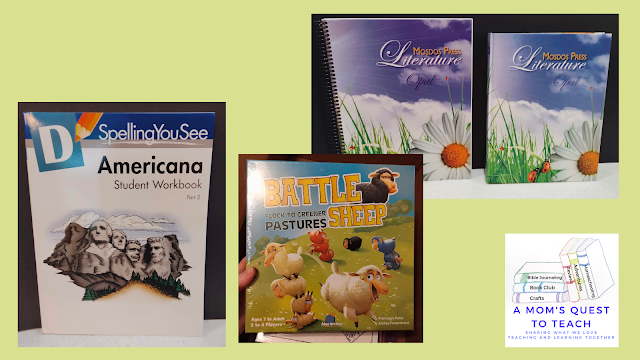
We've had the opportunity to review several materials from Timberdoodle, including a literature curriculum, fun games like Battle Sheep, and a unique puzzle


A Mom's Quest to Teach:  Building Spelling Confidence: A Review of Spelling You See - Level D  - spelling workbook, Battle Sheep Game, Mosdos Lit books


Monday, June 8, 2020

Reinforcing Important Skills: A Review of Math Shed and Spelling Shed

text: Reinforcing Important Skills: A Review of Math Shed and Spelling Shed; A Mom's Quest to Teach logo; cloud background

Disclaimer: I received a FREE copy of this product through the HOMESCHOOL REVIEW CREW in exchange for my honest review. I was not required to write a positive review nor was I compensated in any other way.

Digital learning can be a great way to incorporate the practice of important skills such as math fact fluency and spelling. In our homeschool, when our kids can see learning as a game, they are even more excited about completing their daily tasks. Our family was given a one-year subscription to Spelling Shed and Math Shed to review in our homeschool. We used the program with our younger two children who are in kindergarten and second grade and used both the Spelling Shed and Math Shed platforms to practice different skills.

Text: Reinforcing Important Skills: A Review of Math Shed and Spelling Shed; "online spelling practice and offline activities and worksheets" images of Spelling Shed and Math shed enter screens and play screens

What is Spelling Shed? 


Spelling Shed is an online spelling platform designed by teachers with the goal of making spelling fun. While the practicing of spelling and learning new words is fun, it is also easy for adults – parents and teachers – to manage the platform. There is an entire curriculum available with the site that you can use or you can add your own spelling lists for your children. You can even assign weekly work in the Teacher Hub. 

So families (and schools) can use Spelling Shed either as a curriculum or a supplement to their own curriculum. I looked through the curriculum - which seems very thorough. There are 36 weekly spelling lists which contain one 20-30 minute lesson, resources to deliver the lesson, one spelling practice sheet, and one homework sheet. Since we already had a curriculum we were using, I put our spelling lists into Spelling Shed for our children.

Spelling shed word lists selection page
Our daughter was able to select her spelling list from this page. As you can see she has
worked on some more than others as indicated by the drone and the egg. 

What is Math Shed?


Math Shed provides number skills practice ranging from number bonds, addition, and subtraction to multiplication, division, and negative numbers. Students select which skill they wish to practice and then complete as many questions as they can correctly in 60 seconds. Just like with Spelling Shed, you can assign weekly assignments in the Teacher Hub.

Once your child is logged in and selects Math Shed, they will pick from the planets below to practice their different math skills. Once they pick a planet, they can even further narrow down the skill they wish to practice.

Math Shed selection page
What skill do you want to practice? 


Math Shed times table selection page
Be even more specific – which area in multiplication? 

How Did We Use the Programs in Our Homeschool? 


We used Spelling Shed and Math Shed in two different ways in our homeschool. On some days, both children asked if they could play the games. They enjoyed working together to answer questions, played a modified version of hangman on Spelling Shed, and wanted to collect as many honeypots as they could so they could purchase clothing, backgrounds, and accessories for their avatar.

On other days, I asked each child to spend time completing at least one activity on each program. Depending on if they were eager to go do something other than homeschooling, they spent more or less time completing multiple activities.

For each of our children, I inputted their spelling lists and assigned them tasks to work with those lists. As they worked more and more with the lists, they saw that the characters transformed from larva to drone and to worker bee. Both children liked that they could go back and work on past assignments to practice those spelling lists again. 

What Do We Think? 


I really liked that both of our children enjoyed working with Math Shed and Spelling Shed. They asked to play and sometimes I had to stop them from working on the programs. Anytime that our children willingly complete homeschooling assignments, it makes life easier.

I also enjoyed playing the bonus game, Bee Keeper, with them. It was fun to see if we could identify a variety of words. I think this also helped them think outside the box and learn how to spell new and more difficult words. (The Bee Keeper game did get harder when it was pulling from their spelling lists.)


instructions for Bee Keeper Game on Spelling Shed
One of the bonus games from Spelling Shed.

I think that playing both Spelling Shed and Math Shed have helped both of our children increase their spelling fluency and math fact fluency. When working on his other math assignments, I see our son completing addition and subtraction questions more quickly and accurately. And I think the Spelling Shed has given our daughter encouragement with her reading and writing skills.

Finished page on Spelling Shed with spelling words listed
When children complete the spelling or math, it lists the words or problems and shows if they were correct or not.

I loved that we could include our own spelling lists into Spelling Shed using the Hub Dashboard. This made it very easy to incorporate Spelling Shed into our daily homeschooling routine. It also didn't make it seem like this was just another online program that we were using. It was connected to our children's lessons.

Hub Dashboard for teachers/parents on Ed Shed


I appreciate that our children could use the keyboard to type their answers if they wished or they could use the mouse to click on each letter as they attempted to spell it. This gives them another online resource to help practice keyboarding skills along with their regular homeschool work. And you can turn music, sound effects, and the reading of letters on and off in Spelling Shed. (I love an online resource where you can silence the background music.)

Finally, I also like that there are different levels. Below you can see how the easy levels and hard levels are presented in Spelling Shed. In the easier levels, the words are presented before spelling with fewer letter choices.

showing two screens of Spelling Shed; text: on the easy level, the word is presented and then, after hitting go, our daughter has to pick the correct letters to spell the word.

Spelling Shed spelling screen to spell the word we
Spelling the word we in hard level brings in some extra letter choices.

What Do Our Kids' Think? 


Our daughter's favorite part of Spelling Shed is the spelling of words. She likes counting in Math Shed. She also said she feels clever because the spelling is getting easier for her. She said it is helping her read better because she can read more books.

Our son loves that he can make his own lists in Spelling Shed. (He spends a lot of time looking around on his homeschool online resources to figure things out and find out what he can do.) He said, "I love that you can search for lists that people have made." He also likes the extreme level in Spelling Shed. He has set up his own lists where it requires him to capitalize letters (there is a button on the screen that acts as a shift key). When I asked him about Math Shed, he said, "I like the bonds to ten (number bonds)." He does see improvement in his math fact fluency after using the different parts of Math Shed. 

If you are looking for online programs to assist your children in spelling or mathematics, I recommend you taking a closer look at Spelling Shed and Math Shed. Our son said he would recommend Math Shed to someone if they were really struggling in mathematics. He also thinks Spelling Shed could help children of all ages who have difficulty with spelling. I think Spelling Shed and/or Math Shed might be good fits for your home during the summer break or your homeschool year-round if you want to practice skills. 

Do You Want to Learn More? 


EdShed Logo

Many Homeschool Review Crew families were given the opportunity to use Math Shed and Spelling Shed in their homeschools. Please check out their reviews to see how they used them.

Homeschool Review Crew Click Here logo

Thursday, August 15, 2019

A Family Approach to Spelling: A Review of Spelling and Vocabulary Family Textbook from Love at Home Education


This post contains affiliate links. For more information, please see my Terms of Use and Disclosure Policy page. Thank you.

For many homeschooling families, there are multiple age levels who need to be taught together. Finding materials that can meet the needs of kindergarten to high school students has been made simpler with Love at Home Education. There are a variety of products from short unit studies to fuller curriculum that will enable you to teach your youngest and oldest children together. In this review, I will be discussing the K-12 Vocabulary and Spelling Curriculum from Love at Home Education.


What Do You Get?


You can choose from a PDF or a combination of both Print and PDF copies. We received the 79-page full color PDF for the purposes of this review.


Monthly Themes


  • Neighborhood
  • Space
  • Community
  • Nature
  • World
  • Family
  • Weather
  • Transportation
  • Animals 
When you receive your copy of the K-12 Vocabulary and Spelling Curriculum Family Textbook you will need to decide at which level your children will be working. You will be able to choose from four levels. There are three suggestions for games and activities that will help your homeschooling children with writing skills as well as learning vocabulary and practicing spelling.  And then there are six suggestions for active games and activities to help with learning vocabulary and spelling. You will need to prepare for these games and activities prior to your lesson.

Each month consists of four weeks of weekly stories, suggestion for weekly study, games and study help ideas, spelling words, and vocabulary words. If you choose to do the games and study help idea suggestions, you will need to prepare your own pre-test and test, word searches, fill-in-the blanks and other materials to fill out your weekly studies.


How We Used the Spelling and Vocabulary Family Textbook


Summer time for us means a lighter workload for our teen but we still continue with our younger two children. The Textbook suggests a five-day schedule for the entire family starting with reading the weekly story and administering pre-tests to introducing chosen vocabulary and working on spelling activities and games. Finally, there will be a review and you can administer a spelling test on day five if you wish.

We skipped past the Neighborhood theme to the Space theme since our younger two children are studying astronomy. The first week's story asks you to imagine you are traveling through space and use some of the vocabulary that will be introduced such as oxygen, solar system, comet, and asteroid. 

The vocabulary words are broken up into four categories: 
  1. Novice
  2. Competent
  3. Advanced
  4. Proficient 
The Textbook provides you with information to determine where your children fall so you know which words to focus upon each week. Our two younger children will be looking at mostly the novice words but we will be discussing some of the others as they fit into their science curriculum. For example, later on in the year they will be talking about asteroids, comets, and constellations but these words fall in the competent and proficient categories. And we have already talked about satellites which falls in the advanced category. So, as with most homeschooling curriculum and tools, you can adapt this for your own families' needs.


As we are using this with two younger children, I wrote the words on index cards for them to practice reading and our small white board. This would allow us the opportunity for our six-year-old to copy the words to practice penmanship and spelling.


Do you want to learn more about Love at Home Education?


"Love at Home Education – A Dinner-table friendly, all-inclusive family curriculum; that your high schooler, kindergartner can learn together on their own levels."

Love at Home Education offers both secular and faith-based curriculum for preschool to 12th grade so you will be sure to find something that meets the needs of your homeschooling family.


If you want to see a sample of the K-12 Vocabulary and Spelling Curriculum, check out the gallery at Love at Home Education. You will be able to see the first month's words and recommended activities.

In the past we have reviewed Natural Disasters K-12 Unit Study, Thomas Jefferson Unit Study (K-6), and George Washington Unit Study (K-6) from Love at Home Education.


Monday, July 1, 2019

Improving Children's Reading via Online Programs: A Review of Dyslexia Gold


Our three children have been using the various programs available through Dyslexia Gold for the past several weeks. Dyslexia Gold offers several different options for schools and families. We were provided with a family license and a lifetime subscription to Dyslexia Gold Full Bundle for this review so all three of our children have been able to work on specific areas to improve their reading.

What is Dyslexia Gold? 


Dyslexia Gold helps children who are struggling with reading—whether or not they have Dyslexia. There are several programs that are designed to improve your child's reading. According to Dyslexia Gold there are four skills needed for reading:

  1. Eye control
  2. Phonological awareness
  3. Phonics
  4. Spelling
Two of the programs focus upon building these skills. Because children who are poor readers and/or are dyslexic often have trouble focusing both eyes on the same point and tracking across the page, Engaging Eyes was designed with 8 easy games. Tracking is not something that is tested at a regular vision test so it can often be missed. By regularly playing vision games, children can build their eye muscles and work on not skipping letters, words, or lines and more. 

In order to work on phonological awareness, Dyslexia Gold offers Fluency Builder which helps recognize that words have more than one sound. The example provided on the Dyslexia Gold site is that of the word 'goat.' It has three sounds 'g-oa-t' but often struggling readers do not recognize this fact. So in Fluency Builder, children practice sounding out words in numerous ways to build these skills. (Please see the screenshots below.) 


In spelling the words, each sound is on its own card. After the correct cards are placed, the sound is repeated out loud
by the program. When the whole word is spelled correctly, the word is said out loud.


The third online program is Spelling Tutor which improves spelling of 1,000 of the most common words. Spelling Tutor requires students to have a pencil and paper to write down sentences dictated to them. They then work on writing and rewriting the words they have spelled wrong. It is completely tailored to your child as they correct the words they have spelled wrong. For example, our six-year-old has used Spelling Tutor and has had trouble spelling 'phone,' 'called,' and other words. He has written them on numerous days and the spelling of the words are repeated on a set schedule. Once he has correctly spelled the word 7 times in a row over 21 days, he is deemed to be able to spell it correctly. 


Here our son is asked to write the word "would" as this is one of the words he previously spelled incorrectly.

The fourth program is Times Table Tutor. It teaches up to 12 x 12 at your child's own pace without timing or competition. The multiplication table is taught in three ways: concrete, pictorial, and abstract. Each session is rather long as it reviews the entire times table multiple times requesting that the child work faster and faster.


Note: Dyslexia Gold is a British-based company, so be aware that there are different spelling versions available (UK and American) as well as different pronunciations (English, American, Scottish, and Australian). 


How Did We Use Dyslexia Gold? 


Our three children were each instructed to work on different parts based upon their needs and age. Our teen primarily worked on Engaging Eyes, our four-year-old (the program is recommended ages 5+) worked on Fluency Builder, and our six-year-old primarily focused upon Fluency Builder but has also spent time working on Spelling Tutor and Times Table Tutor. Both of our younger children have spent time using Engaging Eyes.

Our Teen 


Our teen suffered a concussion in November 2017 during an ice hockey game and as part of clearing him to rejoin his hockey team, we needed to see a  vision therapist/optometrist for a special vision test. Through some of the vision tests, we were told he was having trouble tracking while reading. The doctor recommended more reading (30 minute sustained reading) or additional (and very expensive) visits. I saw the opportunity to review Dyslexia Gold, specifically Engaging Eyes, as a perfect way for our teen to work on tracking.

When our teen first started using Engaging Eyes, I frequently checked in with him to make sure Engaging Eyes was not causing headaches or vision problems. He never seemed to have any headaches from doing the vision training. The only problem he has run across is that sometimes when looking away from the screen during Target Practice, he finds his eyes would lose focus and he had trouble being able to hit the targets. This has happened less and less as time as progressed.

I also asked him if he felt there was any improvement in his vision. Without a trip to a vision therapist we can't know for sure but he does feel that there is an improvement. It is hard to quantify but things are a bit easier for him than before starting Engaging Eyes. He finds reading to be an easier task.


This is the Engaging Eyes report children see at the end of the day's activity. 


Our Six-Year-Old 


In reviewing Dyslexia Gold, I wished our six-year-old son to work on improving his reading as well introduce him to spelling and multiplication (mostly because he wanted to see what the Times Table Tutor was like after his older brother checked it out). He did spend the majority of the review period working on the lessons in Fluency Builder with several spelling lessons and multiplication lessons spread throughout the time. 

I find that Fluency Builder has greatly helped our younger son read more fluently out loud. Part of the lessons for him have been reading a non-fiction story aloud twice for fluency and timing for words per minute. I have noticed, sitting with him, that he is reading more clearly. 

We focused upon Fluency Builder with our younger son because the first spelling lesson with Spelling Tutor left him frustrated and in tears, so we took a break from it. I had no problems taking a break since this was his first experience with trying to spell words all by himself. We have now worked through several more lessons and he understands what is expected of him and can work pretty much independently. 


In addition to writing the sentences and words on paper, our son also typed the words on the computer.

I am really happy that what he is learning is being retained. The information our son read during Fluency Builder also stuck with him. For example, while we were talking about galaxies and space during lunch, he shared what he learned about reading about Astronauts on Fluency Builder.

At the end of reading the passage twice, our son answered three multiple choice questions.


There has been an improvement in reading speed for our younger son. He went from 110 words per minute in mid-April to 174 words per minute in late May. He will be tested again in mid-July.


Our six-year-old has had trouble completing the Target Practice with Engaging Eyes. He has trouble focusing upon the targets and has seemed to stall and not made much more progress. He has worked on using Whack an Alien just like his sister. We will revisit Engaging Eyes again in the near future with both of them.

Using the 3D glasses for the Target Practice in Engaging Eyes.

Our Daughter 


Even though our four-year-old is just one year shy of the recommended age, I saw her using Fluency Builder as the perfect opportunity to teach her reading. She has been wanting to learn how to read for almost a year but as her style of learning is very different than her brother's, I thought perhaps this program would help her build strong skills. 


During Fluency Builder she works through several different types of activities: 
  • Hearing sounds
  • Building words
  • Sorting by sound

Sometimes words would be sorted by sound and sometimes by spelling.

  • Finding words
  • Swapping letters
  • Reading speed (as our daughter only knows letters, she is not tested on this each lesson) 

Our daughter is reading words and sentences now. Even before we moved beyond some of the early lessons on Fluency Builder, she was recognizing and reading words. She is currently on level 37 of 50 of the easy level. As she completes more and more of the recaps, she seems to have an even better grasp of the words and sounds. 


My Thoughts 


Overall, I have been very happy with how the programs offered by Dyslexia Gold have fit into our homeschool. I feel that all three of our children will be stronger readers for having used the online programs. However I do have a few thoughts based upon some things that we have come across since April.

As Dyslexia Gold is an online program from the United Kingdom, we did have some problems with pronunciation of words and images used that confused our children (chips aka French fries, football aka soccer ball, torch aka flashlight, rugby player). Even with changing the pronunciation to American there were times that things were hard to understand based upon it being a computer program reading the words and saying sounds aloud.


We also had trouble with one of the Fluency Builder activities because we could not always understand the two words being said. In this activity, two words would be said (such as dad and did) and you would be asked which sound (first, second, or third) changed. In some of instances, the words said were difficult to hear (to make out the distinct differences). Fortunately, this activity was not part of every lesson.


Our younger children do not always like repeating exercises a second time during Fluency Builder. For example, when completing finding words, they are asked to complete each set twice. While I understand the importance of repeating the exercise, this often elicited groans from them.

Finding the words was one of the activities that was often repeated twice.

Sometimes during this activity, words would not disappear even if they had already been found and clicked.
This led to confusion for both of our younger children at times.

I do wish there was a bit more information in the reports and that I could find all of my children's information together rather than having to log in for each one separately. I could also see the reports presented at the end of each lesson as being discouraging for some children.

There were some days when our son or daughter would finish with very low percentages.
For some children, I could see them reacting negatively to this information.


Even though we have had few hiccups and difficulties with Dyslexia Gold, our family will continue to use the programs for each child that work best for them. We will probably hold off on using Times Table Tutor for a while for our two younger children but we will continue to work with Fluency Builder with both younger children. And our teen will continue to use the Engaging Eyes program as part of his regular homeschooling regime.

I would recommend you check out Dyslexia Gold if you have a struggling reader in your home. 

Want to Learn More about Dyslexia Gold? 


Would you like to see how other members of the Crew used Dyslexia Gold in their homeschool? Please be sure to visit to read their reviews