This post contains affiliate links. For more information please see my Terms of Use and Disclosure Policy page. Thank you.
In this week's Blogging through the Alphabet, I share information about one of my favorite places: Gettysburg. For the sake of this post, I will be writing a brief history of the battle that occurred there. In future posts, I hope to share information about things to do in and around Gettysburg and maybe even detail one soldier's experiences from his enlistment to his death on July 2, 1863.

The Battle of Gettysburg is often seen as the turning point of the American Civil War. The clash at this small northern town took place after a lengthy campaign in June that led to the Confederate's last invasion on northern soil. Prior to the battle, President Lincoln had named George Gordon Meade the head of the Army of the Potomac on June 27, 1863 – replacing General Joseph Hooker.
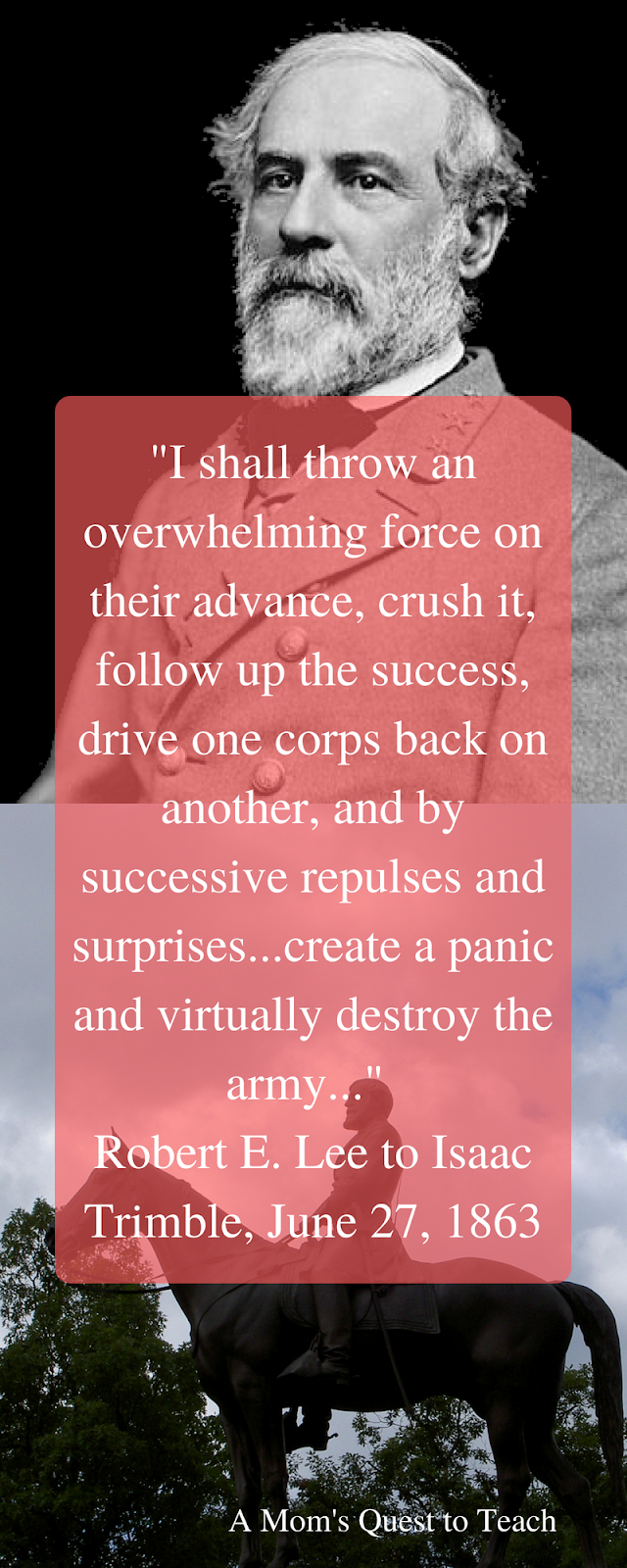
The Confederate General Robert E. Lee had selected an area west of Gettysburg as where he wished to meet the Federals on the battlefield and he wanted his entire army back together. As often happens in life, plans would change because part of the Confederate Third Corps ran into Federal Calvary troops under John Buford. A full-scale battle ensued and the Confederate troops were joined by General Richard Ewell's Second Corps while the First Corps and the Eleventh Corps of the Union army faced them.
Buford's troops were armed with breech-loading carbines so they were able to fire 20 shots per minute which helped them till additional Union troops could arrive. General John Reynolds' First Corps helped bring the Confederate assault to standstill.
The Federal troops were driven back through the town to the high ground of the south – Cemetery Hill and East Cemetery Hill. Lee, hearing that more of Meade's men would be arriving, wanted to capture Cemetery Hill and pressed Ewell to capture the Hill. Unfortunately, Ewell and his men were in no position to follow through on Lee's orders. The Confederate troops were disorganized and facing Federal snipers who even hit Ewell's wooden leg (he had lost it at the Second Battle of Manassas).
Even though the Union army had put up a great defense, the First Corps lost half of its number to casualties on July 1, 1863. The Iron Brigade, which was known for their black hats and hard-fighting, lost 1,200 out of their 1,800 men on July 1. Another great loss for the Federals occurred on July 1, when – shortly after arriving on the battlefield – General Reynolds was killed by a sharpshooter.
During the night, Meade arrived on the battlefield. So did Confederate General James Longstreet's troops. The Union had a strong defensive position running from Culp's Hill and Cemetery Hill towards Cemetery Ridge. The Confederates were parallel to the Union line extending southward down Seminary Ridge.

Lee wanted to make an early attack on the 2nd day but Longstreet did not agree that they should. So, Longstreet delayed putting them in position till late afternoon. He was in favor of a defensive positioning like that at Fredericksburg. Longstreet had wanted to take the whole battle to a new position south of Gettysburg but Lee did not want to do this. (Longstreet would be blamed for the loss of the battle due to his failure to move quickly and his disagreement with Lee.)
Longstreet would not have his men ready to move until 4 pm when they were met with a surprise from two divisions of Union Third Corps commanded by General Daniel Sickles. He had moved his men to a new line (in front of the rest of the Union army) without authorization. They were positioned in a peach orchard, wheat field, and an area of boulders known as "Devil's Den." Longstreet's men were blocked but Sickles' men were in great danger.
After 4 pm on July 2, 1863, the Confederates launched their attack toward's Devil's Den and the two rocky hills – Big Round Top and Little Round Top. Fighting continued hand-to-hand among the boulders and soon 500 Alabamians scaled Big Round Top. They soon turned to take Little Round Top, which was key to the entire Union position. If it was taken, then the Confederates would be able to use artillery on the entire Union line.
General Gouverner K. Warren saw the danger and rushed Union troops to defend Little Round Top. The fighting moved up and down the rocky hill but the Federals pushed the Confederates back at bayonet point, maintaining control of the Little Round Top. This was partly due to Colonel Joshua L. Chamberlain who found his men lacking in ammunition, he ordered his men to fix bayonets and charge down the hill. The Alabamians surrendered to the men from the 20th Maine.
While the defense of Little Round top was occurring, Confederates swept through the Wheatfield and Peach Orchard. General Sickles lost his right leg and was unable to rally his troops. The Federals retreated to Cemetery Ridge.
On the evening of July 2, 1863, Meade met with his commanders and asked their opinion about whether they should withdraw, hold, or attack. They all agreed to stay and fight the Confederates. Meade told General John Gibbon – whose division was in the center of the Union line – to be prepared. From the Confederate headquarters, Lee made the decision to strike at the center of Meade's line.
On July 3, 1863, the major assault took place against the center of the Union line on Cemetery Ridge. 140 Confederate artillery pieces would be moved into position to fire upon the grove of trees that marked the center of the Union line on Cemetery Ridge. At 1:07 pm two cannons fired, followed by the rest of the Confederate guns. The Union returned their own fire and the sides continued this for nearly two hours. The artillery duel of almost 300 guns could be heard as far away as Pittsburgh.
Finally, the Union fire slowed and stopped as General Henry Hunt wanted the gun tubes to cool to prepare for the Rebel attack that he believed was imminent. Unfortunately for the Confederates, they interpreted this as a sign that the Union artillery had withdrawn.
At this lull in cannon fire, General George Pickett asked Longstreet if he should advance. With an affirmative nod, Pickett ordered his men to advance. 12,000 to 14,000 men would advance across the field to face the Union artillery. The guns on top of Cemetery Hill and Little Round Top took out as many as a dozen Confederate soldiers at a time. This ill-fated attack would become known as Pickett's Charge. It was a complete failure with 7,000 Confederate casualties. Most of the Confederate field officers and many of the brigadier generals were casualties. General Pickett returned to Lee with tears saying, "General Lee, I have no division now." In half an hour, the Army of Northern Virginia – the Confederate Army – was crippled.
Both sides wondered if the Federals would counter-attack. There would be no counter-attack by Meade. He had won the defensive battle. He did not want to lose an offensive one. He would be slow to pursue Lee as the Confederate army retreated back into Maryland because the Union suffered their own great number of casualties. (Meade has been criticized for his lack of counter-attack.)
The casualties were immense:
- Confederate Casualties: 25,000-28,000
- Union Casualties: 20,000-23,000
The significance of the Battle of Gettysburg and then the victory at Vicksburg (July 4, 1863) were just as important. These two events were the turning points of the American Civil War. A national cemetery would be dedicated on November 19, 1863 in Gettysburg and President Lincoln would give one of his most famous speeches on the occasion. To this day, the town of Gettysburg continues to draw people who wish to pay their respect to the fallen soldiers of the Civil War as well as those who wish to learn more about America's past.
Resources and References
Read about General Lewis Armistead at
American Battlefield Trust.
Read more about Colonel Joshua L. Chamberlain at the
American Battlefield Trust and
National Park Service.
Gettysburg National Military Park
I linked up with the following blog(s):


 The Battle of Gettysburg is often seen as the turning point of the American Civil War. The clash at this small northern town took place after a lengthy campaign in June that led to the Confederate's last invasion on northern soil. Prior to the battle, President Lincoln had named George Gordon Meade the head of the Army of the Potomac on June 27, 1863 – replacing General Joseph Hooker.
 Lee wanted to make an early attack on the 2nd day but Longstreet did not agree that they should. So, Longstreet delayed putting them in position till late afternoon. He was in favor of a defensive positioning like that at Fredericksburg. Longstreet had wanted to take the whole battle to a new position south of Gettysburg but Lee did not want to do this. (Longstreet would be blamed for the loss of the battle due to his failure to move quickly and his disagreement with Lee.)