Showing posts with label Autumn. Show all posts

Friday, November 3, 2023

Learning Year Round: Autumn Homeschool Plans

A Mom's Quest to Teach: Learning Year Round: Autumn Homeschool Plans leaf clipart

This post contains affiliate links. Please see my Terms of Use and Disclosure Policy page for more information. Thank you.

How do you homeschool in the autumn? In about half the world, the temperature is dropping, and homeschooling outdoors is becoming more difficult. The cooler weather might bring sneezing due to seasonal allergies or rainy days. On the plus side, leaves changing and animals preparing for the winter allow our children new things to study. 


Homeschool Plans Outdoors 

Leaves falling brings a new way to study trees. It might be easier to identify specific leaves and trees when you can easily hold the leaf in your hand. Your children can also collect leaves without having to pull any off the trees! 

Two of my favorite courses at SchoolhouseTeachers.com offer options for studying trees: 

  • Let's Do Science Outside
  • Let's Do Art Outside 
In Let's Do Science Outside, there is a Tree ID Activity and a Tree Tally Chart, which are perfect for early elementary-aged children. For even more ideas about how to use trees and leaves in your homeschool lessons, Let's Do Art Outside offers activities such as 'how to make a leaf owl," "playdough leaf prints," and more. 

If your children collect a lot of leaves, there are numerous craft possibilities. From creating a leaf-themed turkey to making a letter craft, the options are endless. As long as the leaves aren't too brittle, you can even use them for painting. 


Working as a Family 

The change in seasons offers a time for children to learn more about what it takes to care for their home and property. Have them work alongside you as you rake leaves, put away summer toys and tools, and prepare your home for the winter. They will learn valuable skills as well as enjoy the time spent with their parents. 

Autumn homeschool plans can also include harvesting the last of the garden's bounty and preparing the ground for the next season. Pick those last pumpkins or other crops and plan out recipes to use up the last of the harvest. Or learn about canning and preserving food as a family. There are so many lessons we can teach by working together as a family. 

A Mom's Quest to Teach: Learning Year Round: Autumn Homeschool Plans; leaf clip art; owl craft


Learning Year Round About Animals 


The autumn season also allows you to focus on different animals with your family. Depending upon where you live, you might be able to track the migration of birds or how mammals in your area prepare for the winter. Read about hibernation, migration, and more to study how animals adapt to the seasonal change. 

For your little ones, have fun creating a bear craft or an owl craft while you study those animals. Or add some simple toys to their collection for imaginary play. The ideas are only limited by how much time you want to spend on studying animals and following your children's interests. 

Reading Books 

Don't forget to include books in your autumn homeschool plans! We've shared a few favorites in past years, and we are always looking out for new ones. If you have any, please share in the comments. 

Monday, October 26, 2020

Book Club: Children's Autumn-Themed Books

Text: Book Club: Children's Autumn-Themed Books; background of leaves; logo of A Mom's Quest to Teach

This post contains affiliate links. For more information, please see my Terms of Use and Disclosure Policy page. Thank you.

A short while ago, I shared some of our favorite Halloween-themed books. What if you don't celebrate Halloween? There are still plenty of great books that you can read during the months of Autumn with your children. I did a quick search of our library's collection and discovered more than we would be able to check out at one time! How exciting to have new books to read in our homeschool. 


What New Autumn-Themed Books Did We Pick Up At the Library? 


Text: Book Club: Children's Autumn-Themed Books; A Mom's Quest to Teach; background of leaves clip art; 5 book cover photos


Counting on Fall by Lizann Flatt and illustrated by Ashley Barron 


This is one book in the Math in Nature series (we will need to check out the other three) where children work on their understanding of basic math concepts (like counting) while reading about different things that take place during the Fall. There are twelve different scenes that depict the following: deciduous trees, eastern gray squirrels, milkweed pods, humpback whales, Canada geese, pronghorn antelopes, raccoons, monarch butterflies, little brown bats, pikas, black bears, and grackles. In addition to the text about the images, there are questions that ask your children to interpret the images by counting and doing simple addition and subtraction. At the end of the story, you can read more about the animals and plants shared in the book. 

Personally, I really liked reading this book with our two children. I loved the 'what if' questions (that they both could take turns answering) as well as the beautiful cut-paper collage illustrations provided to accompany the easy-to-read text.  I can easily see this being a wonderful addition to your homeschooling bookshelves.

Canada Geese page in fall counting book


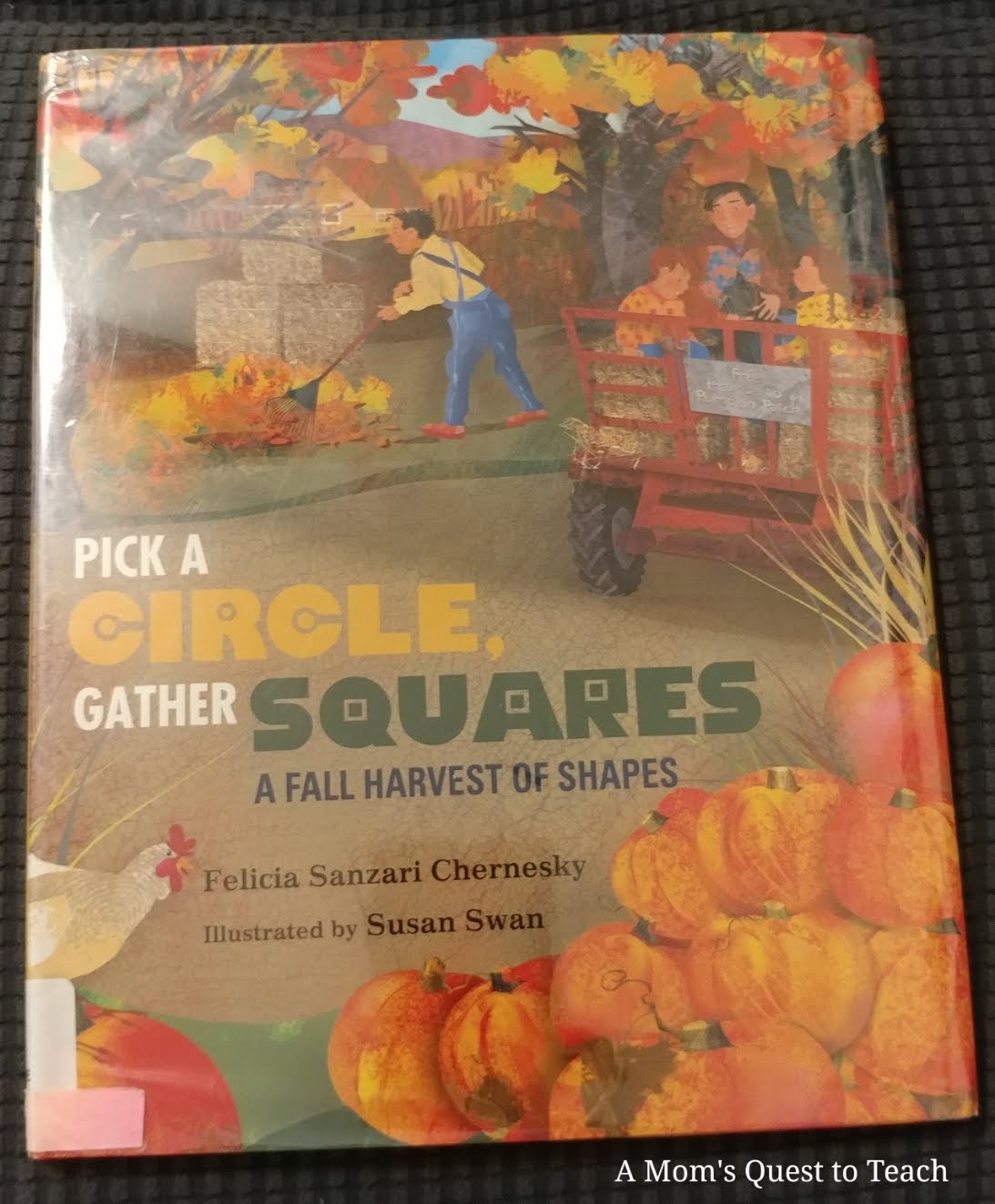
Pick a Circle, Gather Squares: A Fall Harvest of Shapes by Felicia Sanzari Chernesky and illustrated by Susan Swan 

When I picked out this book from the list of autumn-themed books our library had listed, I was not sure what to expect. I thought it might be a little too young for our kindergartner and second-grader to enjoy but I was wrong. Our second-grader and I sat together while I read it aloud and he went through and picked out all the shapes in the illustrations. 

For your preschooler, you can easily incorporate Pick a Circle, Gather Squares into your homeschool day. It would a perfect starting point for a day of searching for shapes either at a pumpkin patch or around the house. If we had a lot of pumpkins to carve, I could see us using the book as inspiration for choosing out different jack-o-lantern shapes

Pick a Circle, Gather Squares book cover


Footballs and Falling Leaves: A Fall Counting Book by Rebecca Fjelland Davis 

Like many counting books, this Autumn-themed one focuses upon the numbers one through ten for your preschooler or kindergartner. The bright colorful pictures open up discussions of bears hibernating for the winter, farming equipment like combines, how corn is used to feed farm animals, and more. At the end of the book, there is reinforcement for your child to practice counting again. There are also two pages of facts about fall, which are a nice addition to help you and your child explore more together. 

6 acorns in fall counting book


Hooray for Fall! by Kazuo Iwamura 

In Hooray for Fall!, we meet Mick, Mack, and Molly as their squirrel parents prepare for the Fall. Mama squirrel knitted her children three matching red sweaters as they explore outside, Mick, Mack, and Molly discover so many things are red like their sweaters. There are red mushrooms, red berries, red leaves, and even a red sky. 

To accompany the reading of Hooray for Fall!, you could spend some time reading about bears and create a bear craft or make a nature-themed work of art (N is for Nature). Or perhaps a walk at sunset would be a nice way to end your homeschool day? 

Fall Seasons children's book


Fall by Moira Butterfield 

Finally, I want to share an Autumn-themed book that will explain the season of Fall to your kindergartner or first-grader. In Fall, you and your children will read about how the sun's journey helps impact the seasons on Earth. There are also great discussions about Fall weather, farm life during Autumn, how animals adapt and migrate during the Fall, and some of the stories associated with Fall. 

And if you are in search of some Autumn-themed learning ideas, this book has some ideas for you! There are painting suggestions, nature-themed puppets, and some simple science experiments. Your child can also find definitions of such important words as chlorophyll, migration, and thermometer in the Words to Remember section. 

Does your family have any favorite Autumn-themed children's books? Perhaps there are a few board books that always seem to find their way into your Fall Morning Basket? 


Looking for more children's books? If you are in search of Halloween-themed children's books, check out my Book Club post. Or perhaps you are studying the early presidents of the United States? Why not learn more about George Washington


Thursday, December 28, 2017

Learning about the Alphabet: A is for Alligator

Text: Learning about the Letter A: A is for Alligator; photo of an alligator; A Mom's Quest to Teach Logo

This post contains affiliate links. For more information, please see my Terms of Use and Disclosure Policy page. Thank you.

Over the course of twenty-six posts, I will introduce my own simple lessons for the letters of the alphabet.  I will provide enough ideas and suggestions for a week's worth of activities.  

For the letter A, we focused upon alligators.  We colored pictures, read books, and completed crafts to help us learn about these amazing animals.

Alligators are a type of animal that belong to the class of reptiles (which includes snakes, lizards, turtles, and the tuatara) and belong to the order of Crocodilians (along with crocodiles, caimans, and gharials).  Depending on the age of your child, you can create a flow chart to show them how they are connected to other animals.

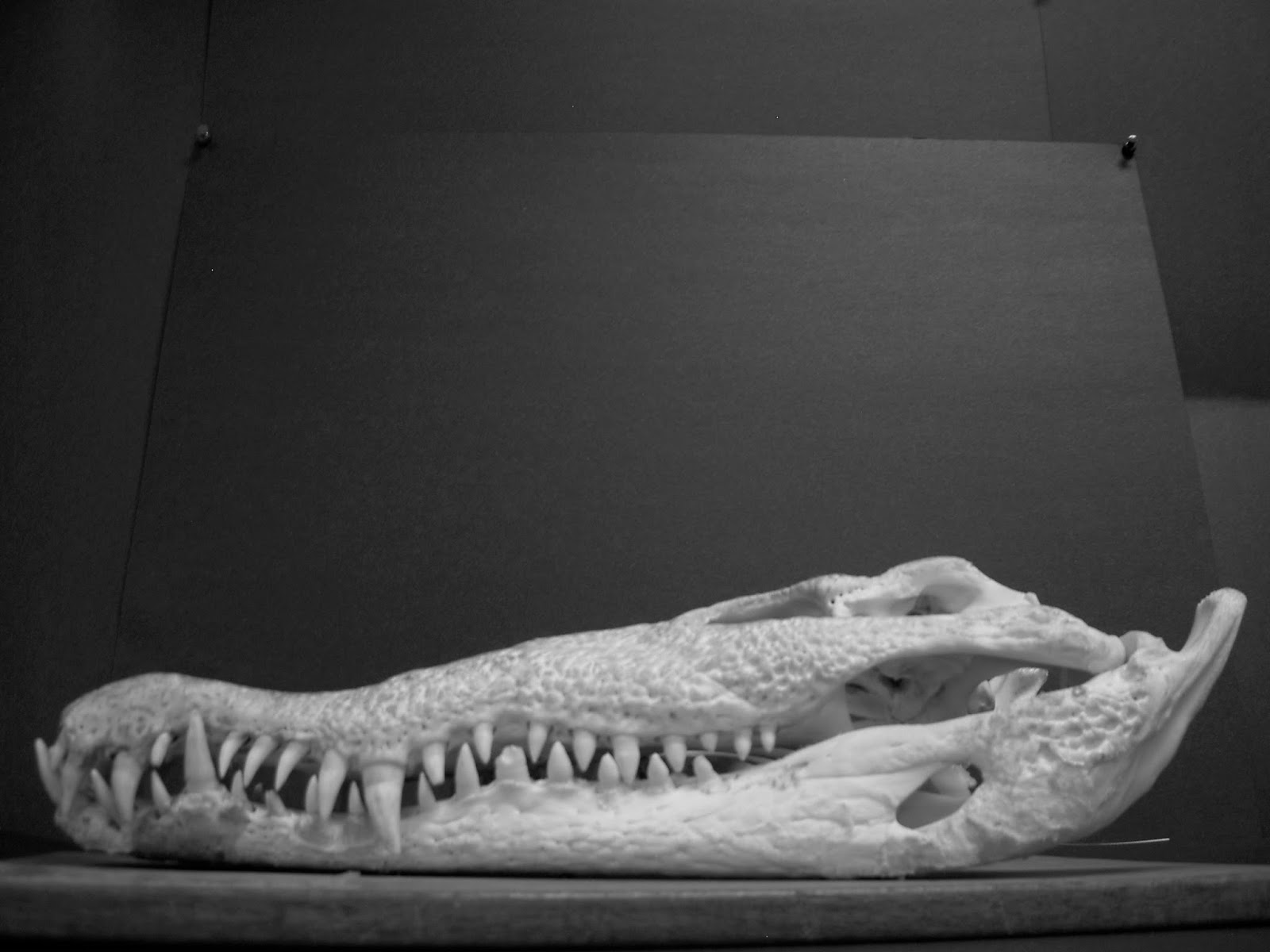
Alligators have short, wide snouts while crocodiles have slender, pointy snouts.  The other major difference is when an alligator's mouth is closed its fourth lower tooth is usually hidden, while a crocodile's fourth lower tooth is visible when its mouth is closed.  You can have your child make an alligator mouth with their hands.

Alligator Skull (fourth lower tooth hidden)

Crocodile Skull (fourth lower teeth visible)

An alligator's body is covered in scales made of keratin (the same protein that makes up our own fingernails and hair). So every time you are touching your finger nails, you are feeling what an alligator (or any reptile) feels like - smooth and dry (not slimy at all!).

Like other reptiles, alligators are cold-blooded.  They must regulate their own body temperature by either basking in the sun to warm up or moving into the cool waters to cool down.

An alligator's eyes and nostrils are located on the top of its head allowing them to sit with just those poking out of the water so they can keep the rest of their body hidden from predators or prey.  Look at different pictures of alligators and other animals to compare where their eyes are ears are located.  You can talk about the differences with your child.  For example, a rabbit's eyes are located on the side of its head letting it see almost all the way around them to keep away from predators.

Crocodilians make a variety of sounds from soft hissing to loud bellows.  Baby crocodilians will make a high pitched noise from inside the egg to let their mom (who stays with the nest) know they are ready to hatch. Using its egg tooth (a hard spot of the tip of its snout) the crocodilian will break free from the egg.  The mother will assist the hatching crocodilians by removing nesting material and then continuing to protect her young for several years.  Talk about the following questions with your child: How does a baby human let his or her parents know it needs help?  How long do humans stay with their families? How long do other reptiles stay with their mothers? In almost all cases, reptiles lay their eggs and leave them; there are some exceptions like the python.

Alligators will prey on most any animal such as insects, amphibians, birds, mammals, fish, and other reptiles. If your child is older, you can talk about food chains (an example could be plant material - insects - amphibians - raccoon - alligator).

Vocabulary

alligator
crocodile
reptile
crocodilian
turtle
lizard
tuatara
cold-blooded
warm-blooded
predator
prey
mammals
amphibians
keratin
egg

Alligator and Crocodile Vocabulary 

Coloring Sheets

Super Coloring Alligator Pages 
This site features realistic and cartoon alligators for your little ones to color.

Mom Junction's Top 25 Free Printable Alligator Coloring Pages
There is a variety of coloring pages and some activity suggestions to go along with each page.


Alligator Projects 

A is for Alligator


Alligator Craft 


Books 

Featured Shape

Have your child work on drawing a triangle this week.  If you take a look at the snout of an alligator, it closely resembles a triangle.

You can build a triangle with craft sticks, cut out scraps of construction paper in triangle shapes, look for signs around town shaped like a triangle, and examine the musical instrument. 

Activities 

My Pinterest Lessons - Letters Board

If you complete any of the crafts, please let me know in the comments. I would love to see them.  

Clay Play 

I purchased a tray from the Dollar Store and gathered together various materials that my children could use with the Play Doh. They created a home and food for the tiny alligator and lizard toys provided with no prompting.

The items I included this time were: a roller and cutter from a Play Doh kit, straws, buttons, plastic lids, rocks, plastic rock, toy alligators, and Play Doh.


Other A Topics 
Apples

Fun Handprint Art's Apple Counting Activity for Johnny Appleseed Day (September 26) 
This is a fun way to count apples involving paint or stamp pads.

123 Homeschool for Me's Apple Seed Counting Activity and From ABCS to ACTS's Printable Apple Seed Counting Activity  
A great activity to practice counting and if your children love dice like mine do, then this is perfect for them.

Airplanes

Play and Learn with Dana's Letter A Airplane Craft 

This is a great craft to introduce the lowercase letter a.

Homeschool Preschool's Printable Airplane Activities 
This packet has lots of fun letter A and airplane activities for your toddlers.


Resources 

Smithsonian's National Zoo and Conservation Biology Institute's American Alligator page 


Thursday, November 16, 2017

Fall Crafts: Scarecrow


A Mom's Quest to Teach: Fall Crafts: Scarecrow


This post contains affiliate links. For more information please see my Terms of Use and Disclosure Policy page. Thank you.

With the autumn weather, comes pumpkin picking, Halloween projects, and fall crafts. There are so many cute ideas on Pinterest and Facebook, it is sometimes easy to be overwhelmed by all the choices.  This year we made a simple paper plate scarecrow to decorate our front door.

Materials 


Steps 


1. Gather materials. (If your children are handy with scissors, have them help out.)

Materials needed for scarecrow paper plate craft

2. Color the paper plate.
coloring paper plate for scarecrow craft

3. Glue on the eyes, nose, and mouth.

gluing on eyes for paper plate scarecrow craft

4. Glue on the hair.
Gluing on hair for paper plate scarecrow craft

gluing on hair for  paper plate scarecrow craft

5. Glue on the hat.

6. Glue on the bow-tie.

completed paper plate scarecrow craft


Both my children enjoyed decorating and creating their own unique scarecrows. If you and your children make any, I would love to see them.  You can share them with me on Instagram or Facebook. Tag my page or use #momquesttoteach on Instagram. 

completed paper plate scarecrow craft
My son's scarecrow 

Resources 


Crafts for Preschooler's Scarecrow 

Original Scarecrow inspiration 

Crafty Morning's Popsicle Stick Scarecrow

No Time For Flash Card's Scarecrow