Showing posts with label Card Games. Show all posts

Monday, July 12, 2021

Focusing on Addition Skills Through a Fun Game

A Mom's Quest to Teach: Focusing on Addition Skills Through a Fun Game - A Review of Clumsy Thief Junior  - game cards

I received a COMPLIMENTARY copy of this game from the Timberdoodle in exchange for my honest opinion. I was not required to write a positive review, nor was I compensated in any other way. This post contains tracking links. For more information, please see my Terms of Use and Disclosure Policy page. Thank you.

Learning addition math facts will help our children in all their future mathematics courses. One of the areas where I would like our six-year-old daughter to get practice in is in addition. We recently had the opportunity to add the game Clumsy Thief Junior, which is part of the 2021 Kindergarten Curriculum Timberdoodle Kits, into our homeschooling lessons. What a fun game to help our daughter practice adding numbers that make ten!


About the Game - Clumsy Thief Junior 


The deck, consisting of 76 cards total, and instructions come in a cute box featuring a raccoon eating an apple on the cover of it. The seventy food cards are labeled with colorful fruit and vegetables and the numbers one through nine. The four thief cards feature a raccoon eating a pear, holding lettuce, and two holding an ear of corn. The two trap cards show the same picture of a basket over top of the raccoon. 


Game cards from Clumsy Thief Junior with A Mom's Quest to Teach Logo


The object of Clumsy Thief Junior is for the players to make ten to collect food cards. Each player starts with seven cards and then the game follows these steps: 

  1. Everyone makes stacks of ten with the cards in their hand. They will use two cards with the same food to add to exactly ten.
  2. After everyone has made all their stacks of ten, players will begin collecting stacks. This is done by looking at everyone's stacks in front of them and seeing if you can add any cards from your hand to the top card to add to ten. For example, someone's stack is showing a four lettuce card, and you have a six lettuce card. You can put the six lettuce card on their stack and take the stack for yourself. This can be done until everyone is done making stacks using the cards in their hands. 
  3. The next step is to replenish your stack up to five cards. 
  4. Repeat the steps until the entire card deck is gone. 
The game moves rather quickly – especially the second step when everyone is trying to make their own stacks of cards. Using the cards in your own hand and the stacks on the table in front of you really does help you learn how to add quickly to ten.


Clumsy Thief Junior box and Clumsy Thief card with A Mom's Quest to Teach logo


How Do You Win? 


Once the entire card deck is gone, you discard any cards that are not a part of stacks adding to ten. Then each person counts the number of fruit cards from their remaining stacks. The player with the most fruit cards wins the game.


Clumsy Thief Junior game cards and game in action with A Mom's Quest to Teach logo


Using the Game – Clumsy Thief Junior in our Homeschool 


When I requested to review the game Clumsy Thief Junior, I had our daughter in mind. She was just finishing kindergarten, and I thought it would be perfect to help her practice her addition skills. One problem – she does not like to play competitive games. She doesn't like losing or winning. She prefers cooperative games, but knowing that learning addition math facts is important, I pushed her to join us in our second game of Clumsy Thief Junior. And she was very glad she did. She had a lot of fun. She told me it was fun to win against her brothers and her dad.

We played the game several times with everyone in our family. From our six-year-old to our 18-year-old, we all had fun. Our eight-year-old son was really into the game. He enjoyed 'stealing' stacks from his siblings and his parents but he also loved cheering everyone else on as we played the game. I liked how fast the game was which makes it perfect to fit into our homeschool day or just to play when we have some free time after dinner. 


A Mom's Quest to Teach: Focusing on Addition Skills Through a Fun Game - A Review of Clumsy Thief Junior  - Game cards


Extending the Learning Beyond the Game 


We love homeschool materials – like games – which we can use in a variety of ways beyond the normal game mechanics or rules. There are several different ways in which we can use the cards that accompany Clumsy Thief Junior in our homeschool lessons. And with the box being such a convenient size, it is very easy to store with all our homeschooling supplies. 

After removing the four thief cards and the two trap cards, children can pick from the deck and do a number of things: 

  • They can write the word for the number card they have chosen. 
  • They can think of one or more ways in which you can add to get the number on the card. For example, if they choose the number nine, they could tell you that 1 +8 = 9 or 2 + 7 = 9. 
  • Ask your child to tell you what number gets added to that card to equal ten. 
  • If you are studying a foreign language, ask your child what that number is in Spanish, Latin, French, etc. 
How do you use games in your homeschool? From games that focus upon addition skills like Clumsy Thief Junior to those that allow our children to work on social skills, games bring lessons to life in many settings, including the homeschool. They can be a quick, fun addition to your homeschool day. Which one will you add to your homeschool lessons today? 


A Mom's Quest to Teach: Focusing on Addition Skills Through a Fun Game - A Review of Clumsy Thief Junior   - Materials from Clumsy Thief Junior


Thursday, February 25, 2021

Finding the Perfect Indoor Game for your Homeschool

A Mom's Quest to Teach logo: Dice, Decks, and Boards; Finding the Perfect Indoor Game for your Homeschool; dice

This post contains affiliate links. For more information, please see my Terms of Use and Disclosure Policy page. Thank you.

There are so many great game choices for your homeschool that can be both fun and educational for your children and your entire family. Our family has quite a few that rank high among our favorites, including ones that require very little setup, ones that are cooperative, and ones that let us roll dice. With board games and tabletop games in general gaining in popularity over the years, you can find them sold at a variety of stores – both offline and online – like chain stores or your friendly local gaming store. I would always recommend you go to your local gaming store first when looking to purchase a new game. They might even be able to find the one you have been searching for through their buying power. 

Games for Toddlers 

It seems like there are a lot better games available for younger children now than when I was a child. I seem to recall games based upon Snow White, Care Bears, or E.T., but I cannot remember how they were played at all. The games we have purchased for our younger children or those they were gifted seem to be a huge step above those of my youth. 

We have many cooperative games (which our daughter loves because everyone wins or everyone loses), such as Mermaid Island, Noah's Animal Rescue, The Fairy Game, and others. These are wonderful for teaching children how to work together as a team and prevent tears when someone loses. Of course, our five-year-old daughter has been known to cry when she wins a cooperative game. 

Several card games that are educational and fun for toddlers include Raccoon Rumpus and Koala Capers. I love how these two games are random-based upon dice, so you don't really have to have a lot of skill to win or lose. I also like that they focus on colors and patterns – perfect learning opportunities for little ones.


A Mom's Quest to Teach logo; blue pieces from Catan Junior; Dragon breath dragon and gems; Finding the Perfect Indoor Game for your Homeschool


Educational Board Games 

As our children get older, there are a variety of educational board games that we can incorporate into our homeschool day, such as those from Byron's Games that we have received for free to review. Our children really like Continent Race, which focuses upon learning the continents, countries, and flags. Math Sprint is also great fun because it not only includes reviewing math facts but also allows the children to do physical activities, like jumping jacks and jogging in place.

Costa Rica, Peru, and other flag cards from Continent Race game


Games with Lots of Components 

I must admit that I love games with lots of stuff! Even though the extra items might also bring more difficulty to learn the game, I love opening the box and finding cards, dice, and other game pieces. Our son received a fun game for Christmas called Dragon's Breath. There are lots of little 'jewels' that your dragon wants to collect. For young children, they are so pretty! 

We picked up Dungeon Drop for our family game night because we enjoy role playing games with Dungeons, so why not create our own with this game? There are all these tiny little cubes that you drop to create the dungeon that represent pillars, monsters, and treasure. Because you drop them onto the table, each game is different from the next. It is a very neat concept that keeps the game fresh and new. 

Another game that my husband picked up is the Quarriors Dice Building Game. It has 130 custom dice and over 50 cards for gameplay. We have only tried playing it once because it is still a bit too advanced for our entire family to be able to enjoy it together, but I just love all the dice! 

Quarriors game box


Role-Playing Games 

My husband and my stepson have been gamers for longer than I have known either of them. My husband's journey with Dungeons and Dragons began when he was in elementary school. He has since gone on to play a variety of editions, versions, "retroclones" (which hearken back to the first three or four versions of Dungeons and Dragons games from the 1970s and early 1980s), and games of several genres. It took a few years for my husband to convince me to play, and now I have lots of pretty dice.

The wonderful thing about role-playing games is that you don't have to play ones that involve dragons or wizards. There are ones that are set in generic outer space or even the Star Wars or Star Trek universes. My husband bought me one set in the 1920s knowing I enjoy that era of history. There are versions geared towards children, too. 

Another benefit to playing role-playing games is the community of players. There are so many different groups out there – some of which may or may not be for you. You can play online through Zoom calls or other apps, watch others play online as they get together via long distance, or roll up a character gathered around the dining room table. And because the entire game requires your imagination and critical thinking skills, there really is no wrong way to play.  Yes, there are rules, but RPGs will help you think outside the box and make great stories with your friends. 

The Perfect Indoor Game 

Just what is the perfect indoor game for your homeschool? I think any game that brings you together with your family and friends – whether via technology or together in one room – is the perfect indoor game. That game may take 15 to 20 minutes, or it may take hours, days, or a lifetime if you are role-playing. There are so many great options available for families, and playing games can teach so many important skills.  

Tuesday, April 23, 2019

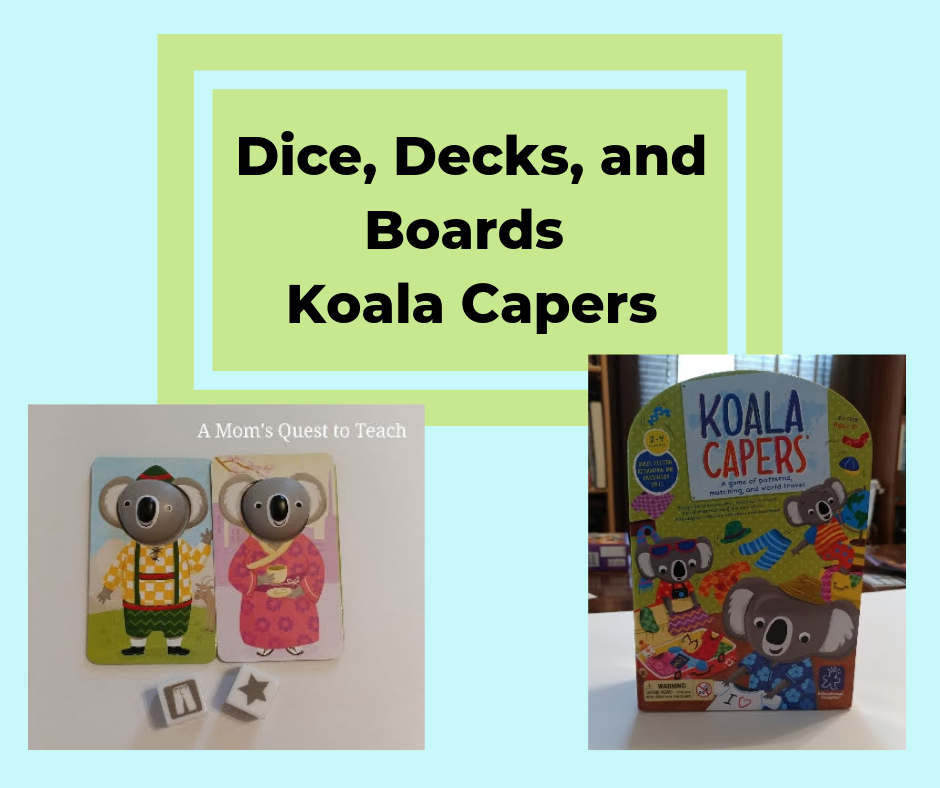
Dice, Decks, and Boards: Koala Capers


This post contains affiliate links. For more information please see my Terms of Use and Disclosure Policy page. Thank you.

Another educational and fun game from Educational Insights is Koala Caper – a game of patterns, matching, and world travel. Perfect for ages 3 and up, Koala Capers helps build pattern recognition, observation skills, and good sportsmanship.

What Do You Get?


Your game box contains 4 koala cards with plastic raised koala faces, 20 outfit cards, 1 jumbo pattern die, and 1 jumbo outfit die. Two to four players will roll both dice and pick an outfit for their koala that matches the pattern and outfit dice. The first player to dress their koala with five outfit cards wins!

The box itself for Koala Capers is colorful with the koalas packing to travel around the world. There are 'stickers' from around the world on the box which allows you to talk about geography with your children.

The directions are provided in English (printed on the lid of Koala Capers and on a pamphlet) with the following three printed on enclosed pamphlet: Spanish, French, and German. The directions include the basic "how to play" instructions and a bonus memory game.

The outfit cards are laminated cardboard and could be bent or torn but a child would have to try to destroy them.

In general, I think the game will stand up to average play by our three- and five-year-olds.


Other Gaming Ideas 


Using the outfit cards, you and your children pick one card and look up where the person wearing it is from in the world. For example, there is an outfit for a "beefeater" or yeoman warder. There are also cards for a cowboy and one exploring the poles.


Using the dice, your children could design clothing. Roll the outfit die to see which piece of clothing your children will be designing. Then either using a template or asking your child to draw the clothing, roll the pattern die. Using the pattern that is rolled, your children can decorate the outfit.


Looking for a cute Koala Craft? 

Learn about Australian Animals on a Summer Safari for Preschoolers – there are several crafts and lots of cool facts for your little ones. 


If you enjoy Koala Capers, you might also be interested in Raccoon Rumpus which is a similar game. Or if you are interested in other games please check out the following posts:


Monday, April 2, 2018

Dice, Decks, and Boards: The Oregon Trail ®


This post contains affiliate links. For more information, please see my Terms of Use and Disclosure Policy page. Thank you.


"You have died of dysentery." 


This Target exclusive is based upon the classic computer game that was first produced in 1974. While many may remember playing the original computer game by themselves or in small groups huddled around a desktop computer, this card game is for two to six players ages 12+. The card game includes 58 trail cards, 32 calamity cards, 26 supply cards, 1 laminated wagon party roster, 1 erasable marker, 1 die, and illustrated instructions.


In The Oregon Trail ® card game, your goal is to have one member of the wagon party survive the journey from Independence, Missouri and reach Willamette Valley, Oregon alive.  Everyone in the collaborative game works together to build the trail which has a number of rivers to ford and obstacles to overcome.

I think the most difficult part of the game occurred when we were down to only three players but no one had trail cards that match up to the previous trail. We made very little progress as we had to keep picking up new trail cards until we got one that matched.

One member of our party made it across the 2,040 mile trail to reach Willamette Valley, Oregon while the rest of us succumbed to disease and snake bites. 
I would recommend this card game to families with older children and teens. I think the best way to boost your odds to win the game is to have a large wagon party so you can overcome the calamities and reach Oregon. 


Resources


Want to learn more about the Oregon Trail?  Take a look at some of these sites. 


You can also read more about the Oregon Trail here!

I linked up with the following blog(s):


Friday, March 30, 2018

What to Do When Rain Changes Your Plans: How to Spend Rainy Days Together as a Family

Rainy Days, Beach, Board Games, Card games, Parenting, Family Fun, Movies, Games, Reading, Books

What do you do on rainy days as a family? Do your kids mope around the house or spend their time on technology like gaming consoles or hand-held devices? What about trying some of these ideas?

This post contains affiliate links. For more information please see my Terms of Use and Disclosure Policy page. Thank you. 

Board Games and Card Games

One way for the whole family to have fun together is to play games. Our family has a few favorites that range from ones we can all play (littles included) to ones where just the teen joins us.

Hoot Owl Hoot - A fun, cooperative game that even our 2-year-old can play

Raccoon Rumpus - Perfect for ages 3+

Rainy Days, Beach, Board Games, Card games, Parenting, Family Fun, Movies, Games, Reading, Books, Hoot Owl Hoot  Rainy Days, Beach, Board Games, Card games, Parenting, Family Fun, Movies, Games, Reading, Books, Raccoon Rumpus


Munchkin - A fun game for ages 10+ where you enter dungeons and defeat monsters to collect their loot. There are a variety of expansions, add-ons, and different versions for fans of science fiction, zombies, vampires, etc.

Red Dragon Inn - A card-based game where players take on the persona of various adventurers who have joined together in the Inn to share stories of daring deeds, drink, and gamble. This game is best for ages 14+ with your discretion as a parent.

Movies and Television Watching 

There are so many movies and television shows from the youth of both my husband and myself that we can share with our children. When it is cold or raining outside, we can all sit together in the living room and watch movies like Tron, Star Wars, or The Muppet Movie.  Or – even better – we can share some of our favorite cartoons like Jem and the Holograms, She-Ra, or Dungeons and Dragons.

Arts and Crafts 

When we can't play outside, creating new artwork or working on projects together is a fantastic way to spend the day. We love to take out supplies like Magic Stix Markers or Kwik Stix paints and design new sun catchers for the windows for when Mr. Sunshine rears his bright face again.

Reading 
Rainy Days, Beach, Board Games, Card games, Parenting, Family Fun, Movies, Games, Reading, Books
Another good way to spend the day is reading – whether everyone gathers together for a read-aloud of The Chronicles of Narnia or The Wizard of Oz - or each person picks their own story to read independently. Sitting in the same room while reading together is a great way to pass the time.

Dance Party 

With two younger children in the house, a fun way to spend an afternoon is cranking up the music and holding a dance party. Whether we are singing and dancing to Mickey Mouse Clubhouse's closing theme, Veggie Tales Silly Songs, or some of our favorites from Huey Lewis and the News or Electric Light Orchestra, we can have so much fun. What are your favorite songs to dance to?


Rainy Days, Beach, Board Games, Card games, Parenting, Family Fun, Movies, Games, Reading, Books
Baking 

A house of cookies or cupcakes baking in the oven on a rainy day smells so scrumptious! And what a better way to teach life skills than have one's children help with the recipe and preparation? (Because we know they will help with the eating!)

How does your family spend rainy days together? Do you share any of the same activities as our family?


I linked up with the following blog(s):