Showing posts with label dice. Show all posts

Thursday, February 25, 2021

Finding the Perfect Indoor Game for your Homeschool

A Mom's Quest to Teach logo: Dice, Decks, and Boards; Finding the Perfect Indoor Game for your Homeschool; dice

This post contains affiliate links. For more information, please see my Terms of Use and Disclosure Policy page. Thank you.

There are so many great game choices for your homeschool that can be both fun and educational for your children and your entire family. Our family has quite a few that rank high among our favorites, including ones that require very little setup, ones that are cooperative, and ones that let us roll dice. With board games and tabletop games in general gaining in popularity over the years, you can find them sold at a variety of stores – both offline and online – like chain stores or your friendly local gaming store. I would always recommend you go to your local gaming store first when looking to purchase a new game. They might even be able to find the one you have been searching for through their buying power. 

Games for Toddlers 

It seems like there are a lot better games available for younger children now than when I was a child. I seem to recall games based upon Snow White, Care Bears, or E.T., but I cannot remember how they were played at all. The games we have purchased for our younger children or those they were gifted seem to be a huge step above those of my youth. 

We have many cooperative games (which our daughter loves because everyone wins or everyone loses), such as Mermaid Island, Noah's Animal Rescue, The Fairy Game, and others. These are wonderful for teaching children how to work together as a team and prevent tears when someone loses. Of course, our five-year-old daughter has been known to cry when she wins a cooperative game. 

Several card games that are educational and fun for toddlers include Raccoon Rumpus and Koala Capers. I love how these two games are random-based upon dice, so you don't really have to have a lot of skill to win or lose. I also like that they focus on colors and patterns – perfect learning opportunities for little ones.


A Mom's Quest to Teach logo; blue pieces from Catan Junior; Dragon breath dragon and gems; Finding the Perfect Indoor Game for your Homeschool


Educational Board Games 

As our children get older, there are a variety of educational board games that we can incorporate into our homeschool day, such as those from Byron's Games that we have received for free to review. Our children really like Continent Race, which focuses upon learning the continents, countries, and flags. Math Sprint is also great fun because it not only includes reviewing math facts but also allows the children to do physical activities, like jumping jacks and jogging in place.

Costa Rica, Peru, and other flag cards from Continent Race game


Games with Lots of Components 

I must admit that I love games with lots of stuff! Even though the extra items might also bring more difficulty to learn the game, I love opening the box and finding cards, dice, and other game pieces. Our son received a fun game for Christmas called Dragon's Breath. There are lots of little 'jewels' that your dragon wants to collect. For young children, they are so pretty! 

We picked up Dungeon Drop for our family game night because we enjoy role playing games with Dungeons, so why not create our own with this game? There are all these tiny little cubes that you drop to create the dungeon that represent pillars, monsters, and treasure. Because you drop them onto the table, each game is different from the next. It is a very neat concept that keeps the game fresh and new. 

Another game that my husband picked up is the Quarriors Dice Building Game. It has 130 custom dice and over 50 cards for gameplay. We have only tried playing it once because it is still a bit too advanced for our entire family to be able to enjoy it together, but I just love all the dice! 

Quarriors game box


Role-Playing Games 

My husband and my stepson have been gamers for longer than I have known either of them. My husband's journey with Dungeons and Dragons began when he was in elementary school. He has since gone on to play a variety of editions, versions, "retroclones" (which hearken back to the first three or four versions of Dungeons and Dragons games from the 1970s and early 1980s), and games of several genres. It took a few years for my husband to convince me to play, and now I have lots of pretty dice.

The wonderful thing about role-playing games is that you don't have to play ones that involve dragons or wizards. There are ones that are set in generic outer space or even the Star Wars or Star Trek universes. My husband bought me one set in the 1920s knowing I enjoy that era of history. There are versions geared towards children, too. 

Another benefit to playing role-playing games is the community of players. There are so many different groups out there – some of which may or may not be for you. You can play online through Zoom calls or other apps, watch others play online as they get together via long distance, or roll up a character gathered around the dining room table. And because the entire game requires your imagination and critical thinking skills, there really is no wrong way to play.  Yes, there are rules, but RPGs will help you think outside the box and make great stories with your friends. 

The Perfect Indoor Game 

Just what is the perfect indoor game for your homeschool? I think any game that brings you together with your family and friends – whether via technology or together in one room – is the perfect indoor game. That game may take 15 to 20 minutes, or it may take hours, days, or a lifetime if you are role-playing. There are so many great options available for families, and playing games can teach so many important skills.  

Wednesday, September 23, 2020

Wordless Wednesday Start of Autumn

Text: Wordless Wednesday: Start of Autumn; background of leaves clip art; logo of A Mom's Quest to Teach


Dice; place value dice and fractions dice
Dice that I bought my husband as a birthday gift. 

Letter D - dragon and dog built with plastic number rods
Lessons from My Father's World

birthday card with tree and Dad written on it
Birthday card for my husband from our son

Polar bear Lego; Batman Lego car
Polar bear fighting crime with Batman

cover of The Haunting at Bonaventure Circus by Jaime Jo Wright
Latest book - review coming soon!

 Text: Wordless Wednesday; A Mom's Quest to Teach; background of leaves

Friday, July 10, 2020

Dice, Decks, and Boards: Tenzi Game and Tenzi Card Deck

text: Dice, Decks, and Boards: Tenzi Game and Tenzi Card Deck; A Mom's Quest to Teach Logo; Tenzi card deck spread out

I received a FREE copy of this game and game deck from Timberdoodle in exchange for my honest opinion. I was not required to write a positive review nor was I compensated in any other way. This post contains affiliate links. For more information, please see my Terms of Use and Disclosure Policy page. Thank you.

dice


Our family loves dice! One of the items I have had on my wishlist at Timberdoodle is the Tenzi Game (which is part of the second-grade curriculum kit). So, I was very excited when the opportunity to review the game and the card deck became available. It actually arrived just in time for our younger son's birthday so it was like a present for the whole family.

Tenzi game rules; Tenzi dice

What Exactly is Tenzi?


Tenzi is an award-winning game that is fast-paced and easy to learn. Each game contains forty dice (10 each of four different colors). One set can be used by four people to play the original Tenzi game. How do you play? Players roll all ten of their dice in order to display ten identical numbers. They keep rerolling until all ten of their dice are the same number. Add in the Tenzi Card Deck and you will find 77 Ways to Play Tenzi (including a couple more ideas that are including on the rules that come with the original set of dice).

With so many different ways to play Tenzi, you can easily fill a game night with just two simple purchases: the Tenzi game and the card deck. On the evenings where we played Tenzi, we played at least six or more games and used the cards to shake up the rules. I think one of our kids' favorites was where you had to make a sound like a farmyard animal after each roll (Farmzi). It was very loud in our dining room during that game!


Tenzi Dice; Tenzi card with rules for Fivezi
The cards are 3.5 inches by 3.5 inches in size. 

Farmzi Tenzi card game rule


We started with playing the regular Tenzi game and then moved on, trying our hand at different versions based upon the card deck. For example, we played Oddzi & Endzi where we had to roll any combination of only 1's, 3's, and 5's. This is a great way to teach or refresh children's memories of odd and even numbers. We also played Clapzi (one claps after every roll), Sixty-Fourzi (you need to roll six 4's and four 6's), and Fivezi (using only five dice), among others. The first night we even ended our gaming session with one where the last one to get Tenzi cleans up the dice.

Tenzi Dice

The Dice 


The Tenzi dice have pips – not numbers on them – which encourages your child to count. If you have other six-siders you might have dice that have numbers printed on them rather than the pips. This can give an unfair advantage (or at least that is what my family said when I was using extra dice so I could play as the fifth person).

I think the dice are well-made and I didn't feel as if any were loaded – or at least I couldn't tell as I was rolling the dice so many times. The pips were all drawn/painted on clearly so they were easy to read.

Text: Dice, Decks, and Boards: Tenzi Game and Tenzi Card Deck; Bring a new fun game to your Gameschooling!; Tenzi dice; Timberdoodle Blog Team logo; Passzi Tenzi Game rule card

What Did We Think?


There is nothing quite like forty (or more) dice rolling at the same time as everyone tries to get their match. For a few moments – at the start of each game – there was silence (which is quite amazing considering there were five of us playing ranging in age from five years to adult).

We loved Tenzi so much that we bought an additional set so all five of us could play at the same time (without raiding our other dice bags). I could easily see this as a game that we take with us to friends' houses for game night. It is easy to transport and simple to explain while still being really fun.


While I love the package for display, I think we will probably buy a dice bag to hold all the dice in so that they don't get lost. Depending on the size of the dice bag, we might even be able to keep the card deck in the bag, too.

I would highly recommend Tenzi and the Tenzi Card Deck! It was easy enough for our five-year-old to understand and play but exciting enough that our teen loved it. There a few cards within the Tenzi Card Deck that we won't be able to use with our youngest (due to dexterity needed or ability to calculate numbers) but – in general – everyone can play this game and have great fun!

Other Timberdoodle Reviews


We have also reviewed other fun and educational products from Timberdoodle including:


Timberdoodle Blog Team logo


Tuesday, April 23, 2019

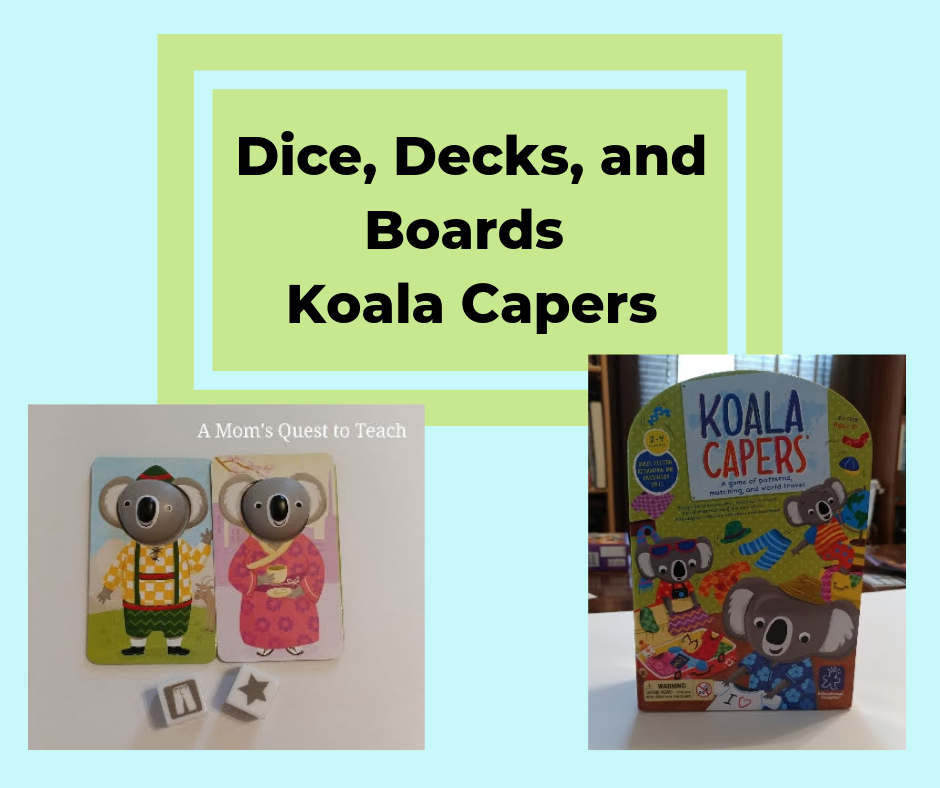
Dice, Decks, and Boards: Koala Capers


This post contains affiliate links. For more information please see my Terms of Use and Disclosure Policy page. Thank you.

Another educational and fun game from Educational Insights is Koala Caper – a game of patterns, matching, and world travel. Perfect for ages 3 and up, Koala Capers helps build pattern recognition, observation skills, and good sportsmanship.

What Do You Get?


Your game box contains 4 koala cards with plastic raised koala faces, 20 outfit cards, 1 jumbo pattern die, and 1 jumbo outfit die. Two to four players will roll both dice and pick an outfit for their koala that matches the pattern and outfit dice. The first player to dress their koala with five outfit cards wins!

The box itself for Koala Capers is colorful with the koalas packing to travel around the world. There are 'stickers' from around the world on the box which allows you to talk about geography with your children.

The directions are provided in English (printed on the lid of Koala Capers and on a pamphlet) with the following three printed on enclosed pamphlet: Spanish, French, and German. The directions include the basic "how to play" instructions and a bonus memory game.

The outfit cards are laminated cardboard and could be bent or torn but a child would have to try to destroy them.

In general, I think the game will stand up to average play by our three- and five-year-olds.


Other Gaming Ideas 


Using the outfit cards, you and your children pick one card and look up where the person wearing it is from in the world. For example, there is an outfit for a "beefeater" or yeoman warder. There are also cards for a cowboy and one exploring the poles.


Using the dice, your children could design clothing. Roll the outfit die to see which piece of clothing your children will be designing. Then either using a template or asking your child to draw the clothing, roll the pattern die. Using the pattern that is rolled, your children can decorate the outfit.


Looking for a cute Koala Craft? 

Learn about Australian Animals on a Summer Safari for Preschoolers – there are several crafts and lots of cool facts for your little ones. 


If you enjoy Koala Capers, you might also be interested in Raccoon Rumpus which is a similar game. Or if you are interested in other games please check out the following posts:


Monday, December 3, 2018

Dice, Decks, and Boards: Cauldron Quest


This post contains affiliate links. For more information please see my Terms of Use and Disclosure Policy page. Thank you.

We love cooperative games for kids. Therefore, the games we have from Peaceable Kingdom have not disappointed us. They "believe that children (and adults!) thrive when they work and play together in respectful ways. Cooperation encourages bonding, teamwork, shared decision making, trust, and emotional health."


Cauldron Quest is a game for two to four players aged 6+ that takes about 20 minutes to play. The object of the game is to get the three correct ingredients into the cauldron before all six paths on the board game are blocked. The story of the game is that there is an evil wizard who has cast a spell that will destroy the kingdom. The players have the power to break the spell – but only if we work together! We must find the three correct ingredients and move them down the paths to the cauldron.

"Work your Magic! Break the Spell!" 


Game Pieces include:
  • 6 plastic potion bottles with ingredient stickers 
  • 6 cardboard cauldron ingredient disks
  • 6 cardboard path blocker disks
  • 1 cardboard wizard hat & plastic stand 
  • 1 cardboard spell breaker token
  • 3 action dice
  • 3 "magic dice" (normal D6) 
  • 1 circular game board
  • 1 set of instructions 
The set up and instructions for play are clearly written with appropriate illustrations to further explain the game. On our first play through, I read the instructions prior to playing and referred to them during game play. 

Our entire family – 3-year-old, 5-year-old, teen, and parents – played the game. Except for our daughter wanting to use her own pink dice, we all were able to play the game successfully. We even won!

I would recommend Cauldron Quest to families of young children, day-care centers, preschools, and others. It is fun and will have a good replay value as things change each game play with different ingredients needed and the rolling of dice.


Looking for more posts about games and gaming? Please check out the following: 


Friday, August 24, 2018

Back to School: Homeschool Style: Must-Have Items in Our Homeschool


This post contains affiliate links. For more information please see my Terms of Use and Disclosure Policy page. Thank you.

What items just make your homeschool day run smoothly? Are there items that you couldn't live without? Earlier in the week I addressed some essentials in our homeschool and I want to showcase a few more today.


The Printed Word 


There are so many books that I find invaluable for our homeschooling. I have large collection of classic novels that we will be able to share with our children. I also have shelf after shelf of numerous history books that will be great for reference.

Over the years I have collected most of William Shakespeare's plays as well as the novels of Charles Dickens. I have several collections of Edgar Allan Poe's poems, short stories, and essays. In addition to these fictional works, I also have biographies and histories of individuals from Tudor England, the American Civil War, and Russia to name a few places and time periods.

Pretty Pictures 


Visuals are so important to education – from paintings and comic books to movies and videos – children can learn in so many different ways. I love that we live near enough to several museums where we can view art from a variety of time periods and styles.

We can also incorporate movies and videos into our homeschooling day without them just becoming a time filler like so often happens in the classroom. For example, if we are studying the American Civil War, we can watch Glory and then discuss its facts and inaccuracies. If we have the means, we could also visit the sites in Boston and South Carolina that feature prominently in the movie. I also have own several other fictional accounts of the Civil War including the North and South miniseries, the Blue and Gray miniseries, and Gone with the Wind.


For our younger children, our collection of Veggie Tales DVDs is a must-have! From the retelling of Bible stories to lessons about how to treat others, they are an excellent resource for families with younger children. Our children like Veggie Tales so much we even had a Veggie Tales-themed Birthday Party for our son.

How Many Dice Do You Need? 


Okay – that is really a trick question because you don't really need more than one set with D4, D6, D8, D10, D20, and percentile with a few extra D6 for most activities we do. But who doesn't want all the pretty dice? In our family, we each have a lunch box of dice (plus more). We use them for role playing as well as for games, counters, markers for activities and lessons, counting syllables, adding and subtracting, telling stories, and more.


Dice collecting is a side effect of liking dice. Multiple sets of dice are inevitable because they're often so brilliant and/or colorful. You can even buy dice by the pound! How cool is that? Then there are the rarer dice like the D3, D5, D7, D14, D24, D30, and on and on...


Writing Utensils 


Personally, I dislike using pencils. I have at my hand a collection of different brands of pens – including many colors. I like to use a purple pen for my blog and blue for making notes about others' blogs. I like to color code my notes, calendar, and schedule so that I keep everything straight. Right now I think our children use whatever pen or pencil is handy. Do you have a preferred pen or pencil brand? Do you like to color code with pens or maybe highlighters?

What are the must-haves in your homeschool?

If you have a moment, please visit the other members of the Homeschool Review Crew to see their posts for today and the rest of the week!