Showing posts with label Gamers. Show all posts

Monday, May 27, 2024

Dice, Decks, and Boards: Dungeon Drop

A Mom's Quest to Teach: Dice, Decks, and Boards: Dungeon Drop; image of door on stone brick

This post contains affiliate links. Please see my Terms of Use and Disclosure Policy page for more information. Thank you.

Adventurers! Are you ready to explore an ever-changing dungeon? Then you'll love the game Dungeon Drop from designer Scott R. Smith and Artist MarĂ­lia Nascimento. This game allows you to create the dungeon as you go using small cubes of varying sizes which serve as pillars to form rooms, the monsters guarding the rooms and treasure, as well as treasure of various value. 


What Is the Game Dungeon Drop? 

The game itself is self-contained in a small box, but the playing field will encompass your entire table as you drop the dungeon. One to four players will enjoy three rounds of dropping the dungeon and looting the dungeon over the course of about twenty minutes.

"Venture into an ever-shifting labyrinth teeming with untold treasure. Colorful cubes represent gold, gems, goblins, and more. Raid the rooms that best suit your hero's quest, but stay alert – the dungeon changes with every drop. Grab the most loot and become the Dungeon Drop Master!" (from the box) 

During Dungeon Drop, you assume the role of a brave hero who takes turns with the other players to explore the dungeon. You select your hero by choosing one random Race card and one random Class card. Race cards include humans, Boblins, high elves, dwarves, and others. Classes available include mage, cleric, bard, beastmaster, and more. These cards give you different choices of actions you can make, as well as your initiative score.

One player sets up the game by dropping all of the small cubes (plus the large dragon cube) on the table from about 6 to 12 inches in height. Be careful you don't lose any cubes! This is the dungeon where players will add additional cubes on their turn and then create rooms to loot.


A Mom's Quest to Teach: Dice, Decks, and Boards: Dungeon Drop; game box

What Do You Get? 

Dungeon Drop includes everything you need to play the game. The box contains the following: 

  • Four player aids
  • Four turn order markers 
  • One score tracker
  • Four Meeples
  • Four solo tokens
  • Four teamwork tokens
  • 87 cubes
  • Six custom dice 
  • Fifteen Race cards
  • Fifteen Class cards
  • Ten quest cards
A Mom's Quest to Teach; Hawkin card from Dungeon Drop Game


How Do You Play Dungeon Drop? 


After the dungeon is set up, initiative (that is, which player goes first) is first determined based on the initiative number on the Race card. In the next round, it will be determined based on the weight carried (how many cubes you have collected during the previous rounds).

During a player's turn, there are three things to do:
  1. Explore: Draw cubes from the box without looking at them and drop them into the Dungeon.
  2. Act: Use either their Race or Class ability. 
  3. Loot: Form a room using the gray, shiny cubes as pillars and collect the cubes. 
The quest card selected helps players determine which cubes they want to try and collect. If they have a quest card where the clear cubes are worth more for scoring, they might want to focus on only collecting those particular cubes. Or perhaps they want to have the fewest number of cubes because they receive extra points for having the lightest weight. 

Players play three rounds and then everyone counts up their score based on their quest card and the scoring information in the ruler booklet. The player with the most points wins. 

A Mom's Quest to Teach logo; square cubes for Dungeon Drop game


What Do We Think? 


This is an easy game to set up (as long as you don't lose any cubes off the table) and clean up. As long as you have a large, flat surface, you can play this game almost anywhere. The box itself is rather small, which means it can fit in between your larger game boxes and tuck neatly in a bag to take with you. 

We haven't played the Heroic "Teamwork" Game Mode or Solo Spelunker versions yet, so I can only speak to the basic game. In general, I think this is an enjoyable game. There is competition, but it is not "in your face" and the points can fluctuate depending on which new cubes are adding to the dungeon or if any of the pillars are moved.

Our daughter who does not enjoy competitive games played this one rather readily without any tears. She and I played as a team (there were five of us at the table), and even though we went last, she was very patient. Each players' turn can take a while as they try to line up the pillars to create rooms in the form of triangles. Everyone definitely wants to see if they can collect the cubes most important to their quest. Sometimes, players get to flick cubes around the table in attempts to better their loot scoring!

Overall, I think this is a very fun game and I would recommend it. Is it educational? Well, any game helps you work on compassion, teamwork, and good sportsmanship. This one definitely helps you think about triangles as that is how you form rooms with the pillars. There is also some arithmetic involved on a few of the quest cards due to varying gem cube bonuses and values. Beyond that...I think it is just a fun game to bring families and friends together.

A Mom's Quest to Teach logo; Collector's Curiosity card

Interested in More Game Reviews? 


We play a lot of games in our family. Some are ones that I have reviewed in the past for Timberdoodle such as Penguins Huddle Up™ or for HomeschoolingFinds.com such as Math Sprint while others are ones we have picked up over the years. Here are a few favorites:

Friday, September 15, 2023

Dice, Decks, and Boards: Qwirkle


This post contains affiliate links. Please see my Terms of Use and Disclosure Policy page for more information. Thank you.

Sometimes, there is a game that has been on your wishlist for so long that when you finally buy it, you worry if the game will actually be worth the wait. Qwirkle was the game on our wishlist for a long time. It was totally worth the wait!

What is Qwirkle?


Qwirkle is a fun game that will challenge your critical thinking skills. Yes, it is about matching shapes and colors, but you need to think and plan ahead to ensure that you will be able to score the most points. It is easy to learn but difficult to master! 

While you are looking to place your tiles or blocks, you need to make note of colors and shapes and make sure there are no duplicates in the row. So you can place a red circle in a row with a green circle and a blue circle, but not if there is already a red circle in that row. Since you connect the blocks in a way similar to a cross between Dominoes and Scrabble, you need to think ahead of the current move, too. 

Players score points by adding up how many tiles or blocks are in the row where they played their last block or blocks. If they are able to complete a row of six, they then score a "Qwirkle" and gain bonus points. So, it can be easy for the leadership board to change as people play their tiles. 

The game is designed for two to four players, ages 6 and up, with an average playtime of 30+ minutes. 


How else can you use the game?


The wooden tiles can help your younger children work on patterns and color recognition. Even if your little ones can't play Qwirkle, they can still use the brightly colored wooden blocks or tiles. 

  • Place only one set of colors in the drawstring bag. Have your child pull out one block or tile and name the shape depicted. Or have them draw the shape shown on the block matching the color when they draw it. 
  • Place only one set of shapes in the drawstring bag. Have your child pull out one block or tile at a time and identify the color. 
  • With all the blocks or tiles in the bag, have your child draw one at a time. Ask them to identify both the color and the shape. 
  • With all the blocks or tiles in the bag, have your child draw one at a time. Have them find an object in the house that matches the color or the shape. Or have objects or cards ready for them to match at the table. 
  • Use them as building blocks to practice fine motor skills

Games in Your Homeschool 


Including games in your homeschool day can bring such joy and fun! When you are able to include games that encourage critical thinking skills, you are building those skills as well as communication skills, good sportsmanship, patience, and more. 

Read more about games that foster critical thinking skills in my reviews of Zig Zag Puzzler and Bugzzle. Click on the images below to visit the reviews!


Tuesday, April 23, 2019

Dice, Decks, and Boards: Koala Capers


This post contains affiliate links. For more information please see my Terms of Use and Disclosure Policy page. Thank you.

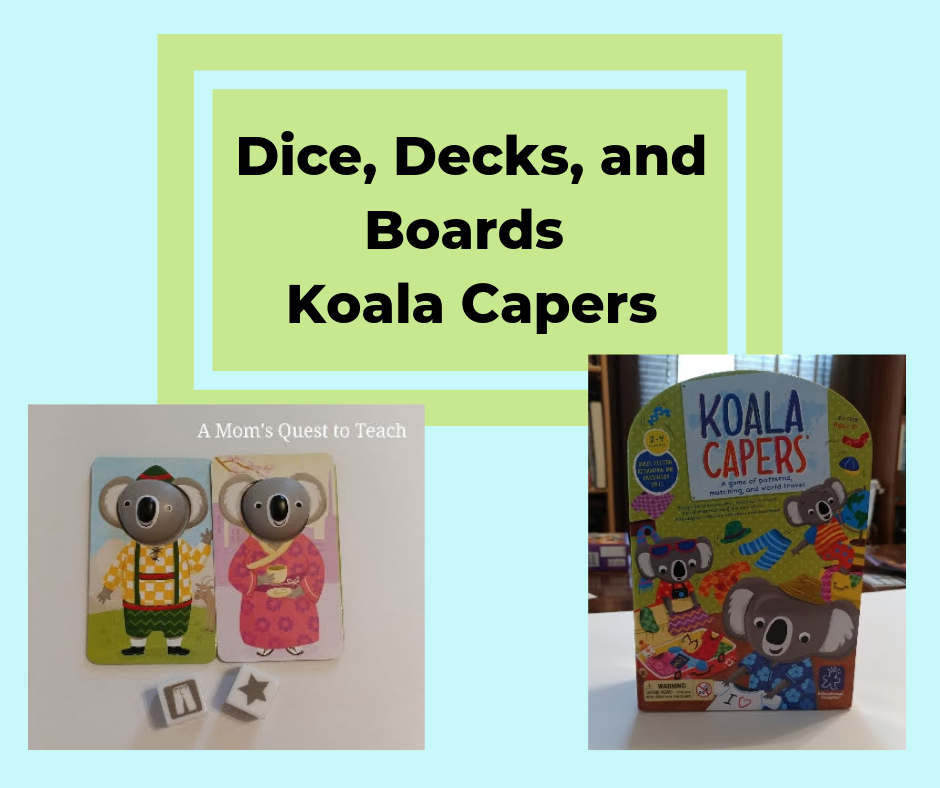
Another educational and fun game from Educational Insights is Koala Caper – a game of patterns, matching, and world travel. Perfect for ages 3 and up, Koala Capers helps build pattern recognition, observation skills, and good sportsmanship.

What Do You Get?


Your game box contains 4 koala cards with plastic raised koala faces, 20 outfit cards, 1 jumbo pattern die, and 1 jumbo outfit die. Two to four players will roll both dice and pick an outfit for their koala that matches the pattern and outfit dice. The first player to dress their koala with five outfit cards wins!

The box itself for Koala Capers is colorful with the koalas packing to travel around the world. There are 'stickers' from around the world on the box which allows you to talk about geography with your children.

The directions are provided in English (printed on the lid of Koala Capers and on a pamphlet) with the following three printed on enclosed pamphlet: Spanish, French, and German. The directions include the basic "how to play" instructions and a bonus memory game.

The outfit cards are laminated cardboard and could be bent or torn but a child would have to try to destroy them.

In general, I think the game will stand up to average play by our three- and five-year-olds.


Other Gaming Ideas 


Using the outfit cards, you and your children pick one card and look up where the person wearing it is from in the world. For example, there is an outfit for a "beefeater" or yeoman warder. There are also cards for a cowboy and one exploring the poles.


Using the dice, your children could design clothing. Roll the outfit die to see which piece of clothing your children will be designing. Then either using a template or asking your child to draw the clothing, roll the pattern die. Using the pattern that is rolled, your children can decorate the outfit.


Looking for a cute Koala Craft? 

Learn about Australian Animals on a Summer Safari for Preschoolers – there are several crafts and lots of cool facts for your little ones. 


If you enjoy Koala Capers, you might also be interested in Raccoon Rumpus which is a similar game. Or if you are interested in other games please check out the following posts:


Monday, June 4, 2018

Holidays: Father's Day Gifts for Gamers

Fallout Lunchbox, Dice, and dice bag


This post contains affiliate links. For more information please see my Terms of Use and Disclosure Policy page. Thank you.

When it comes to gift giving for Father's Day, there are so many options available. One can make a homemade card with their children, provide their husband or dad with a gift card to a outdoor store, or find something that aligns with their personal likes.

My husband loves gaming – from video games that we play together to roleplaying to board and card games. If your loved one is also into games, here are few ideas to help you find the perfect Father's Day gift.

Board and Card Games


Two of our favorite games are the Red Dragon Series and the Munchkin Series. But there are also a lot of other games we enjoy including Superfight, Monopoly, as well as cooperative games that help us work together or grow team-building and communication skills.


Roleplaying Games


My husband has been a fan of roleplaying games like Dungeons and Dragons, Top Secret, and others since he was in elementary school. Over the years he has collected a number of handbooks, modules, and materials that allow him to lead family and friends in adventures. As it is a genre where people are always adding new adventures, plots, and materials, there are multiple options for gifts within the RPG community.

And if you are really stuck, a gamer is always happy for a new set of cool looking dice! Or a way to store those dice in a purchased dice bag, lunch box (like we use), or a hand-sewn bag.

Dice cup and dice with a DM screen in background

Miniatures are also a great gift for a gamer. Especially since it doesn't matter if they have one skeleton or a hundred skeletons - they can always adapt a dungeon to include the necessary amount for the adventure.

Figures or minis of an Owlbear, Dwarf, and Golem


Video Games


XBOX One Controller and Star Wars Battlefront Guide Book
Over the years my husband has gone from playing single-player games to those that allow him to play with our teen, other family members, and me. This way, what could be a time-consuming hobby that takes one away from the family is actually turned into a team-building activity where we can all work on communication skills. Whether we are playing Minecraft, Wii Sports games, or games rated for older players like Borderlands, we can enjoy time together.

There are many options for husbands and fathers who enjoy video games. Controllers, headsets, and games are great options as well as gift cards that allow them to make in-game purchases or DLC purchases for games they already love and play often.


Then you have the T-shirts, books, collectible figures, and more affiliated accessories that many companies offer. For example, one could purchase a Fallout Crate for a fan of the Fallout Series, a bobble-head or lunchbox, or T-shirts with a D&D theme. There are so many great options for the the Gamer Dad!

Fallout Bobblehead (medicine) makes a great gift for a gamer for Father's Day