Showing posts with label Homeschool Bible Lessons. Show all posts

Tuesday, June 15, 2021

Book Club: Book Review of Help Your Kids Learn & Love the Bible

 A Mom's Quest to Teach: Book Club: Book Review of Help Your Kids Learn & Love the Bible

I received a COMPLIMENTARY copy of this book from the publisher in exchange for my honest opinion. I was not required to write a positive review, nor was I compensated in any other way. This post contains affiliate links. For more information, please see my Terms of Use and Disclosure Policy page. Thank you.

A brand new wonderful resource available to help parents on the journey to teaching their children about the Bible has been published by Bethany House Publishers. Help Your Kids Learn & Love the Bible by Danika Cooley gives parents "the tools and confidence to study the Bible as a family." In three parts and only 199 pages, Cooley provides advice, experience, and personal stories that will help parents "initiate and strengthen your child's relationship with the Lord through His Word." 

About Help Your Kids Learn & Love the Bible 

Sandwiched between an introduction where readers are introduced to the idea that they are Generation Bible and a conclusion that reminds us of several real-world stories that "the whole Christian history is full of faithful parents" (184) are three parts that give you the practical advice and concrete ways in which you can help your children learn and love the Bible. 

The message at the heart of Help Your Kids Learn & Love the Bible is that as a family you can read the Bible from cover to cover, no matter if you have preschoolers or high schoolers. Reading the Bible as a family can become a natural part of our day using the plan and advice of Cooley.

A Mom's Quest to Teach: Book Club: Book Review of Help Your Kids Learn & Love the Bible cover of the book


Part One: You're the Leader 

Cooley helps put to bed the myth that the Bible is too difficult to read as a family. Our children can appreciate the Bible as we find a translation that works for our family, look at which parts we can skip for our younger children (for now), and find ways to go to God and His Word every day. And yes, there will be times when we need to adjust our plans, but that is okay. 

Part Two: Faithful Reading 

To help parents understand the Bible, Cooley looks at the authors of the Bible, all the "i" words - inspired, inerrant, and infallible, how the Bible is organized, and the primary themes of the Bible. I truly appreciated Cooley's reminder to look for the main themes and read the Scripture in context. 

Part Three: A Daily Walk 

In this final section, Danika Cooley shares how to actually help your kids learn and love the Bible. From round-robin Bible reading to concrete hands-on activities, there are so many wonderful ways shared to help parents. Songs, puppet shows, memorizing scripture, praying the Bible, and other ideas will help you make your Bible reading time come to life. 


book cover of Help Your Kids Learn & Love the Bible


My Thoughts 

I loved Help Your Kids Learn & Love the Bible. The practical advice and suggestions for teaching your children, like creating a 'bookcase' of the genres of the Bible, to the personal stories the author shared were wonderful. One of the things I liked the most about Cooley's book is the fact that she speaks of her homeschooling experience. As a homeschooling family ourselves, it was nice to read about how one mom incorporated the Bible into her family's homeschooling day.

While reading Help Your Kids Learn & Love the Bible, I had my pen ready because there were so many parts that I wanted to notate and revisit. Even though we use several different homeschooling curriculum pieces that allow us to bring the Bible into our daily lessons, I found many new ideas from Cooley's book. I want our family to work on Scripture memorization more and create more crafts with our younger children. I also want to go through the list of works consulted to find more information to help our family grow in the Word of God. 

I recommend Help Your Kids Learn & Love the Bible to parents whether their children are homeschooled or attend public or private school. There is so much useful information and advice to help us set up a routine of Bible reading. Churches would also find the book helpful so they can minister to their families and help them bring their children to the Bible. I feel this book will help our children fill their hearts full of Scripture. 


Wednesday, July 29, 2020

Studying the Bible: A Review of The LIFE Plan

Text: Studying the Bible: A Review of The LIFE Plan; logo of A Mom's Quest to Teach; background faded confetti

Disclaimer: I received a FREE copy of this product through the HOMESCHOOL REVIEW CREW in exchange for my honest review. I was not required to write a positive review nor was I compensated in any other way.

Over the past several weeks our family has been using The LIFE Plan by Allen L. Elder from The LIFE Network to study the Bible. Our younger children, my husband, and I started with Volume 1: The Bible's Story: Genesis 1-11 while our teen started reading Volume 3: The Structure of the Entire Bible. I spent some time reading through Volume 4: The Life of Jesus on Earth by myself in the evenings.

The mission of The LIFE Network is to produce, publish, present, and provide Christian learning resources. They help to establish and support the growth of churches both locally and globally as well as provide spiritual training and physical resources for pastors and churches. The LIFE Plan is one of those resources. It will take the reader from the beginning with God to helping fulfill God's purpose in one's life.

Text: Studying the Bible: A Review of The LIFE Plan; Prepare to live intentionally and strategically for God; image of 2 The LIFE Plan books; flower clip art; logo for A Mom's Quest to Teach


What Books Did We Receive? 


There are six volumes in The LIFE Plan which contain 216 lessons. "The LIFE Plan is a discipleship curriculum which takes you from a beginning with God into a life lived according to his purpose and for his glory" (ix).  LIFE stands for Living Intentionally For Eternity. The goal of the books is for followers of Jesus to live a life according to His purpose and glory.


  • The LIFE Plan Volume 1: The Bible's Story: Genesis 1-11 
  • The LIFE Plan Volume 2: The Bible's Story Genesis 12-Malachi 
  • The LIFE Plan Volume 3: The Structure of the Entire Bible 
  • The LIFE Plan Volume 4: The Life of Jesus on Earth 
  • The LIFE Plan Volume 5: The Church 
  • The LIFE Plan Volume 6: Your Personal Ministry 
covers of The LIFE Plan volumes 1-6; logo for A Mom's Quest to Teach

The volumes are paperback books (size 8.5" by 11"). Each lesson is designed in a similar manner. The lesson starts with the theme, lesson aim, and scripture reference. There is then a one- to three-page reading that addressed the topic following by an outline, Scriptures for you and your family to read to broaden your understanding of the topic, theological connections, a lesson glossary with vocabulary, and finally questions to answer. I highly appreciate it when a curriculum is presented in the same manner. It makes it easier to know how to prepare for the next day as well as provides reassurance for children as to what to expect.  

How Did We Use The LIFE Plan in our Homeschool?


When the six-volume set arrived, I looked through the volumes to determine which book I wanted to read on my own and which one would be best to hand to our teenage son for him to read independently. I knew I wanted to start with Volume 1 with our younger children. My husband and I sat down and looked through them and decided upon giving Volume 3 to our teenage son.

During the beginning of our studies, I sat with our younger children after dinner and read from Volume 1. They both sat at the dining room table with me and had their Bibles ready to start reading the Scriptures referenced. I would read through the reading selection aloud - stopping frequently to discuss the ideas and topics with our younger homeschooled children. I then used the lesson outline to review the ideas with them - to make sure they understand what I had read aloud. Next, we all took turns reading the Scriptures to Broaden Your Understanding. I loved that this curriculum allowed them the opportunity to practice finding different Scriptures in the Bible. Through our time use The LIFE Plan, they have become more family with the Bible and the order of the books of the Bible. I did skip the Lines of Theological Connection and sometimes the Lesson Glossary with our younger children and some of the questions.

page from The LIFE Plan Volume 1; page in Bible
Reading aloud the Scriptures to Broaden Your Understanding


One of the things that I love is that our younger children will be able to work through the curriculum twice over the course of their homeschooling studies. This will hopefully bring them into a much closer relationship with God and a better understanding of the Bible.

reading page in Bible
On some nights, our daughter sat across the table from me with her Bible.


Volume 1: The Bible's Story: Genesis 1-11 is taking us through the seven days of creation as well as reintroducing us "to the one true and living God," presenting the idea of the holy trinity, discusses sin, temptation, and other important events in the first 11 books of the Bible. As our children are young, things a bit more slowly (originally we were doing one lesson a day). But by the end of this week, we will have finished reading about the creation and start learning more about how man and woman bear the image of God.

The LIFE Plan Volume 4 book cover

During the evenings, I took the time to read through Volume 4: The Life of Jesus on Earth. I sometimes read several lessons each evening and skipped reading the Scriptures to Broaden your Understanding and questions, as I was more interested in reading what the author, Allen L. Elder wanted to convey to his readers. I will probably go back and use the books with all the lesson features at a future time to have a more in-depth Bible study.

Volume 4: The Life of Jesus on Earth starts with the Messianic Prophecies and quickly moves on through Jesus' birth and childhood (touching upon the fact that while we don't know a lot about Jesus' childhood, we can see that he had a great understanding of the things of God). The next several lessons discuss the plan of Jesus and disciple-making. Elder describes the steps that Jesus presented to make disciples - which we are meant to do as Christians. One of the lessons even has a matching section to help you remember the step-by-step method for making disciples.

Text: "A Follower of Christ is to both be a disciple and is to make disciples" (33). The LIFE Plan; A Mom's Ques tot Teach


During the writing of this review, I am in the middle of the lessons demonstrating how Jesus was a healer in Volume 4: The Life of Jesus on Earth. I am reminded that Jesus healed in various ways, as presented in the text and outline: by speaking, commanding the sick to do something, and by touch. The healing of individuals revealed to his followers and to us that Jesus is sovereign and a deity. Everything that Jesus did was for a reason to reveal who he was.

I really like how the books are written and I can see them being very useful in our future homeschooling years. While I think it might be helpful to read the books in order, since I am reading Volumes 1 and 4 I haven't really felt any confusion. So if you are more interested in one volume over another, you probably can make the decision to purchase or read that one first. And so far I haven't seen any problems with our children using different translations of the Bible to read the Scripture mentioned in the books. And finally, I love the amount of space in the books for notetaking.

one of the pages in The LIFE Plan Volume 1

Each book could be used over the course of one homeschool year. So if you purchase the entire six-volume set you have six years worth of elementary level curriculum (grades 1-6). You could then have your homeschooling students complete the work again in grades 7-12 so they will have worked through each book twice during the homeschooling years.

An Overview of What is to Come 


As we have not spent time with volumes 2, 5, and 6 yet, I would like to provide a brief overview of the information presented in those books. Each book is similar in length ranging from 183 to 201 pages – printed in the United States. Just like with the other volumes, they are presented in the same manner with text to read, an outline, scripture references, and questions.

Volume 2: Abraham and Israel focuses upon God calling Abraham, the lives of Isaac, Jacob, and Moses. Readers then follow the story of the Bible through reading about the different leaders of Israel like King Saul, King David, and King Solomon. In general, Volume 2 presents a brief overview of the history of Israel and then closes with looking at the prophets in the Old Testament.

If you want to study the church from a biblical perspective then start with Volume 5: The Church. Over the course of 36 lessons (which you can complete over 36 weeks/one homeschool year), you will learn about the early days of the church, how the church spread, broke, was reformed, and continues to this day. There are also chapters on non-Christian religions, cults, and the occult. The author recommends that Christians should be grounded in the Word of God to help them in dealing with other religions.

The final volume, Your Part in the Story, helps you bring everything together so that you can make disciples. The final year (which will be 6 grade and 12 grade if you follow the suggested plan) is "focused on what you will do with your training for the rest of your life" (1). The reading text for the lessons is a little bit longer than some of the ones we are currently reading and the questions ask readers to delve even deeper into their beliefs. Some questions include: "Are you growing in Christ as a child of God?" and "Have you believed on Jesus for salvation?"
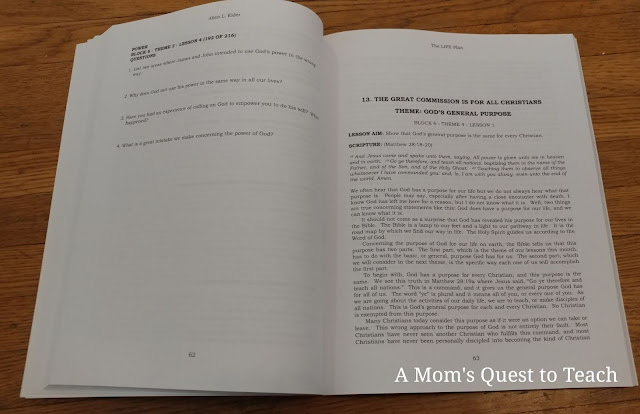
page from The LIFE Plan
Easy-to-read font

I think The LIFE Plan would be a welcome addition to a homeschool family, a church ministry, or someone going on a mission trip. The information is presented in a clear and concise manner and provides plenty of opportunities to get back into the Bible and read the word of God. The questions also provide the perfect starting point for discussing our beliefs with others. And if you are stumped on an answer, check the back of the book for the answer key.

Do You Want to Learn More?


The LIFE Plan logo


Website – Facebook – YouTube 

There were several other members of the Homeschool Review Crew who had the chance to use The LIFE Plan in their homeschool. Please be sure to read their reviews, too.

Homeschool Review Crew Click Here Logo

Wednesday, March 18, 2020

Looking to Connect with God Using The Action Bible Anytime Devotions

A Mom's Quest to Teach logo; David C Cook logo; Anytime Devotions book cover; text: Looking to Connect with God Using The Action Bible Anytime Devotions

Disclaimer: I received a FREE copy of this product through the HOMESCHOOL REVIEW CREW in exchange for my honest review. I was not required to write a positive review nor was I compensated in any other way.

Our son enjoys reading different youth bibles and devotionals so he was very excited to review The Action Bible Anytime Devotions from David C Cook. We approached this devotional in several ways in our homeschool. From my passing it to our first grader to read independently, to our son and I sitting together to read some of the devotions together, to our daughter and I reading a few of them together before bedtime. There are quite a number of ways in which one could incorporate The Action Bible Anytime Devotions: 90 Ways to Help Kids Connect with God Anytime, Anywhere into their children's' lives.

The Basics of the Book


The paperback book is 193 pages with a set of illustrations by Sergio Cariello that repeat as you read through the book. There is a place to write the name of the child to whom you are presenting the book, along with your own name and the date. It is geared for children ages 8-12 years old to help them learn about God's world, relate to the people in the Bible as real people, think about the Bible in a way that will help them grow, and apply the lessons to their own life. There are eight general topics covered that address many important difficulties and problems that children may be facing in their everyday lives. In total, there are 90 devotions to read.
image from The Action Bible Anytime Devotions; text: Looking to Connect with God Using The Action Bible Anytime Devotions; "What can you do when you are confronted with real-world problems? Explore God's Word!"

The topics include:
  • Love
  • Courage
  • Hope
  • Trust
  • Faith
  • Kindness
  • Strength 
  • Service

If you or your child wishes to focus upon a specific topic, you or they can flip through the book as the topics are listed on the top right-hand side of the pages. Or you can look through the table of contents where the topics are listed behind the devotion title but before the Bible reference. The manner in which the book is laid out makes it easy to find topics that might help address your child's current worry, problem, or concern.

Each two-page devotion opens with a quote from the Bible and then a story to help make connections to the real world. From there, children are introduced to questions that will help them explore the topic on their own, a prayer relating to the topic, and a way they can take it further by reading in their Bible (the book references The Action Bible).

Take it Further image from The Action Bible Anytime Devotions book


Each devotion does not take long to read – probably only a couple of minutes. We were able to read several different ones before bedtime one evening.

How Did We Use Anytime Devotions in Our Homeschool?


Like with most books, I gave The Action Bible Anytime Devotions book to our first grader when it arrived for him to read on his own. He read through several devotions, flipping through and picking and choosing from the book based upon the various specific topics. He then pointed out some that might be helpful for his sister to read or have read to her.

Reading The Action Bible Anytime Devotions book

Taking a break from our writing curriculum that includes Bible stories, I incorporated the Devotions into our everyday lessons. Our first grader and I would sit down together and read through one devotion. We talked about the quote that was chosen as well as the story that was shared. We then went through the story and talked about whether or not our son had ever felt like the boy or girl in that story. We answered the questions provided. I read the prayer and on one occasion our son said, "I really need to remember this prayer." Finally, we sometimes looked in my Bible "take it further."

One of the devotions I read with both our younger children was "Always Time to Forgive." Like many siblings, our son and daughter get into arguments. The story shared in this devotion was about a brother and sister who play video games with each (much like our children) but on this occasion, Sarah ended her brother's turn playing the game early. There have been a number of times that our daughter has 'ruined' something in the Minecraft world, upsetting her brother. And of course, he has said he never wants to play games with her again. But they always do – sometimes after a long period of cooling off or lots of intervention and discussion from myself or my husband. After reading through this devotion, my hope is that both will remember how important it is to forgive not just seven times but seventy times seven times.

When I asked our son which devotions he wanted to read, he would flip through the book and look at the different topics to pick and choose which to read. Having the topics listed at the top of the pages was very helpful!

page from The Action Bible Anytime Devotions book with Trust circled on top right corner of the page

He would also use the table of contents to pick and choose which devotions he wanted to read each evening. The table of contents had lots of useful information that he used to choose from the topics to Bible references.

Table of Contents from The Action Bible Anytime Devotions with some key words circled

What Did We Think?


I think that The Action Bible Anytime Devotions is a great resource for children and their families who are looking to connect with God through His Word. The use of 'action verses,' prayers, and references to Scripture really brings the Devotions to life in my eyes. I appreciate that the book is not just a collection of stories or prayers for children. It really does try to meet multiple needs for children. I also really enjoyed the illustrations. I just wish there were more than one set that repeated as well as ones that were more directly connected with each devotion.

Our four-year-old daughter likes the pictures in the book, too. One of her favorite illustrations was Jonah and the fish. As she was looking at the pictures, she would recount the stories she was familiar with from the Bible. She was also impressed with how large Goliath was in the illustration of him fighting David.

book cover of The Action Bible Anytime Devotions

When I asked our six-year-old son what he enjoyed the most he said, he liked the inclusion of the real-world struggles and how they tied into the rest of the devotion. He liked reading about the examples of other children and their problems. One of the devotions that stuck out to him was "For Times When You Need a Guide." The real-world struggle presented is that of Chad approaching a group of older boys who are looking at bad videos on someone's phone. Chad knew it was wrong and walked away. The devotion then goes on to remind children that Jesus sends the Holy Spirit as a guide to help them when they might not know what to do. I think this is a great devotion to include in the book because too many of our children will be tested with inappropriate content when we, as parents, are not around to offer advice.

I would recommend The Action Bible Anytime Devotions to families who are seeking a book for their preteen to read either independently or with their parents that will help guide them to God's message. It is the perfect size for them to carry in their backpack and take with them to use at any time.


Do You Want To Learn More? 


David C Cook logo


David C Cook publishes a great number of excellent books and they also help spread the Gospel around the world when people purchase books, music, and curriculum.

Website – Facebook – Twitter – Instagram – Pinterest – YouTube 

Our family was only one of many that had the opportunity to read and review The Action Bible Anytime Devotions in their homeschool. Please visit the reviews to see what other members of the Homeschool Review Crew thought of this newest book from David C Cook.

Homeschool Review Crew Click Here

Monday, February 10, 2020

Teaching the Old Testament to Children: Review of What God is Doing

A Mom's Quest to Teach (logo); Book Club: What God is Doing: Old Testament Object Lessons for Kids by Anne Marie Gosnell; book cover; Future Flying Saucers logo

Disclaimer: I received a FREE PDF copy of this book from the author in exchange for my honest opinion. I was not required to write a positive review nor was I compensated in any other way. This post contains affiliate links. For more information, please see my Terms of Use and Disclosure Policy page. Thank you.

I had the privilege of receiving a PDF of What God is Doing: Old Testament Object Lessons for Kids by Anne Marie Gosnell to review with our family. I have previously read and reviewed Helping Your Children Become Prayer Warriors and also enjoyed watching the explanation of Bible object lessons on the YouTube page, "Bible Object Lessons for Kids." I have wanted to try some of these with our own children. So, having access to the text of What God is Doing was a fantastic opportunity for me.

What Can You Find in What God is Doing?


There are 25 interactive lessons geared towards children ages 5 to 12 in What God is Doing: Old Testament Object Lessons for Kids. Anne Marie Gosnell wrote each lesson to take about 20-30 minutes with one main goal in mind: to show how God is bringing about His plan of salvation. From examining the experiences of Adam and Eve in Eden to Nehemiah building the wall, the main focus of this curriculum is the Old Testament as you may have already gathered from the subtitle (Old Testament Object Lessons for Kids). There are two lessons at the end of What God is Doing which address the time that elapsed between the Old and New Testaments (between Malachi and the birth of Jesus) which bring a nice conclusion to the book.

In addition to the 25 object lessons, there are a number of other chapters to help you get the most of What God is Doing. For example, there is an introduction, a chapter on how the book works with links to resource pages, tips and advice on how to become an excellent Bible teacher, and coloring pages for you and your children.

Book Club: Book Review; What God is Doing book cover

Each lesson contains the following elements:

  • Scripture Focus
  • Materials
  • Geography
  • Background 
  • The Object Lesson itself
  • The Bible Lesson
  • A Life Application 
  • A Comment Box for the teacher to answer the questions "What went well as you taught this lesson? What can you do better?" 


Quote from What God is Doing by Anne Marie Gosnell: "Fear. You cannot see it, but you can surely see the effects of it." In one of 25 object lessons, shown children how God is with us wherever we go.

How Did We Use What God is Doing: Old Testament Object Lessons for Kids


During the time we were reviewing this thorough book, we took a look at a few lessons. Specifically, I would like to talk about our experiences with Lesson 7: Abraham's Challenge to Sacrifice Isaac and Lesson 9: Jacob Wrestles with God. As we have the PDF of the book, I printed out the pages necessary to read ahead of time as well as the black and white image that accompanies the lesson (for our children to color).

We actually took a look at Jacob Wrestles with God first because I knew that our daughter would really enjoy the focal point of the object lesson. In this lesson, we made oobleck. We have never made this before in our homeschool, so I knew this would be a memorable experience for them. Our daughter really enjoyed helping me prepare the oobleck while our son colored in the picture. This was really a wonderful piece to include in the lesson to teach about how we often have hard hearts when we encounter God (like the solid nature of the oobleck) but "in God's hand we become usable, flexible, and able to glorify God" (59).

empty container, measuring cup, cornstarch, Jacob Wrestles with God lesson plan
Getting the materials together for the object lesson.

coloring picture that accompanies Jacob Wrestles with God

oobleck
The oobleck was hard when punched but soft if you rested your hand on it.


The second lesson I would like to share is that of Abraham's Challenge to Sacrifice Isaac. The materials for this lesson were quite simple to gather: a small model or picture of a ram and several colors of construction paper. We read about the promise given to Abram and Sarai and their name changes, compared the story of Isaac to that of Jesus, and looked through the wordless picture book I created with the construction paper.

Lesson plan page; yellow construction paper


After we used some of the lessons from What God is Doing: Old Testament Object Lessons for Kids, we were able to tie it back into our son's language arts where we are reading excerpts from the Bible and writing sentences about them. We also were able to find videos of the stories we read to watch during lunchtime. So, the lessons in the book fit in perfectly with our homeschooling day. 

What do I Think?


This is a tremendously well-organized book with lots of great information! This book would be good for homeschooling families or those who are Bible teachers or Sunday School teachers. There are lessons that require more than a couple of children but they can be easily adapted, if necessary.

There are resources available including video links for a few of the lessons and the posters are available to either purchase or download as individual posters. This is quite helpful when planning out the lesson.

I also like that in most cases the materials necessary for the lessons are quite easy to gather together. There are only a few that require a trip to the store—like if you don't have toy plastic insects for the lesson on the twelve spies and the wandering or the cornstarch needed for the lesson about Jacob wrestling with God.

I also like how Anne Marie Gosnell helps us teach our children difficult lessons from the Bible in simple ways, including ways to apply the information to their own lives. For example, in the lesson regarding Anointed King David, children learn about how God sees inside our heart. Even if the outside looks good, the inside might not be good. A chocolate candy box and a clear candy jar are used in the lesson and the life application portion reminds children that God can see through us just like we can see through the clear jar.

What God is Doing book cover; two coloring pages; A Mom's Quest to Teach logo


Finally, I especially liked how using the lessons from What God is Doing: Old Testament Object Lessons for Kids allowed our children to demonstrate the knowledge they had previously learned from homeschooling and Sunday School. When asking one of the questions from Abraham's Challenge to Sacrifice Issac ("What do we know about sheep and the Old Testament?"), my children were able to discuss how David protected sheep (from lions and bears) prior to his fighting Goliath. Our son also shared a modified version of the parable of The Lost Sheep—of how the shepherd goes after the one sheep that runs away. They also recalled a new version of a song they were learning about Father Abraham at Sunday School. All of these connections to homeschooling and church combined are why I can easily and enthusiastically recommend What God is Doing: Old Testament Object Lessons for Kids by Anne Marie Gosnell.

Future Flying Saucers logo

Would You Like to Learn More about Anne Marie Gosnell? 


Monday, June 10, 2019

Classical Approach to Learning How to Write Sentences: Reviewing Products from Memoria Press

Reviewing: Simply Classical Writing Book One: Step-by-Step Sentences (Bible Story Edition) and Simply Classical Writing Book Two: Step-by-Step Sentences (Bible Story Edition) with Teacher Key, Skill level about 1st-3rd grade


Our family was excited for the opportunity to review products again from Memoria Press. Our son has been using the Simply Classical Writing Book One: Step-by-Step Sentences (Bible Story Edition) for the past several weeks. As part of the review we received three paperback books from Memoria Press:


Each book is designed to provide a full year's worth of instructions when approached at a slower pace. The books are part of the Memoria Press Classical Curriculum adapted for Special Needs. A Classical Christian education is one in which children are trained in the liberal arts and are introduced to the great books and great thinkers of Western tradition. With the slower pace of these books adapted for Special Needs, families can provide a Classical Education for all of their children. However, your child does not need to be classified as special needs in order to benefit from using these slower-paced books.  I would use Simply Classical Writing books with all children. They provide a firm foundation in learning how to write.


In the beginning of the 118-page Book One, there are two pages of Teacher Notes that outline supplies, how to teach the curriculum, an outline explaining day by day activities, and recommendations for special situations.

Each week consists of the following activities: 

  • Read the assigned story
  • Learn the rules
  • Copy and mark decodable sentences
  • Read-Aloud sentences
  • Create a sentence
  • Challenge sentence – students will use their own words to tell something that happened in the story – our almost six-year-old found this to be one of the harder tasks for him 
  • Illustrate and describe the drawing – students draw something talked about in the story and then write a caption for their picture 
The sentences our son copied, wrote, and created were marked using colored pencils according to the instructions: 
  • Green for capital letters at the beginning of the sentence
  • Red for the ending punctuation 
  • Blue for specific names that need to capitalized (in our lessons, these were God, Eden, Adam, and so on) 
In the beginning, we worked on reviewing the rules. You can see how he circled the beginning letter of the sentence.
We had to review what words needed to be circled in blue on more than one occasion. 

Each week's work is spread out over three pages and – depending on your child and their ability – you could take a week to complete the work as suggested or less time. For example, some days we completed one whole weeks' sentences and other days we only worked on one or two parts. In general, we took two days to complete each lesson. 

Our son had some difficulty with the challenge sentence and the illustrate and describe part, so we usually did these two on separate days. As Simply Classical Writing Book One is geared towards ages 6-8, it did not surprise me that our son would need more assistance with some of the work. 


How We Used the Book 


We started using Simply Classical Writing Book One: Step-by-Step Sentences as soon as it arrived. We were both pretty excited to get started.

I decided to break up the rules about sentences (there are four pages) into separate lessons. We started with the first four rules. Then, each day I would introduce one more rule while reviewing the previous ones briefly. Sometimes I wrote them on our small white board and other times we read directly from the book. 


As this is the Bible Story Edition, it is recommended to have an introductory Bible story collection. They teach from A Child's Garden of Bible Stories. As we already have three illustrated collections, I used these books. If a lesson took us more than one day, I even swapped which book we were using to read the story. So while one book might have information regarding Moses as just a baby, hearing the word of God, and then leading his people out of Egypt; another of our books told of the plagues and wandering in the desert. This gave our son lots to pick from when he was writing his own challenge sentence for several lessons (weeks 8-10). 

On the first day, I would read the story to both our children. Then our son and I would work on the lesson together. The next day I would read the story again (or use a different book) and then he would complete the lesson.

When working the challenge sentence and the illustration, he would often have the book in
front of him for reference as you can see at the top of this photograph. 


What I Like 


I like how this seamlessly incorporates Bible reading into our day. It is great to talk about the Bible – such stories as that of Abraham and Sarah, Elijah, Daniel and the Lions, the message delivered to Mary by the Angel, the miracles of Jesus, the parables of Jesus, and His death and resurrection – during our language arts lessons. So while our son gains a firm foundation in sentence writing and learns about nouns, verbs, punctuation, and more; he is also receiving a firm foundation in his faith. 

I also appreciate the binding of the book, the quality of the pages (they can take quite a bit of erasing), and the fact that there is ample room to write in the book on the lines provided. At the end of Week 34, there is an appendix with a certificate for completion and a reproducible template for further practice. I think this is fantastic as it will let us continue to use this format (which works) when we read other books and stories.

Because of the high quality of the pages, I could have asked our son to erase the first sentence where he forgot two words. Instead I decided to show him two editing notations to help him correct his mistake. 

The lessons allow us to discuss how wonderfully God provides for His people.


I also think using Simply Classical Book One: Step-by-Step Sentences has helped our son's handwriting tremendously (see example above). The copy work is serving a dual purpose – he is working on his ability to construct sentences, learning grammar rules, and improving his handwriting.


Looking Forward to Book Two 


We will probably begin to work with Simply Classical Writing Book Two in the new year – January 2020. I think finishing up Book One slowly will enable our son to continue to grow as a writer, give him some free time over the summer, and let us focus on building the foundation for writing good sentences using the classical approach of Memoria Press. 

I previewed Book Two so I would be able to schedule the lessons into our homeschooling planner. I like that Book Two continues with the same basic format as Book One but then includes instructions in grammar and sentence writing that are a little more complex. It looks like there is a lot of natural progression for students as they move from one book to the next.

I have included two photographs from the Student Guide and one photograph from the Teacher's Guide to give you an idea of how the lessons change to introduce more complex topics. Students will learn about nouns, pronouns, verbs, commas, apostrophes, synonyms, antonyms, adjectives, adverbs, and how to start writing paragraphs. Mixed into the lessons on all these important concepts are reviews built in for your child. Book Two also has an appendix with some great items like a week-by-week list of themes, scriptures referenced, and the page in the recommended story Bible. There are also a couple of reproducible pages to help you continue the lessons. I am very excited to start working on this book in the new homeschool year with our son.

Simply Classical Book Two: Step-by-Step Sentences


Teacher's Guide


If you would like learn more about Memoria Press, please visit the following:


Memoria Press gave families the opportunity to review several products including:


I think all these look like excellent products so I can't wait to check out the reviews myself to see what the members of the Homeschool Review Crew think about them.