Showing posts with label Elementary Homeschool Courses. Show all posts

Thursday, February 29, 2024

Adding Writing Into Our Curriculum: A Review of Daily 6-Trait Writing Grade 3

 A Mom's Quest to Teach logo: Adding Writing Into Our Curriculum: A Review of Daily 6-Trait Writing Grade 3

I received a COMPLIMENTARY copy of this book from Timberdoodle in exchange for my honest opinion. I was not required to write a positive review, nor was I compensated in any other way. This post contains affiliate links. Please see my Terms of Use and Disclosure Policy page for more information. Thank you.

While many of the subjects our third-grader has been studying include some writing, nothing focused on it specifically. So, I wanted to add writing to our curriculum, and with the opportunity to review Daily 6-Trait Writing Grade 3, it was the perfect time.


About the Workbook 

The workbook is designed to be used in a classroom setting. The lesson plan information is located at the beginning of each week for the teacher. Because of the way the book is set up, two of the four days of worksheets has the teacher's lesson plans located on them. So, you will need to decide – how will you share the work with your child(ren)? I photocopied side one and four for our daughter and then pulled out day two and three of the workbook.

teacher instruction pages

Each week has a similar set up. Monday introduces the idea or concept, children practice it with short passages and questions on Tuesday and Wednesday, brainstorm ideas on Thursday, and then write on Friday. 

The book has 5 units: 

  • Ideas
  • Organization 
  • Word Choice
  • Sentence Fluency 
  • Voice 
  • Conventions 
And each unit has five weeks of lessons. These lessons are geared towards being taught with more than one child. For example, opportunities are given for students to work together and for you to collect ideas from a classroom of children. I found some of this put pressure on our daughter. She wasn't always willing or able to answer every question in the teacher lesson plans, so I had to adapt lessons quite a lot. 

A Mom's Quest to Teach: Adding Writing Into Our Curriculum: A Review of Daily 6-Trait Writing Grade 3 cover of book


Our Thoughts 


I really like the idea of Daily 6-Trait Writing Grade 3 as it provides short assignments focused on key topics that will help your child become a better writer. Mixed in are short grammar lessons, such as the discussion of commas when teaching about organization. These two topics fit hand-in-hand. 

With each week following a similar teaching pattern, children who thrive on consistency will do well. Knowing what to expect is important for children, and this workbook sets them up for success. However, if they find one or more activity difficult, they may dread those days. Our daughter was not fond of writing when we started out, so Fridays were not a fun day for her. I ended up staggering when I would start each week, so that the activities did not always fall on the same days. In other words, weeks would start on a Wednesday or Thursday, and then we would pick up again on Monday.

As a former teacher, I really wanted to like using Daily 6-Trait Writing Grade 3 in our homeschool. Unfortunately, I am finding out that the longer we homeschool, the more books designed for the classroom don't work for our family. With teaching only two children who don't happen to be on the same level for writing, it was difficult to make this resource work in our curriculum.

This is a good resource if you are teaching multiple children out of one workbook. With reproducible student pages and the opportunity for lots of class discussion, this will really help you add writing into your curriculum. There is an assessment rubric, so if you are unsure as to how to grade or evaluate your child(ren)'s work, you can do so easily. The tools are there to help teachers (and parents). 

One of the features I really like is something quite simple. At the end of the book there is a page of proofreading marks. I really like that the common proofreading marks are all listed on page. We'll be copying that and keeping that in the front of our language arts notebook for easy reference! 

A Mom's Quest to Teach logo: Adding Writing Into Our Curriculum; page from book and clipart of boy writing


Other Things to Know When Adding Writing Into Your Curriculum 


Daily 6-Trait Writing Grade 3 is published by Evan-Moor®. Permission is given to photocopy the pages in the book for single-classroom use. Correlations are available online for the current standards. So if you are interested in adhering to national standards, you have that information at your fingertips. 

There is a handy "How to Use This Book" guide in the beginning. This explains the teacher overview pages, the student activity pages, and ways to use the book. You can teach the lessons trait by trait or just pull out the lessons for the topics where your child(ren) need help and extra support. 

More Curriculum Choices 


Are you looking for more for your homeschool? Check out my other posts featuring Timberdoodle products. 

Wednesday, November 22, 2023

Homeschooling Second Grade


This post contains affiliate links. Please see my Terms of Use and Disclosure Policy page for more information. Thank you.

This was our second time around homeschooling a second grader in our house. So, what did we do this time? Since this was our daughter's second-grade homeschool year, we used Adventures in U.S. History from My Father's World as our spine. We also used a variety of other resources to make this year educational and fun. 

Resources for Second Grade 

With Adventures in U.S. History as our starting point for our daughter's education, we added in lessons from Math Mammoth, Skill Sharpeners Geography – Grade 2, Stepping into Science Kit, and Science: Lessons and Investigations - Grade 2. We also used Math Challenge from Memoria Press and I Can Do All Things Book and DVD for art.

We read wonderful books for history and as read-alouds. These included: 


One of our favorite resources was the Patriotic Songs of the U.S.A. CD that was part of the second-grade curriculum. It contained the following songs: 
  • God Bless America 
  • America
  • Yankee Doodle
  • America the Beautiful 
  • There Are Many Flags
  • The Star-Spangled Banner 
  • You're a Grand Old Flag
  • The Stars and Stripes Forever
  • Columbia the Gem of the Ocean 
  • The Battle Hymn of the Republic 
  • Armed Services Medley 
We spent the year listening to each song for two to three weeks and learning the words. It was fun singing along with the songs with our children. We also spent time looking for different versions of the songs to hear the different lyrics and musical choices. 


Homeschooling Second Grade Science 


We used a variety of science resources including those that are part of Adventures in U.S. History: 
And a fun science kit we reviewed, courtesy of Timberdoodle, brought science to life with more experiments. There were quite a few experiments from all these resources that our children loved doing! 


A Fun Year 


Homeschooling second grade was so much fun. Our daughter built upon the skills she started in kindergarten and first grade with My Father's World. We spent time working on speed and accuracy in math. We read more books and dug deeper into U.S. History with Drive Thru History, our read-alouds, timeline, and more. And we also worked on adding more Scripture to our memorization work. 

Adventures in U.S. History was a great curriculum for both our daughter and son. It was our spine for our daughter and we used the history, scripture, and read-alouds for our son. I can't wait to see where Exploring Countries and Cultures will take our family!

Tuesday, August 15, 2023

Bring Science to Life with Timberdoodle

 A Mom's Quest to Teach — Bring Science to Life with Timberdoodle

I received a COMPLIMENTARY copy of this kit from Timberdoodle in exchange for my honest opinion. I was not required to write a positive review, nor was I compensated in any other way. This post contains affiliate links. Please see my Terms of Use and Disclosure Policy page for more information. Thank you.

Science is one of those homeschool subjects that I both love and dislike. When I can teach about animals, habitats, or nature, I am in my element. I worked for many years, both part-time and full-time, at a metropolitan zoo in the education department. But when it comes to the other areas of science, I often feel I am at a loss. So when I get the chance to use a kit to help teach science, it makes my homeschool day! 

We have been using the Stepping into Science Kit, which is part of the Kindergarten Curriculum Kit from Timberdoodle. While we have a set science curriculum for both our second grader and our fourth grader, I love bringing science to life with additional experiments. This kit provides new ideas and experiments for relaxed summer homeschool days. 

What is Part of the Stepping into Science Kit? 

This science kit contains an experiment manual and 28 separate types of materials for the experiments. These experiments fall into five different categories: 

  • Experiments in Nature 
  • Experiments in Physics
  • Experiments in Air
  • Experiments in Water
  • Experiments in Chemistry 

Some of the experiments require items both in your house and ones that you might need to purchase, such as a scrap of wool or a house plant. Since you don't really need to complete the science experiments in any specific order, you can skip those if you don't have the materials. 

A sampling of specific items in the science kit includes: 

  • garden cress seeds
  • clay pot
  • modeling clay 
  • small polystyrene soap boat
  • funnel 
A Mom's Quest to Teach — Bring Science to Life with Timberdoodle - Stepping into Science Kit box


A Look at Some of the Experiments 

Experiment 1: The Cress Garden 

Our daughter really enjoyed this first experiment. She took joy in making sure the cress seeds had water each day. We even did the experiment a second time where we set up two small plates - one with water and one without water to observe the differences. 

Experiments 8 & 9: The Confetti Magnet and Salt and Pepper 

These were fun experiments to look at electrostatic charge. We did need to reach out to a family member for a scrap of wool as we didn't have wool fabric in the house. 

A Mom's Quest to Teach — Bring Science to Life with Timberdoodle - page from Stepping into Science Kit manual and straw with salt and peper


Experiments 15 & 16: Paper Airplanes 

All three of our children enjoyed taking the paper airplanes outside to test. They discovered that one flew farther and faster than the other while testing them. 

A Mom's Quest to Teach — throwing a paper airplane

Experiments 24: The Soap Boat

Not all of the experiments worked out perfectly. When we tried to move the small boat by dipping the soap-tipped drinking straw into the water, nothing happened. We hypothesized that it was because our straw had a hole in it. We will be conducting this experiment again with a new straw. And then maybe with different soap to see if that makes a difference. 

A Mom's Quest to Teach — Bring Science to Life with Timberdoodle - instruction page in manual and floating soap boat


Our Thoughts 

I always appreciate kits where everything is included. While I know that Stepping into Science can't include live plants or water, there were a few things that I wish had been included to make preparing the experiments easier. For example, finding a scrap of wool was not easy, and we haven't been able to find sugar cubes yet. 

I thought the manual was very well-organized. I especially appreciate the kit contents with the photograph and list of all the items so I could check them off. And while I know that the manual was written to younger children, I wish there had been longer explanations for some of the experiments. Or maybe even an online resource so we could find out more information. 

Our daughter and son both loved when I said it was time for science. And they are eagerly awaiting the completion of the rest of the experiments. Stepping into Science really helped bring science to life this summer. 

I would recommend this kit to families with younger children (preschool-first grade). It is a great way to introduce experiments to children. It doesn't matter if you homeschool your children or not. You could easily complete a few experiments over the weekend to reinforce what your children are learning in their public, private, or homeschool lessons. 

We still have experiments left! Which one should we try next? 

  • The floating paper clip 
  • Super soap bubbles 
  • Color detective 
If you want to see what else Timberdoodle has to offer families, please check out my following reviews: 

Wednesday, June 21, 2023

How Do I Teach in My Homeschool?

A Mom's Quest to Teach: How Do I Teach in My Homeschool?

This post contains affiliate links. Please see my Terms of Use and Disclosure Policy page for more information. Thank you.

New and seasoned homeschoolers are always interested in how others homeschool. Whether they want to know because they are starting on the homeschool journey themselves or they want to see if there is a better way to homeschool, the goings on in other homeschool households are always fun to read about! And as we modify and adapt our homeschool lessons and days as our children grow, we might need some new tips and tools, too. 

How I Teach a High Schooler 


I was a high school history teacher for several years, so homeschooling a high schooler should be easy, right? Well, the skills and methods needed to teach a classroom of teenagers are a bit different from those required to teach one high schooler who happens to be your stepson. The differences between teaching in a public school setting and a homeschool setting make almost all of the skills I acquired as a high school teacher unnecessary.

When you are homeschooling your high schooler, you have a relationship with that child already. Whether or not you homeschooled them from their first days of school or started at some point along the way, your bond with your child is stronger than any bond you will form with a student. Parents will also find that a lot of the problems of the high school classroom are not there in the same way. There will be distractions but not necessarily from other high schoolers. It is easier to discuss the common things that pop up when teaching high schoolers. From body odor to relationships, you have more authority as a parent, so you can more easily address these delicate topics. 

So how did I teach our high schooler? We used SchoolhouseTeachers.com as our primary curriculum for 10th-12th grades. Our oldest joined his younger siblings in the homeschooling journey after he had attended public school from preschool to ninth grade. Since SchoolhouseTeachers.com is an online curriculum, our son and I utilized email and shared documents as a way of sharing lesson plans, materials, assignments, and more. 

Takeaways from homeschooling a high schooler: 
  • High schoolers are pretty self-sufficient. 
  • Even though they can do things on their own, you still should check in with them. Whether that is through reminders sent or daily chats, you can easily find their struggles and missing assignments through communication. 
  • Communication is key. 
  • Allow them to participate in course selection when possible. 
  • Don't be afraid to change things if you need to during the homeschool year. 
If you want to read more about how we picked courses, set up a schedule, and more, I have shared several posts over the years: 


A Mom's Quest to Teach: How Do I Teach in My Homeschool? photograph of Memoria Press Latin curriculum


How I Teach an Elementary-Aged Child 


Currently, on our homeschool journey, I have taught preschool through fourth grade and tenth through twelfth grade. Each grade brings different joys, challenges, and requirements. When homeschooling younger elementary-aged children, a variety of resources and curriculum has been important for our son, but a box curriculum has been the key to homeschooling our daughter. 

For our daughter, we were fortunate enough to review the kindergarten level of My Father's World, God's Creation from A to Z in 2020. This curriculum was a great fit, so we have been using it ever since for her. This year we are including her older brother (who is in fourth grade) in some of the lessons, too. Having everything laid out in a teacher's manual makes homeschooling our daughter so easy. 

Our younger son seems to thrive on variety. We use a mix of curriculum resources for him, including the history and Bible components of his sister's box curriculum. We are currently using materials from Memoria Press for Latin, penmanship, science, and some additional history, as well as mathematics from both CTCMath and Math Mammoth. And we have two books from The Critical Thinking Co.™ that have helped build his language arts and critical thinking skills. And finally, we are finishing up a study guide from Progeny Press for The Cricket in Times Square (please note we did not read the edited version). 

I write out the tasks for each day in our children's agenda books. All the materials that they can complete independently, I put in a pile with their agenda. They can get started working right after breakfast by themselves or wait until I start working with them. I try to save the assignments they both do together to serve as breaks in between difficult work. That way we can have our read-aloud time or work on our memory verse as a break. 


Takeaways from homeschooling an elementary-aged child: 

  • Be prepared to change things if they are not working. 
  • Allow for time for siblings to work together and work independently. (Or if you belong to a co-op, make sure you have some courses that you do alone at home.) 
  •  School when your children are ready. You do not have to start at 7 am or be finished by 3 pm. You can school after dinner if you want or need to. 

How I Teach a Preschooler 

Preschoolers do not need a lot of formal education. Play is the most important thing for homeschooling a preschooler. But what do you do when they want to school because they have older siblings who are homeschooling? Well, that all depends on the child. 

Both our younger son and daughter enjoyed coloring, painting, and playing with Play Doh and educational toys to different degrees. They went through phases where they wanted worksheets to complete because their older brother was homeschooling with worksheets. Or they wanted to use scissors to cut but not practice cutting using the fancy book we bought for them. 

Takeaways from homeschooling a preschooler: 

  • Preschoolers are never predictable. 
  • Keep things simple with games, toys, etc., that you already own. 
  • If you want to use a curriculum, you can! 

Typical Day 


What is a typical day? There really isn't one. We homeschool year-round so that we can take off days or weeks when we need to. And even though we start the new year in September, we keep moving along with our curriculum from the previous 'year' if it is not completed and I see value in finishing it. We do not have to follow the tradition of the public school and try to cover the curriculum by a certain time. We can finish books, lessons, and more because we have the time and freedom to do so. 

How do you teach in your homeschool? Do you have a typical day? 

Monday, October 17, 2022

Five Fun Ideas for Homeschool Science

 A Mom's Quest to Teach logo: Five Fun Ideas for Homeschool Science; background photo of clouds

This post contains affiliate links. For more information, please see my Terms of Use and Disclosure Policy page. I received complimentary copies of the puzzles and workbooks. I was not required to share a positive review. Thank you.


For every homeschooling family, there are one or two subjects that fill them with dread. How will we teach that in our homeschool? They might say, "I'm not good at math," or "I don't like to read." Or maybe they are concerned about art because they feel like they don't have the necessary talent or materials. And what about science? How can you possibly do science experiments in your homeschool? Today, I want to share five fun ideas for your homeschool science lessons. 

Crafts 

Sometimes, homeschool science lessons come with built-in crafts and activities, and other times we are inspired by books we read. We have created multiple volcano crafts and experiments over the years, including a painting that was part of a Natural Disasters Unit Study, and created a craft that showed the process of metamorphosis in a butterfly.

It's also fun to build dioramas for the animals and habitats you are studying, craft a model solar system, or build DNA out of candy. These are some fun hands-on craft ideas that are easy to incorporate into your homeschool science lesson. And many ideas can be completed with the items you have around your house. (I am all for not having to buy anything extra to complete a craft or experiment!) 


A Mom's Quest to Teach logo: Five Fun Ideas for Homeschool Science; photograph of puzzles


Puzzles 

We have reviewed several really cool puzzles over the years in our homeschool that are science-themed. It is wonderful to incorporate a fun past-time into our homeschool day. Why are puzzles important to include in your homeschool science lessons? 

Puzzles provide your children (and you) with the opportunity to develop memory skills. You need to remember what the picture will look like when you are done and remember where you have previously put pieces. As you pick and choose pieces, you test your ideas and solve problems. Does this piece fit here? Do the colors and patterns match? Often when I am working with our children, I will look for shapes first and then look at colors and patterns. 

We have used a number of anatomy-themed puzzles in our homeschool, including:

  • For older children try: Dr. Livingston's Anatomy Jigsaw Puzzle: The Human Thorax
  • For younger children try one of the following: 
    • Dr. Livingston JR Human Body Floor Puzzle
    • Dr. Livingston JR. Human Brain Floor Puzzle
    • Dr. Livingston JR. Human Heart Floor Puzzle
And a really fun puzzle that depicted the periodic table of elements. I would definitely recommend the Periodic Table of the Elements Puzzle to homeschooling families whether or not your children are studying chemistry. Read my review here: Finding The Fun in Homeschooling: Adding a Puzzle into your Chemistry Course. 

Hands-On Activities and Kits 

Our daughter really thrives on hands-on activities – especially in science. She loves to get outside, collect leaves, measure water, weigh objects, etc. Whether we are using her curriculum from My Father's World to examine roses (see if I have a photo) or using unit studies from SchoolhouseTeachers.com, she learns better with these hands-on homeschool science lessons. 

If you don't know where to start, you can purchase science kits to help you get started. From growing your own crystals to dissecting an owl pellet, there are so many great options. And they make perfect gifts for homeschooling families. 


A Mom's Quest to Teach logo; volcano craft and poem worksheet


Courses, Workbooks, and Other Lesson Resources 

Where do you turn for homeschool science lessons, workbooks, and resources? I hope you have my blog bookmarked, as I have shared numerous resources over the years. And today I would like to share more ideas with you. 

Our son enjoyed studying  Astronomy with Exploring Creation with Astronomy textbook and junior notebooking journal from Apologia so much so that we are using  The Book of Astronomy Set from Memoria Press this year for his science. We will be memorizing the 15 brightest stars and looking at constellations in more depth. I can't wait to go star gazing with him! 

SchoolhouseTeachers.com Courses 

Another favorite place to look for science courses is SchoolhouseTeachers.com. 

  • Charlotte Mason Preschool – This six-month preschool course doesn't need a desk! Complete age-appropriate nature studies with your preschool to learn more about the world around you. 
  • Creation, Nature, and You – For kindergarten through third grade. Explore how nature can point you and your children to God as the creator. There are 11 videos that can be used alongside your regular science homeschool curriculum to reinforce topics you are already studying. 
  • General Biology by Core Academy – A great look at biology for your high schooler from a Christian worldview. 
And if you are looking to supplement your homeschool science lessons with worksheets, Super Teacher Worksheets is a great option. You can search for specific topics to find pre-made worksheets or create your own crossword puzzles or other worksheets to accompany your science lessons. Read more about Super Teacher Worksheets in my review here: Printables for Your Homeschool Classroom. 


A Mom's Quest to Teach logo; three course covers from SchoolhouseTeachers.com


Workbooks 

Some homeschooling families shy away from workbooks and worksheets. I've seen some very passionate arguments about why one should never use a workbook or worksheet in one's homeschool. But...every child is different. Some thrive on hands-on activities and lessons while others enjoy the process of reading and writing on a piece of paper. While our daughter loves hands-on experiments, our son would often rather just complete an assignment in a workbook. He is not a big fan of getting his hands dirty. So you must make the decision that works best for your family. 

One science workbook that I reviewed combined the best of both worlds. We reviewed the second and fourth grade editions of  Science: Lessons and Investigations published by Evan-Moor courtesy of Timberdoodle recently. The workbooks contain reading and writing activities as well as hands-on crafts and projects. Our daughter has been highly enjoying it. In fact, we just made a volcano craft to go along with a poem as part of her disasters unit last night. 

Fields Trips! 

There are so many great science-themed museums families can visit. And if you don't live near them, you can visit their website to see virtual exhibits or follow them on social media as many often share videos of experiments, talks, and more. 

Here are a few museums to get you started on your field trip experiences:

  • The Franklin Institute (Philadelphia) – While you are there make sure you travel through the giant heart. 
  • Museum of Science (Boston) – They have livestreams so you can enjoy science at home or at the museum. 
  • Smithsonian (Washington DC) – There are several different museums ranging from natural history to astronomy. Be sure to plan your day to spend lots of time touring! 
  • Science Museum (London) – Stop by to see a variety of traveling exhibits as well as visit the IMAX theater for a unique movie-going experience. 

Thursday, October 13, 2022

Learn to Code in Your Homeschool

A Mom's Quest to Teach logo - Learn to Code in Your Homeschool  - coding background

I received a COMPLIMENTARY copy of this product from Timberdoodle in exchange for my honest opinion. I was not required to write a positive review, nor was I compensated in any other way. This post contains affiliate links. For more information, please see my Terms of Use and Disclosure Policy page. Thank you. 

Do you have a child who wants to learn about coding, but you don't know where to start? We were blessed with the opportunity to review the Let's Start Coding Base Kit, courtesy of Timberdoodle. This Base Kit allows children to immediately start coding with hands-on lessons. 

A year ago, our younger son had the opportunity to learn some coding, but our subscription to the course ran out. I wasn't sure where to go next because he was still interested in coding, but I wanted something easier to include in our homeschool day. When the opportunity to review the Let's Start Coding Base Kit appeared, I jumped at the chance. 


USE Cable and Maker Board 2 for Let's Start Coding Base Kit 2


What is the Let's Start Coding Base Kit? 

The Base Kit is part of the 2022 Fifth-Grade Timberdoodle Curriculum Kit. It contains a number of components, including: 

  • One Maker Board (Maker Board 2) 
  • One speaker
  • Five LED Lights (3 separate colors and 2 RGB lights) 
  • One push button 
  • One turn knob
  • One USB cable 
  • One "fan wristband" (our son's name for the band that holds the cards together)
  • References cards for each component and common coding concepts
It is recommended for grades 4 and up and is perfect for ages 8-12. After visiting the website, your child will begin by learning how to transfer code to the Maker Board. After this first online lesson – there are both text and a video to teach the lesson, our son continued to complete more projects.


A Mom's Quest to Teach logo - Learn to Code in Your Homeschool; background coding photo; photo of base kit


How Did We Use the Kit in Our Homeschool? 


Can I let you in on a secret? When I opened the Let's Start Coding Base Kit, I didn't know where to start. Teaching coding is definitely outside of my comfort zone. I was so happy when I saw the first card provided me with a website at which to start for the free software. Once we connected the Maker Board, our nine-year-old started working his way through the projects. I helped for the first few – attaching the Maker Board and the LED lights – but very soon this became one homeschool lesson our son could complete on his own. 

I wrote coding in our son's agenda several days a week, and he would simply go to the website and start the next lesson and project. This really has been a hands-off hands-on homeschool "course" for our son. He would complete the project and then share what he learned when modifying the coding. On one occasion, he needed his father's help with the speaker, but he has done the rest on his own.


A Mom's Quest to Teach logo; reference cards; Let's Start Coding box


Our Thoughts 


As these are electrical components, some of the pieces are fragile. They do warn of that on the speak components card: "Heads up! The speaker legs aren't bendable." So as long as you explain that to your child, there shouldn't be any problems. 

Everything fits neatly in the sturdy box! I love homeschool resources that provide good storage. The software is compatible with Windows 7, 8, 10, and Mac OSX 10.9 and above, plus Chromebooks. So there is a lot of flexibility, no matter what type of computer you use in your homeschool. 

I love that the 50 kid-friendly projects provide immediate feedback as the lights blink or the speaker plays a tone. Because our son is working with C++ Coding, he gets to change things and modify the coding. These projects can be repeatable because of this feature. 

Our son shared his thoughts: 
"It's been fun! So far, I've learned setting it up, LED lights, making old-school video game sounds, and sending messages from the Maker Board (that's where we send code) from the computer. You can do the lessons or read the cards and jump in."

I would recommend the Let's Start Coding Base Kit for families with older elementary-aged children. It's great for learning coding in your homeschool or as a summer project for children who attend public or private schools. 


A Mom's Quest to Teach logo; boy using Let's Start Coding software


Wednesday, August 10, 2022

Online Math Curriculum for Your Homeschool

 A Mom's Quest to Teach: Online Math Curriculum for Your Homeschool - A Review of CTCMath 12 month family membership; math background

Disclosure: I received this complimentary product through the Homeschool Review Crew.

Math was a struggle for our oldest son for many years so I was happy when we were able to review CTCMath several years ago. Since that first review, CTCMath has been a staple of our homeschool schedule. Having a 12-month family membership to CTCMath has meant that I do not need to worry about how I will be teaching math to our younger two children. The video lessons, summaries, and weekly revisions are so helpful in an online math curriculum.

About CTCMath 


CTCMath is an online math curriculum for grades K-12. It has several key features which help parents and children master key mathematics concepts from addition and subtraction to geometry and calculus. Lessons are short and to the point and students can view the video lessons again if they need help on a specific point. You can even email CTCMath if your children need additional help. The customer support is fantastic. They really want your children to succeed in math.

As a homeschool family, we have access to every grade level for the children in our home. So while our children are working through first and third grade, I could move them up or down depending upon if they found the work too difficult or too easy. There are diagnostic tests and placement tests your children can take to see where they fit you don't want to assign them to a grade level. You can also use the diagnostic tests to skip lessons if your children are proficient in those skills. For example, for some of his third grade work, I asked our son to take the diagnostic test at the beginning of the section to see if he needed to complete the lessons within that section.


A Mom's Quest to Teach logo: Online Math Curriculum for Your Homeschool - A Review of CTCMath 12 month family membership; photo of tally mark lesson with math background


How We Are Using the Program in Our Homeschool 


CTCMath is the primary curriculum for our third grader. He is assigned to complete a lesson about three to four times a week. I merely write in his agenda that he is to complete CTCMath, and he will log on and complete the next lesson. With the addition of Mastery, he has been completing additional questions to achieve Mastery on the specific lessons.

For our younger daughter, we aren't using CTCMath as frequently during the week. I will often ask her to complete a lesson when I believe she needs extra work on a math skill or she needs to learn about a different mathematical topic than is in her current math curriculum. It provides a nice break for her to be online completing her mathematics lessons. She has also taken to completing additional questions to achieve Mastery.

There are many features to CTCMath that help your children engage in this online math curriculum. One of the features we are not using in our homeschool is that of assigning tasks. I used that feature when homeschooling our oldest so he would know specifically which lessons I wanted him to complete and when, but for our younger two children, I merely have them do the next lesson on CTCMath. Since they are completing their work at the dining room table rather than in their bedrooms, it is easier to monitor their math assignments on CTCMath.

Another feature that I am not currently using is the Question Bank Wizard. I did use that for our high schooler when he was using CTCMath, but I have not used it for our younger children. This allows you to pick lessons from different course levels and topics to create your own question banks to assign to your children.

These features are available in the parent login. The parent login also allows you to view your children's profiles and examine their specific grades on different lessons, try lessons and questions yourself, assign tasks, create question banks, browse lessons, download checklists, and export the data for your children's grades. I can also see when my children have logged in, what they completed, and how long it took them to complete those CTCMath lessons. I can also download awards to print out and see weekly reports (which I can have emailed to me).


A Mom's Quest to Teach; Math lesson logon list with awards


Our Thoughts 


Your children will be able to learn about math at their own pace and watch video tutorials as many times as they need to ensure mastery of a topic. CTCMath also allows for your children to be independent while working on their math. While I do sit by our children on a regular basis, I can also just ask them to log in and complete their work without my needing to be there for them.

Our younger son really enjoys CTCMath. He shared with me the following: 
"My favorite part about CTCMath is its fun math with videos and games. It's not just some test. It's fun! I think the ages are through 4 and a million. I mean it's like kindergarten through 12th grade. The newest thing is Mastery, where if you get three questions right you get a star. If you get one wrong though, you lose a part of the bar. (You don't lose stars though. Whew!). There's four stars so you'll need to do the same one [lesson] again to get a final grade. And for people who already have CTCMath before this update, you won't lose grades."

I think – of all the online math programs he has tried – CTCMath is our younger son's favorite program. He enjoys the videos and the multiplication game. I think he also likes the fact that he has control over his work. He can move at his own pace and see exactly how well he understands something as the program grades each question immediately.

While our son completed a lesson on tally marks, our daughter has been working on geometry. One of her recent lessons was on the cube. She enjoyed watching the video and bringing out her dice to physically examine a cube. So even though the program is online, you can easily include manipulatives or (for the older grades) print out worksheets so that your children complete math assignments offline. 

CTCMath Logo; A Mom's Quest to Teach: tally math lesson and cube lesson


I would recommend CTCMath for homeschool families. I find that one of the greatest features is your ability to move around within the different grades to pick the lessons that are right for your child. You are not beholden to one grade level since you get access to kindergarten through twelfth grade. And with the parent login, you can try out the different lessons and questions without it counting towards your children's grades. I like that I can refresh my memory on topics if I need to or just look through them to see what is coming up for our children.


If you are interested in seeing how other homeschool families use CTCMath in their homeschool, please visit the Homeschool Review Crew. And be sure to check out the homeschool discount offered CTCMath! 

Homeschool Review Crew Click here to read more reviews banner


Thursday, July 14, 2022

Homeschooling Plans for our First Grader

A Mom's Quest to Teach logo: Homeschooling Plans for our First Grader - photo of books in background

This post contains affiliate links. Some of the materials are complementary products received for review purposes. For more information, please see my Terms of Use and Disclosure Policy page. Thank you.

We were blessed with reviewing My Father's World kindergarten curriculum, God's Creation from A to Z Package last year. I really appreciated having everything organized and laid out for me because it allowed me to focus on pulling materials together for our oldest son's final year of high school. With the great experience with My Father's World, we decided to purchase the first grade curriculum for our daughter.

There are so many wonderful components to the Learning God's Story first grade curriculum from My Father's World. Personally, one of my favorite aspects is the Learning God's Story Teacher's Manual. Each week is laid out on a grid for Monday through Friday and then additional information follows that week's grid. It makes it so easy to plan the individual days as we move through the curriculum. 

Our daughter was so excited when everything arrived and wanted to get started immediately – even though we were finishing up the kindergarten curriculum. As we unboxed everything, our daughter was quite enamored with the math manipulatives, but I was very excited to see My Big Book of 5-Minute Devotions. I love that it included devotions based upon animals. What a neat idea! 


What Did We Get? 


The package that we ordered last year included the following: 

  • Learning God's Story Teacher's Manual
  • Student Sheets for Learning God's Story
  • Student Workbook
  • Bible Notebook 
  • Bible Reader
  • Geared Student Clock
  • Horizontal Addition and Subtraction Flashcard Set
  • My Big Book of 5-Minute Devotions
  • Pattern Animals: Puzzles for Pattern Blocks
  • Science with Plants
  • Science with Water
  • Outdoor Things 
  • The Complete Book of Math Grades 1 - 2
  • Unifix Cubes - 100
  • Wooden Pattern Blocks

Bible reader from My Father's World; Proverbs quote


How Have We Used My Father's World? 


When we started using our first grade curriculum, we spent the first several weeks following the Teacher's Manual and completing the majority of the suggested activities. Everything went very smoothly as we read from My Big Book of 5-Minute Devotions, completed pages in our Math Workbook, and worked in the Student Workbook. I enjoyed working one-on-one with our daughter. 

When my mom's health began to deteriorate more quickly, we needed to take a break from the parent-led instruction of My Father's World and turn to other work that would allow our daughter to continue to learn while freeing me for other tasks. I went through some of the workbooks we have collected over the years, printed out worksheets, and found other activities for her to do. I utilized some of the subscriptions we received as members of the Homeschool Review Crew for our daughter, too. 

After the death of my mom, we were able to jump back into our first grade curriculum from My Father's World. So, while most are finished or finishing up their 36 weeks of first grade, we are right in the middle of it, and because we homeschool, it doesn't matter. We can move at our own pace. Because My Father's World is a complete curriculum that does not rely upon online subscriptions, we didn't have to worry about running out of time. I opened up the Teacher's Manual, collected the books and materials we needed, and we started again. 


My Father's World weekly schedule chart; timeline from My Father's World


Daily Schedule 


Each day when we get started on our homeschooling, I usually hand to our daughter the one or two things she can do on her own as I get her brother organized. Recently, this has been handing her the chart for her to write the numbers over 101 and the chart listing the 66 books of the Bible. 

As we started each day, I looked through the specific day on the grid to see what activities we have scheduled. After our daughter completes the few tasks she can do independently, we review the Proverb for the week together. During the week, she will write it out on her own. Then, each day contains a Bible/History activity or reading, a language arts/reading lesson, a math lesson (utilizing The Complete Book of Math book most days), and sometimes there are music, science, or art activities. 

One of the things I love about homeschooling first grade is that we can complete all the work in a short amount of time, which allows our daughter to have a lot of free time to pursue her own interests. She can play with her toys, read books, color, or complete STEM kit activities.


A Mom's Quest to Teach: Homeschooling Plans for our First Grader; book and paper clip clip art; photograph of Learning God's Story from My Father's World


Adding In 

I also included other activities and lessons from a variety of resources for our daughter this year. As the Social Media Manager of the Homeschool Review Crew, I receive a variety of homeschool products and resources over the course of the year. Some of them are above her age range or grade level, but there have been quite a few that are a good fit for her first grade homeschooling. 

We have been slowly working through Preschool: Exploring God's Love from Positive Action Bible Curriculum. Even though she is in first grade, this curriculum has been a nice addition, as it reviews the key lessons in the Bible. She enjoys the workbook, which includes coloring, cutting, and drawing, and I like the read-aloud sections with questions. 

To sharpen her math skills, we have been using Memoria Math Challenge Level A sporadically. The math curriculum in My Father's World is solid, but I would like her to be able to add more quickly. The Memoria Math Challenge workbook starts with the dictation of numbers, writing the numbers that come after, and then counting and number lines. Eventually, she will be working on her addition math facts. 

Finally, we are adding in more science from Science: Lessons and Investigations from Evan-Moor, courtesy of Timberdoodle (look for a full review in a few weeks). Our son is working on the fourth grade level, while our daughter has the second grade level. They both start with the topic of plants, so we have been completing the lessons and activities together. 


Friday, October 8, 2021

Building Spelling Confidence: A Review of Spelling You See - Level D

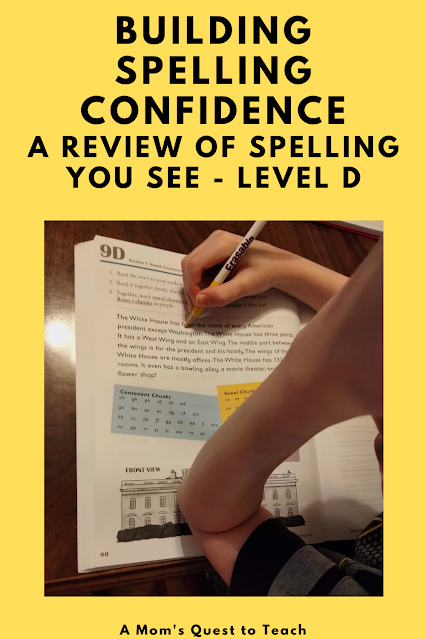
A Mom's Quest to Teach:  Building Spelling Confidence: A Review of Spelling You See - Level D with faded photo of the materials

I received Spelling You See - Level D at a 50% discount from Timberdoodle in exchange for my honest opinion. I was not required to write a positive review, nor was I compensated in any other way. This post contains affiliate links. For more information, please see my Terms of Use and Disclosure Policy page. Thank you.

We have tried a few different approaches to helping our younger son master spelling, from creating our own spelling lists using his current literature assignments or science units to picking words he is consistently spelling wrong in homeschool and outside homeschool assignments. Nothing seemed to be sticking with him. 

Over the summer, I researched several different options and looked at Spelling You See again. I had passed over the earlier levels because our son learned how to read and write at an early age. So even with the Readiness Guidelines that Spelling You See provides, I was unsure if I should start with levels A, B, or C. This year Level D seemed to be the perfect fit. We are studying American History. And Level D - Americana seemed to provide a challenge but also allow our son to build his spelling confidence.  

When Timberdoodle offered us the opportunity to purchase the Spelling You See - Level D curriculum at a 50% discount in exchange for a review, it seemed like the perfect time to try this spelling curriculum. And as it is part of the 2021 Third Grade Curriculum Kit at Timberdoodle, it also seemed like a great idea to pick this level for our son. 


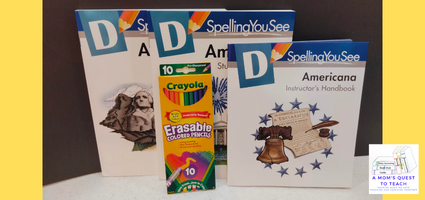
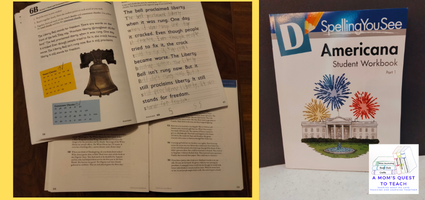
A Mom's Quest to Teach:  Building Spelling Confidence: A Review of Spelling You See - Level D - Spelling books


What Is Spelling You See? 

Spelling You See takes a multi-sensory approach to teaching spelling through writing, reading, speaking, and listening. It was invited by Dr. Karen Holinga, a former teacher, to allow students to build confidence and develop spelling skills at their own pace. There are no spelling lists. Instead, there are reading passages with everyday words for your child to practice their spelling skills. 

What Is Part of the Curriculum from Timberdoodle? 

If you purchase Spelling You See - Level D, you will receive the following items: 

  • Instructor's Handbook 
  • Student Workbook, Part 1 
  • Student Workbook, Part 2
  • Colored Pencils 

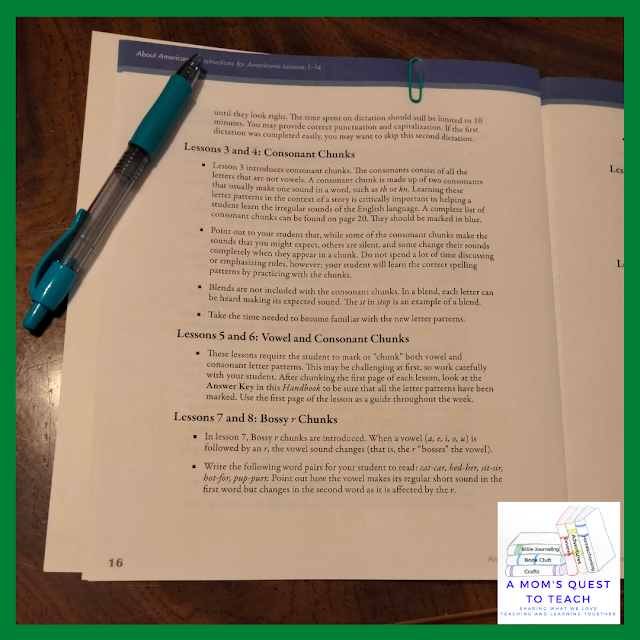
A Mom's Quest to Teach:  Building Spelling Confidence: A Review of Spelling You See - Level D  - Instructor's Manual with pen


Instructor's Handbook 


The slim 52-page Instructor's Handbook provides all the information you need to smoothly run the lessons with Spelling You See. In it, you can read about the philosophy behind Spelling You See, the five developmental stages of spelling, the sequence for Spelling You See, and general information about the level you purchased. 

After the general introduction, the Instructor's Handbook provides instructions for the lessons, which are grouped together based upon chunks: 
  • Vowels 
  • Consonants 
  • Bossy r 
  • Tricky y 
  • Endings 
  • Silent Letters 
The weekly activity guide is explained, which consists of guided reading, chunking, copywork, and two levels of dictation. The material needed for the dictation is printed separately from the answer key for the chunking. If you want to learn more, there is a glossary and bibliography, as well as access to online videos. 


A Mom's Quest to Teach:  Building Spelling Confidence: A Review of Spelling You See - Level D  - Student Workbook with student working


Student Workbooks 


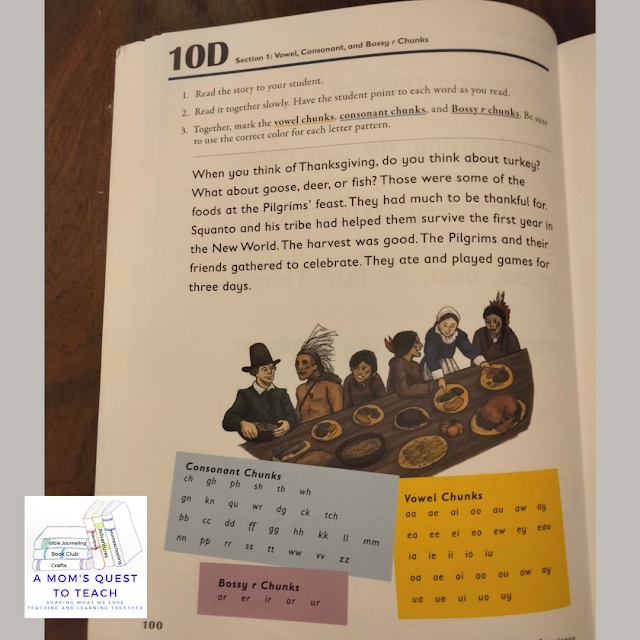
The lessons for your child are split into two workbooks – Part 1 and Part 2. Each part contains 18 lessons for a total of 36 lessons for your homeschool year. The pages are thick and colorful. Each of the paperback books has over 180 pages. Each daily lesson has two pages dedicated to it. The story is on the left-hand side, while the page for your child to write the passage is on the right. For those days when you are doing dictation, you merely cover the left-hand side.

Some of the stories included in Spelling You See - Level D are: 
  • Pilgrims arriving in the New World 
  • The story of Lewis and Clark 
  • Information about the Liberty Bell 
  • Explanation of Poor Richard's Almanac 
  • The usefulness of the buffalo 
  • The gift of the Statue of Liberty 
  • Information about the American Civil War 
  • Biographical information about Paul Revere, Abraham Lincoln, Daniel Boone, Martin Luther King, Jr., Johnny Appleseed, and more 

A Mom's Quest to Teach:  Building Spelling Confidence: A Review of Spelling You See - Level D - student workbook showing chunking


How We Use Spelling You See - Level D in Our Homeschool Day 


We work on completing our spelling assignments during the week. So, Monday through Friday, our son completes lessons A through E. If we miss a day, we sometimes complete it during the weekend even though the book does say if you don't finish, you may go ahead to the next set of lessons the next week. So if we didn't finish 9E, we could jump to 10A on Monday. I usually only skip one day of dictation as I feel it is important to practice spelling the words without seeing them at least once. 

Sometimes, we complete the spelling lessons first thing in our homeschool day, as our son likes to get it out of the way. Other times, I need to save it for the end of the homeschool day because he needs me to work through the lessons. But no matter what time we complete our spelling lessons, they have become an integral part of our homeschool day.

Day One starts with reading the story and working together to find all the chunks. These can be vowel chunks (aa, ae, ai, ea, oa, etc.), consonant chunks (ch, gh, wr, etc.), bossy r chunks (ar, er, etc.), or others. These are marked in different colors. The chunking provides hands-on experience with irregular letter patterns in English. After the chunking is completed, our son copies the story and chunks it again. 

Day Two and Three follow the same pattern. I usually help him less each day as our son looks for the chunks. He then copies the story again. The copywork should be timed to ten minutes. 

On the last two days of the week, we read the story, mark chunks, and then I dictate the story for our son to write down. On the first dictation day, I assist him with his spelling. I ask him if he is sure about a word or if he wants to try writing it differently to see if that spelling is correct. On the second day, I do not provide much assistance as he writes the story. 


A Mom's Quest to Teach:  Building Spelling Confidence: A Review of Spelling You See - Level D - student working in student workbook


What We Think 


I have mixed feelings about Spelling You See - Level D. I love the fact that it includes nonfiction stories about American history and culture. The tie-in to our history curriculum is terrific. The stories provide a way to not only focus on vocabulary but also to introduce new facts and review ideas with our son. 

I appreciate the philosophy – that children work through five stages of development and not focus upon memorization of spelling words. We tried that route, and it didn't seem to work for our son. As we are only nine weeks into Spelling You See, it is hard to see how much progress our son has made. There are some weeks where he corrects mistakes from dictation day 1 to the second dictation day, but then there are a few words he continues spelling wrong, like British. 

There is not a lot of prep work required on my part as a parent. I just need to review a few paragraphs for the lessons as we progress through the different chunking lessons. I also like that there is one Instructor's Guide but two Student Workbooks. It makes it easier to keep track of the materials. 


A Mom's Quest to Teach:  Building Spelling Confidence: A Review of Spelling You See - Level D  - student workbooks


I asked our son his feelings about the curriculum, and here are his thoughts: 

Q. Is it difficult? Too easy? Too hard? 
A. It can get a little difficult once you are starting a new story or part. The first day can be hard as the new words are introduced. The dictation days are also hard. 

Q. Do you think it is helping you with your spelling? 
A. It may not be helping with spelling, but it is helping me find the chunks. (He is finding the vowel, consonant, and other chunks in his other homeschool assignments. Whether he realizes it or not, I think this is helping him with his spelling.)

Q. What is your favorite part about the curriculum? 
A. I like all the different colorful parts where I have to chunk more than one thing. I am looking forward to reading about Thanksgiving because it will remind me of the best food ever – turkey. 

Will we use Spelling You See - Level E next year? I am not sure yet. I don't think I have found anything I want to use instead of Spelling You See, but I think we need to evaluate the curriculum around the 30-week lesson with our son. Would I recommend Spelling You See - Level D? Yes, I would recommend it. I think it might be easier if you were able to start with the lower levels, but I think that our homeschool year will be enriched by the use of this curriculum. 

Looking for More Homeschool Resources from Timberdoodle? 


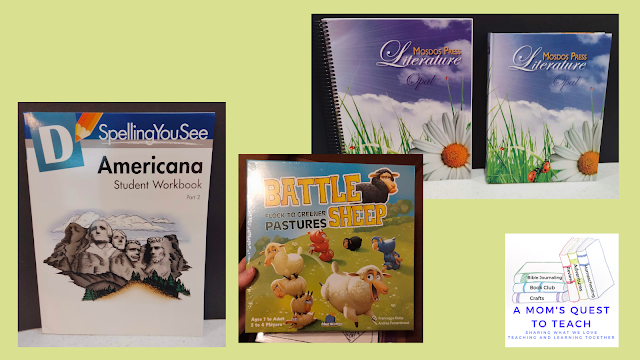
We've had the opportunity to review several materials from Timberdoodle, including a literature curriculum, fun games like Battle Sheep, and a unique puzzle. 


A Mom's Quest to Teach:  Building Spelling Confidence: A Review of Spelling You See - Level D  - spelling workbook, Battle Sheep Game, Mosdos Lit books