Showing posts with label vocabulary. Show all posts

Thursday, August 15, 2019

A Family Approach to Spelling: A Review of Spelling and Vocabulary Family Textbook from Love at Home Education


This post contains affiliate links. For more information, please see my Terms of Use and Disclosure Policy page. Thank you.

For many homeschooling families, there are multiple age levels who need to be taught together. Finding materials that can meet the needs of kindergarten to high school students has been made simpler with Love at Home Education. There are a variety of products from short unit studies to fuller curriculum that will enable you to teach your youngest and oldest children together. In this review, I will be discussing the K-12 Vocabulary and Spelling Curriculum from Love at Home Education.


What Do You Get?


You can choose from a PDF or a combination of both Print and PDF copies. We received the 79-page full color PDF for the purposes of this review.


Monthly Themes


  • Neighborhood
  • Space
  • Community
  • Nature
  • World
  • Family
  • Weather
  • Transportation
  • Animals 
When you receive your copy of the K-12 Vocabulary and Spelling Curriculum Family Textbook you will need to decide at which level your children will be working. You will be able to choose from four levels. There are three suggestions for games and activities that will help your homeschooling children with writing skills as well as learning vocabulary and practicing spelling.  And then there are six suggestions for active games and activities to help with learning vocabulary and spelling. You will need to prepare for these games and activities prior to your lesson.

Each month consists of four weeks of weekly stories, suggestion for weekly study, games and study help ideas, spelling words, and vocabulary words. If you choose to do the games and study help idea suggestions, you will need to prepare your own pre-test and test, word searches, fill-in-the blanks and other materials to fill out your weekly studies.


How We Used the Spelling and Vocabulary Family Textbook


Summer time for us means a lighter workload for our teen but we still continue with our younger two children. The Textbook suggests a five-day schedule for the entire family starting with reading the weekly story and administering pre-tests to introducing chosen vocabulary and working on spelling activities and games. Finally, there will be a review and you can administer a spelling test on day five if you wish.

We skipped past the Neighborhood theme to the Space theme since our younger two children are studying astronomy. The first week's story asks you to imagine you are traveling through space and use some of the vocabulary that will be introduced such as oxygen, solar system, comet, and asteroid. 

The vocabulary words are broken up into four categories: 
  1. Novice
  2. Competent
  3. Advanced
  4. Proficient 
The Textbook provides you with information to determine where your children fall so you know which words to focus upon each week. Our two younger children will be looking at mostly the novice words but we will be discussing some of the others as they fit into their science curriculum. For example, later on in the year they will be talking about asteroids, comets, and constellations but these words fall in the competent and proficient categories. And we have already talked about satellites which falls in the advanced category. So, as with most homeschooling curriculum and tools, you can adapt this for your own families' needs.


As we are using this with two younger children, I wrote the words on index cards for them to practice reading and our small white board. This would allow us the opportunity for our six-year-old to copy the words to practice penmanship and spelling.


Do you want to learn more about Love at Home Education?


"Love at Home Education – A Dinner-table friendly, all-inclusive family curriculum; that your high schooler, kindergartner can learn together on their own levels."

Love at Home Education offers both secular and faith-based curriculum for preschool to 12th grade so you will be sure to find something that meets the needs of your homeschooling family.


If you want to see a sample of the K-12 Vocabulary and Spelling Curriculum, check out the gallery at Love at Home Education. You will be able to see the first month's words and recommended activities.

In the past we have reviewed Natural Disasters K-12 Unit Study, Thomas Jefferson Unit Study (K-6), and George Washington Unit Study (K-6) from Love at Home Education.


Wednesday, May 8, 2019

Learning New Vocabulary: A Review of Vocabulary Virtuoso PSAT-SAT Book 1 (Grades 8-12+)


No matter where your homeschooling journey may take you and your high school students – such as taking standardized tests like the PSAT or the SAT – building vocabulary skills is always important. Our tenth grade high school student has spent most of the year taking a literature-based language arts course. So when the opportunity arose to review Vocabulary Virtuoso PSAT-SAT Book 1 (Grades 8-12+) from The Critical Thinking Co. I knew it would be a great fit for us. It is a 204-page paperback book (it is also available in eBook form) with twenty vocabulary lists and lots of different activities to help students learn the vocabulary words.

What is Vocabulary Virtuoso? 


Vocabulary Virtuoso PSAT-SAT Book 1 (Grades 8-12+) from The Critical Thinking Co. contains nine sets of vocabulary words in twenty lessons. "85% of all the words are from current PSAT or SAT lists" (Introduction). The vocabulary lists include a pronunciation key, definition, other forms of the word, and a sentence using the word in context.  There are a variety of activities included to provide students a chance to use the words in context as well as a story in each lesson. The stories take place in a fictional classroom where students learn the following concepts:

Literary

  • Characterization in literature
  • Idioms
  • Puns
  • Jargon
  • Irony
  • Euphemisms
  • Aphorisms
  • Allusions
  • Theme 

Rhetorical 
  • The art of persuasion in speech and writing
  • Using extended simile to write a poem

Historical 
  • The Renaissance
  • Renaissance Artists 


You can even see some sample pages on The Critical Thinking Co.'s website. This sample includes the table of contents and exercises for Vocabulary List 1. What a great way to see if the book will be a fit for your family!


How We Are Using Vocabulary Virtuoso 


Each vocabulary list and corresponding activities can be spread out nicely over the course of one week. On Monday, I ask our son to create note cards with the vocabulary words and definitions provided or ones from a dictionary if he needs a different one to more clearly understand the word. I also ask him to complete Part A (for the the first four lists, Part A asks the student to choose the best word to complete each sentence).


On Tuesday, I ask our tenth grader to complete parts B and C. For the first four lists, Part B asks students to choose the best word to complete the sentence while Part C is a Story Challenge. Students read through the story and fill in the blanks using the vocabulary words. The Story Challenges also provide useful information. For example, for Vocabulary List 3, the Story Challenge addressed idioms while using words from the list like obfuscate, justify, and malign.


Parts D & E are completed by our high school student on Wednesday. These two parts have been similar to those in the first section. Part D directions are: "The underlined part in each sentence is a synonym, idiom, phrase, or definition for a list word. Unscramble the list word and write the word on the blank."  One of the sentences is: "In a debate, with good reasons, Christopher defended his position that the school should adopt a uniform dress code." (justify being the correct answer) Part E asks students to choose the word, idiom, or phrase from the box that best defines each list word. For List Four Part E includes one word in the choice box, effervescent, which was in Vocabulary List 1 to match with ebullient.


Finally, Part F is completed. Throughout the book Part F asks students to "Complete each sentence to show that you understand the meaning of the underlined word." For example, here is one of our son's sentences: "Because he had been frugal with money he earned and received as a gift, Dylan bought a decent car at 18."


At the end of each week, I created a short vocabulary quiz (10 to 15 questions in length) using some of the questions from the book in addition to some I created myself. We are counting his work in Vocabulary Virtuoso PSAT-SAT Book 1 and the quizzes for his American Lit course.

At the conclusion of each section, there are review lists (for five review lists in total). There is a crossword puzzle, sentence completion, and matching questions. When reviewing Lists 5-8, our son will have to match vocabulary words with fictional book titles – what a neat idea to help build vocab skills!


What Does Our Teen Think? 


When talking with our teen while he was completing the review activities for lists 1-4, I asked him what he liked about Vocabulary Virtuoso. He said he really liked the format of the book. It is clean and concise and easy to look at while working on the activities. The way the information is presented suits the way he learns. For example, he explained he does not like the way most textbooks are organized with main text, boxed secondary information, and information set into separate parts. He prefers something that is straightforward in layout.


He appreciates the variety of activities so that while he is working on each list he does not feel bored. His least favorite activity is the last one where he needs to complete the sentences. He said sometimes it is harder to figure out an ending for the sentence than other times. (I think this means his brain is working to make sure that he demonstrates he understands the vocabulary word!)


In the Future 


We may take a break from working with Vocabulary Virtuoso PSAT-SAT Book 1 during the summer, but I see us completing the work in our next homeschool year in a similar fashion – one list per week. I even hope to ask our son to include the vocabulary words in his other course work – when writing essays, letters, notes, etc. This is a perfect way to ensure he is absorbing and utilizing all these excellent words.

And since our teen seems to enjoy working with Vocabulary Virtuoso, I see this being a good fit in the upcoming homeschooling year and in the future with Book 2.

And while we are unsure as to whether not our son plans on taking the SAT (his future plans after completing high school are still undecided), I am definitely glad we are using Vocabulary Virtuoso PSAT-SAT Book 1 (Grades 8-12+) as building a good vocabulary is important in a variety of careers, professions, and educational paths.


Notes and Observations


Our teen sometimes completes all the work on one day – he prefers to complete work that doesn't need a computer done at one time – so there is no reason why each set of vocabulary would need to take an entire week. I think it all depends on what you and your children are doing in your homeschool. This makes Vocabulary Virtuous a great addition because it can be used in a variety of ways.

I like how each list can build upon the previous lists and that even within the different activities there are words that may challenge a student.

There are answer keys at the back of the book which you may choose to remove from the book to ensure your child completes all the work on their own. There is also a sample activity from Critical Thinking Detective TM – Vocabulary Book 1. (This looks like another great resource!)


If you are interested in learning more about The Critical Thinking Co., please be sure to check out the following sites:


And if you are interested in purchasing any of their products...use the code TOSCREW19 to receive Free Shipping and 15% off any size order! This code (TOSCREW19) expires 12/31/2019.


And be sure to check out all the other reviews – The Critical Thinking Co. publishes many great products! From a book of 20 Elementary Math Games to works that will help your children build writing skills. The Critical Thinking Co. might have the perfect resource for your homeschool.


Thursday, July 19, 2018

K is for Knight (Blogging through the Alphabet)

Knight

This post contains affiliate links. For more information please see my Terms of Use and Disclosure Policy page. Thank you.

What images come to mind when you hear the word "Knight"? Do you immediately think of King Arthur and the Knights of the Round Table? Or perhaps A Knight's Tale – with its music and action – comes to mind? Knights were seen as an elite warrior class that evolved during the Middle Ages. They were sung about by troubadours, written about by poets, and remembered even in the movies of today.

Typically, the "Age of Chivalry" is the four centuries between 1100-1500 but there really isn't anything typical about the time. There was great variation in fighting methods and armaments.

Between the years 1325 and 1380, there was a change from chain mail to polished steel plate armor due to a number of changes in fighting. Two new weapons – the longbow and the great axe – grew in use, necessitating the change in armor.

"What is the function of knights? To guard the church, to fight unbelievers, to venerate the priesthood, to protect the poor from injuries, to pour out their blood for their brothers...and if need be, to lay down their lives." John of Salisbury, Policraticus, 1159 as quoted in Warrior: A Visual History of the Fighting Man 


What identifies a knight?

What identifies a knight? 


  • Special ceremonies
  • Heraldic emblems decorating banners, shields, and surcoats
  • Hereditary status 
  • Armor made of chain and later plate
  • Process through which one becomes a knight
  • Chivalrous attitude 
  • Horse 
  • Participating in tournaments 
  • Lance, sword, and shield 
Knights were trained to be chivalrous – upholding moral standards and loyalty to one's leader and brothers-in-arms. Christian values were also emphasized: knights were supposed to respect and aid the needy and the poor when possible. When fighting battles and facing defeat, knights could surrender and not face death. As higher ranking members of society, a knight who surrendered could be ransomed by the winning side. 

Not all knights were wealthy as some sought to better themselves in tournaments or on the battlefield with a military career. Others joined religious orders while still others might be hired during times of disorder and chaos. Knights were not always the most honorable. 

Coat of arms on a shield, tunic, or banner

Tournaments 


Since there weren't always wars going on – I know, shocking, right? – knights needed to hone their skills and support themselves. So, they participated in tournaments. These events would not only provide entertainment for the public (can you hear the crowd cheering?) but also allow the knights to seek fame and fortune as they won jousting tilts. 

There were several different ways knights participated in tournaments: 
  • Melee – mock battle that often devolved into a free-for-all 
  • Jousting 
  • Sword Fighting  
Even though tournaments were not battles, life and death was still at stake. For example, in 1241 at the tournament at Neuss, there were over 60 knights killed. Eventually due to injury, death, and destruction of land where the tournaments were held, there would be strict rules put into place and the introduction of blunt weapons to be used. Rules were also introduced that stated what part of a knight or his horse an opponent could hit during the tournament in an attempt to make things safer.

What is the most important item for a knight? Question


The Longbow 


One of the greatest changes came with the advent of the Welsh longbow. This allowed arrows to be fired that could pierce the chain mail armor of the best protected knight. The English used the longbow en masse to fire volleys of arrows – hundreds at a time – towards the enemy. They could fire 500 arrows and then 12 seconds later another 500 arrows would be launched towards the enemy. The English longbowman could fire arrows until they ran out of them. Usually he was equipped with 60 arrows stuffed into his belt or at his feet for easy access.

Along with the longbowman, there were other men with whom knights had to contend on the battlefield like pikemen and foot soldiers. During the Middle Ages, there were only about 200 knights participating in the battles but they are probably the most remembered.

There were 3 basic types of warriors in the 1100s:
  1. Men-at-arms – could include heavy cavalry and those fighting with a lance and sword
  2. Professional infantry
  3. Crossbowmen 
War horse is the most important thing for a knight

Warfare Changes – The Hundred Years' War 


During the Hundred Years' War, the true impact of the longbow was felt on the continent. At the battle of Crecy, the first true impression outside of England was seen by the French. The French would no longer be charging into battle on horseback.

Why was the Hundred Years' War fought? What were they like?

o       In 1328, the last male member of France’s Capetian Dynasty died. King Edward III of England claimed the French throne.
o       French assembly choose Philip VI – Count of Flanders – as king.
o       In 1337, Edward brought an army to Flanders.
o       War continued 116 years as a series of raids & battles. Sometimes there were long periods of uneasy peace.
o       England won many battles but lost the war. By 1453, France controlled all of England’s French lands except Calais.
o       New weapons
o       English foot soldiers used longbows – one could fire arrows quickly – hitting targets up to 200 yards away.
o       Both the French and the English used gunpowder & cannons in battle
o       Castles no longer provided protection for a feudal lord b/c one powerful cannon could break through a castle’s walls
o       Knightly warfare weakened 


Click here to download your own vocabulary worksheet!

There is so much to study when it comes to knights. If you wish to find out more information, I have provided some resources for you to read at your leisure.

I will also have a review on Home School in the Woods' Knights Lap-Pack at the end of July. Our five-year-old son and I are having a fun time working on projects relating to all things knight!

If you enjoyed this post, please check out my other similar posts: 


I linked up with the following blog(s):


Tuesday, July 17, 2018

Reviewing the e-Guide of Perelandra from Progeny Press

Perelandra e-Guide Cover

C.S. Lewis is one of our family's favorite authors, so we were very happy to be able to read Perelandra and use the e-Guide from Progeny Press to help our teen understand the material at a deeper level. Progeny Press offers "study guides for literature from a Christian perspective" with hundreds of e-Guides available from The Josefina Story Quilt e-Guide geared towards grades 1-3 to the Perelandra e-Guide for grades 9-12 which we reviewed.

The Mission of Progeny Press is "To teach our children to think clearly, to understand literature, and to rely on the scripture for truth and values, and enjoy themselves while they do it!"

You can watch this video from Progeny Press to learn more about the company.


Each study guide takes approximately 8-12 weeks to complete which means your child will complete about one page per day. Guides for younger children can take less time. As Perelandra proved to be a difficult text for our teen to read, we are working through the e-Guide more slowly to ensure that he understands the material that he is reading.

C.S. Lewis, Venus, and Perelandra e-Guide cover

The Perelandra e-Guide contains the following elements:
  • Synopsis of Perelandra, background information, and a Synopsis of Out of the Silent Planet (the first book in the trilogy) 
    • Since our teen has not read Out of the Silent Planet yet (my husband has read it), it was great that he could review the events on Malacandra and Ransom's encounters with the Sorn and Hrossa.
  • A biography of C.S. Lewis 
    • I love having a brief biography of the author as it prevents the need to go to the Internet to look it up.
  • Activities to complete prior to reading Perelandra 
    • While we didn't complete the prereading activities, they are quite good. I really like the idea of researching the mythical origin of Mars and Venus as well as that of 1930-1950s science fiction. These are just two of the six activities suggested. 
  • Vocabulary words and a variety of activities to introduce and teach the new words 
    • Vocabulary activities range from sentences from the book with the new words to discussion of mood and tone to searching for antonyms. With a variety of ways to learn vocabulary, students are sure to find at least one way which suits their learning style. 
Vocabulary from Perelandra e-Guide

  • Examination of literary techniques 
    • There are questions pertaining to metaphors, similes, descriptions, and imagery to name a few. 

Does Weston believe in moral absolutes - one of the questions from the Perelandra e-Guide

  • Examination of moral lessons and character values 
    • Through a variety of questions, we are able to discuss the difference between Weston and Ransom as we read quotes from the Bible and examine their decisions. I think this has been one of my favorite aspects of the e-Guide – we can have good conversations with our son with Perelandra as a starting point. 
  • A variety of activities and writing assignments 
    • There are typical essay assignments available, as well as art suggestions, and research papers to pick from for culminating activities. 
  • Suggestions for further reading 
    • Having a suggested list of books written by C.S. Lewis to look for and other books that relate to the series takes the guess work out what to read next. And the great thing is our son has already read some of the other books such as The Martin Chronicles and The Hobbit

Perelandra e-Guide and questions

What Our Family Likes 


My husband and I have been enjoying the fact that while we are discussing Perelandra with our son – and the answers to the vocabulary and other questions – we are also getting the opportunity to discuss real world events as well as the concepts of morality, right and wrong, and other topics in relation to the Christian view we are trying to instill in our son.

Perelandra e-Guide Questions

I also like that my husband is reading the book via an online application that allows him to search for key words as we discuss the various questions in the e-Guide. This way we can find the exact phrase or quote that a question brings up and find the reasons within the text for the answer suggested in the answer key. One specific instance would be that of the question pertaining to "emergent evolution" and the Force in Chapter 7. Our son had difficulty with that question, so in addition to giving him hints from the answer key we were able to re-read that portion of the text aloud to discuss whether or not Weston is presenting a paradox or a contradiction.

Perelandra e-Guide questions

Going Forward 


There is also an interactive feature to the e-Guide that allows your children to type their answers directly into the e-Guide. We chose to print out the unit study so that we could all be able to look at it while discussing the questions.

As our younger two children, who are being homeschooled, move forward in their reading journey, I look forward to relying upon Progeny Press for their e-Guides. Within the next year, we could use Frog and Toad Together e-Guide for our 5-year-old son. If our teen makes the decision to homeschool in the future, we will be looking for others such as Hamlet e-Guide, Introduction to Poetry: Forms and Elements e-Guide, and The Screwtape Letters e-Guide.

In addition, if you are curious, Progeny Press does offer an e-Guide for Out of the Silent Planet, if you would rather read Book # 1 in the Space Trilogy first and complete that e-Guide with your child. There are also sample pages from the various e-Guides to help you decide if it is a fit for your family.

To learn more, please visit the following:


The Homeschool Review Crew also reviewed the following e-Guides:


To see more reviews, please visit the Homeschool Review Crew!


Saturday, December 2, 2017

Book Club: What's the Difference Between an Alligator and a Crocodile?


This post contains affiliate links. For more information please see my Terms of Use and Disclosure Policy page. Thank you.

In the book What’s the difference between alligator and crocodile? by Lisa Bullard with illustrations by Bandelin-Dacey, children can learn some of the key differences between the two reptiles. 

Bullard's book provides great illustrations with an easy-to-read text sharing many facts.  It is well-organized and provides examples for each reptile on each pair of pages.  There is also a section for fun facts and a glossary at the end of the book to further your knowledge.


Vocabulary 


Free Alligator and Crocodile Vocabulary Worksheet for your children to color – words include the following:

Cold-blooded
Endangered
Mammals
Reptiles
Nostrils
Pretty
Scaly
Snout
Species
Territory
Freshwater
Saltwater
Alligator
Crocodile
Bellow

Activities


Share sounds with your children of baby alligators and crocodiles, as well as the noises that adults make

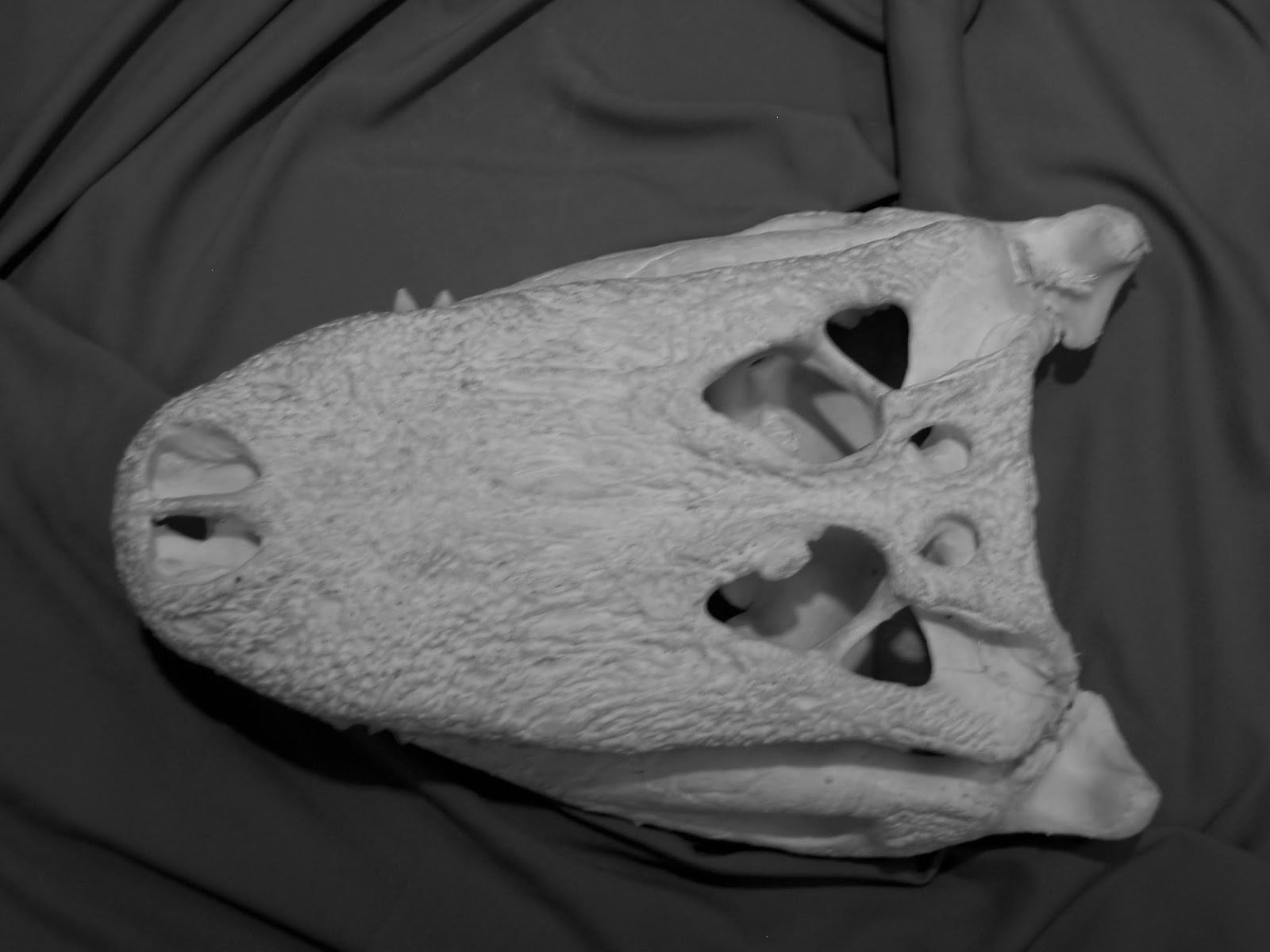
Share the following images of an alligator and crocodile skull with your children to review the physical differences of their snouts.  In the first two photographs, you can see the difference in shape and size.  The alligator's snout is wider and rounder while the crocodile's is narrower and more pointed. In the second two photographs, you can notice the bottom tooth sticking up on the crocodile's jaw.  This tooth is visible when their mouths are closed.


alligator skull
Replica Alligator Skull

crocodile skull
Replica Crocodile Skull

alligator skull
Replica Alligator Skull

crocodile skull
Replica Crocodile Skull 


Clay Play


Gather together materials to play with homemade or Play Doh.


Crafts 


These are two of the alligator themed crafts we have made at our home. 

Alligator Craft


Alligator at Magnolia Gardens in South Carolina