Showing posts with label World War I. Show all posts

Friday, August 9, 2019

Y is for (Battles of) Ypres (Blogging Through the Alphabet)


This post contains affiliate links. For more information, please see my Terms of Use and Disclosure Policy page. Thank you.

During World War I, three battles would be fought to control the Belgium city of Ypres. This was an important city to control due to its location in West Flanders and its guarding of the port cities leading to the English Channel. Belgium's neutrality was guaranteed by Great Britain so the German invasion of Belgium brought Great Britain into the First World War. Germany saw the invasion and control of Ypres as central to their Schlieffen Plan.

First Battle of Ypres


The first Battle of Ypres took place October 8 to November 22, 1914. The battle would be part of the race to the sea by the Germans.

The commanders of the Allied forces did not fully see what was happening during this battle. For example, on October 20, the French believed they were attacking when they were actually hardly holding ground. The next day, aware of the danger of losing the area so important to protecting the port, the French ordered the men to entrench.  The Germans would also dig a system of trenches. It has been suggested that the trench warfare of World War I began at Ypres.

Winter would force the conclusion of the battle. Overall there wasn't a lot of advancement from either side but the Allied forces did prevent the Germans from accessing the French ports in Calais and Dunkirk through Belgium.

Casualties

  • French: 50,000 
  • Belgians: 20,000 
  • Germans: 130,000


Second Battle of Ypres


The Germans used poison gas – chlorine –  for the first time in the opening of the second battle of Ypres on April 22, 1915. Surprising the Allies with the use of gas did not necessarily give the Germans an advantage. However, they were able to push forward in this early battle known as the Battle of Gravenstafel Ridge.

There would be a series of four battles that comprised the Second Battle of Ypres. There was no significant loss or gain for either side as the British occupied the trenches built by the French to defend themselves from the Germans' attacks.

Casualties:

  • Allied forces: 70,000
  • Germans: 35,000 

Third Battle of Ypres


The largest battle to take place at this site during World War I, started on July 31, 1917. The battle was also known as the Battle of Passchendaele (because the Allied forces recaptured the Passchendaele Ridge east of the city). With horrible weather, the battlefield turned into a mucky, muddy field. In three months time, the Allied forces would only advance 6 miles.

The third battle of Ypres would also cost nearly half a million casualties:

  • Allied: 250,000
  • Germans: 200,000

Other Facts


  • In 1914, Ypres was one of the sites of the unofficial Christmas truce. With the result of Ypres being inconclusive, there was a lull in hostilities which allowed both sides to exchange Christmas greetings after crossing the trenches. 
  • Ypres is also known as Ieper.
  • Not a lot of progress was gained at the battles of Ypres until September 1918 when the Allies advanced forward to take back Belgium from the Germans.
  • Almost every building in Ypres was destroyed. 


Do You Want to Join Blogging Through the Alphabet?


You are invited to the Inlinkz link party!
Click here to enter

Wednesday, June 19, 2019

Book Club: Book Review of The Number of Love


This post contains affiliate links. I was provided with a copy of The Number of Love for free from the publisher in return for my honest opinion. For more information, please see my Terms of Use and Disclosure Policy page. Thank you.

Are you someone who loves numbers? Do you see in numbers? 


Roseanna M. White shares a fantastic story in The Number of Love. I was so glad I was able to review this new book from Bethany House Publishers.

Margot De Wilde is one of the codebreakers in the secretive Room 40 in London. She works via deciphering intercepted German telegrams and sees numbers everywhere. These help her with her work and help her in her prayers.

I know I have been saying it a lot about books I have been reading of late, but The Number of Love was another book I was unable to put down! There were many nights when I stayed up well past my bedtime to see what would happen next to Margot and Drake.


"The toughest puzzle she'll have to solve 
might be the wishes of her own heart." 

White takes us on a journey with Drake Elton, a secret agent of the British government, as he seeks out the newest plot of the German government during World War I. Readers read about his interactions with his sister, Dot, with Margot (Margot quickly becomes Dot's friend), and with his co-workers and old friends.

Weaved among the field experiences of Drake in Spain, readers become acquainted with those who work with Margot and his family. Margot is a very intelligent and beautiful young woman (she celebrates her 18th birthday during the telling of the story). I see her as a good role model for female readers. She is someone to aspire to – she trusts God is bigger than her and knows best, she wants to help her friends and family, and eventually admits when she has made mistakes (she is human).


My Thoughts 


I love how the main characters trust in God. I think more of this trust needs to be shared in fictional books. Readers need to know they are not alone in their love and trust of God. While saying this, let me be clear that religion is not the main focus of the book. The Number of Love is still a story of secret agents, mystery, love, and intrigue. We see Elton dodging bullets from a German secret agent and Margot spending time with her brother and sister-in-law.

I recommend The Number of Love! I will be on the look out for the next in The Codebreakers series by Roseanna M. White. 


Friday, June 14, 2019

Q is for Quiet (Blogging Through the Alphabet)


This post contains affiliate links. For more information, please see my Terms of Use and Disclosure Policy page. Thank you.

World War I became one of my favorite time periods in history to study—especially the origins of the war. What makes reading primary sources, secondary sources, and literature about World War I—including All Quiet on the Western Front—so important for studying the events? As we progress further and further away from events of the past, it is becoming increasingly important to look at sources that were written before, during, and immediately after the events. So many of today's history books are reinterpreting history—not always for the better.

All Quiet on the Western Front was written by Erich Maria Remarque and published in 1928 in a German newspaper and as a novel in 1929. Perhaps if the book had been written and published during World War II or after WWII, then the events of that war might have impacted the author, a German veteran of World War I. But since it was published in between the wars, we can trust the experiences described with a greater certainty that new wars did not influence Remarque. The first movie adaptation was even released before WWII (it is considered a very realistic account of the first World War).


Who was Erich Maria Remarque? 


Serving as a German soldier during World War I, Remarque gained first-hand knowledge of the experiences he would write about in All Quiet on the Western Front. He was drafted in November 1916 and was sent to the Western Front (Belgium) where he worked in a support unit, laying barbed wire and building bunkers and dugouts. He was injured while retrieving a wounded soldier in July 1917 and was sent to a hospital. He would remain in hospital until the end of the war. During that time, he would write short stories that were published.

Before the publication of All Quiet on the Western Front, Remarque worked as a teacher and in other odd jobs for a time. The success of the book allowed him to turn to writing full time.

All Quiet on the Western Front was viewed by many as a powerful antiwar statement. The view of the Nazi party was that it was unpatriotic and was in fact one of the first books burned in public. The 1930 American movie was also banned in Germany. Remarque, who had moved to Switzerland in 1931, had his German citizenship revoked in 1938.

Remarque moved to the United States in 1938 and maintained homes in New York City and Hollywood. He became friends and acquaintances of famous people like Charlie Chaplin and Ernest Hemingway.

The Novel 


"This book is to be neither an accusation nor a confession, and least of all an adventure, for death is not an adventure to those who stand face to face with it. It will try simply to tell of a generation of men, who even though they may have escaped its shells, were destroyed by the war." – Introductory statement in 1967 Fawcett Crest Book publication.

Twelve chapters tell the story of Paul Baumer, the narrator, and the men with whom he served during the war. Scenes move back and forth between the front and settings away from the intense fighting and danger. Through the novel, we are introduced to a number of specific experiences of the narrator including the use of poison gas and the repercussions of bombardments.

"The gas still creeps over the ground and sinks into all hollows. Like a big soft jelly-fish it floats into our shell-hole and lolls there obscenely." 


The imagery of a total war—destroyed nations—is experienced over and over as you progress further in the novel. Brand new coffins are stacked up against a shelled schoolhouse. Rats are everywhere, gnawing at the available food and the men. Barriers of barbed wire and holes from bombings are spread throughout the countryside. The book does not remain quiet in regards to how destructive war can be for the land and the people.

Primary Sources – Telegrams, Treaties, and Letters 


If one is studying the origins of World War I, one could seek the telegrams, treaties, and letters written prior to the war. I was fortunate enough to take a course in college—Origins of World War I—where we conducted a diplomacy simulation. In it, we formed groups to represent the different countries in the war and to see if we would start World War I or find a peaceful resolution. We read through telegrams and other primary source documents. We also read one secondary source on the causes of the Great War. For this course, our professor had gathered together specific primary sources he wished us to read and examine for class discussion.

Diplomacy Simulation 


Our purposes as nations were not just to survive but also to prosper and grow. Our countries could increase and grow our prosperity in three ways:


  1. Expansion 
  2. Diplomatic success
  3. Satisfaction of population 
Prior to the actual simulation in which we would send 'telegrams' back and forth between nations to meet these goals, we researched our nations. We examined the events that took place from 1908-1913 in relation to our specific country and wrote a research paper in which we presented historical information as well as goals for the diplomacy simulation.


My country was France and the other nations represented were Germany, Serbia, Austria-Hungary, Russia, and the Ottoman Empire. Did we wage war? Did World War I start? No...somehow our class managed to meet some of our nations' specific goals without needing to go to war. I think the United States did not even get very heavily involved (our professor was representing America). 


Final Thoughts 


I enjoyed this trip down memory lane. It was nice to share my experience at college and my thoughts about history. I am glad that Blogging Through the Alphabet affords me the chance to not remain quiet on the topic of history.

Because history is so important to me, I do not ever want to remain quiet in regards to remembering history and the events of the past. Some people would be content with seeing controversial historical figures like Robert E. Lee erased from history. Others are finding their educational videos about Nazi Germany being removed. No matter how painful events are, we must remember them.

Resources and References


World War I Document Archive at Brigham Young University Library


Won't you join us for Blogging Through the Alphabet this week?


You are invited to the Inlinkz link party!
Click here to enter

Friday, May 31, 2019

O is for Owen (Blogging Through the Alphabet)


This post contains affiliate links. For more information, please see my Terms of Use and Disclosure Policy page. Thank you.

World War I brought about a lot of changes to history, society, and culture. Some of them were to be expected like huge advancements made in the way in which battles (and ultimately) wars were fought. There were improvements to tanks and the introduction of airplanes on a large scale as well as guns that would allow armies to more effectively decimate the enemy. There were also new countries added to the map as well as the redrawing of some borders for older countries. In terms of society and culture, the period after World War I was very odd. The 1920s became known as the Roaring Twenties and the Jazz Age but also gave birth to the Lost Generation of writers who were facing a period of time where previous values no longer seemed as important and they remained unsettled after the Great War.

Surprisingly, World War I also brought a number of poets into existence. Most of these men participated in the Great War itself and a few did not survive to see Armistice Day. Some of these poets had entered service feeling it was noble and just while others eventually felt disillusioned with the war. One such poet was Wilfred Owen of Great Britain. 


As a Young Man 


Wilfred Owen, born on March 18, 1893, was the son of Thomas Owen (former seaman) and Susan Shaw. Owen was the eldest of four children and became protective of his siblings and had a close relationship with his mother. Owen did not attend university, like so many of the other British WWI poets, but instead attended Shrewsbury Technical School until he was 17. He worked for a time as an assistant for a minister and during that time planned to determine whether or not he wished to train as a clergyman. During his spare time, he read and began to write poetry. He would start to develop his own writing style that would help him become one of the most technically innovative and influential of the World War I poets. 


He returned home from his time volunteering with the minister due to an illness and – after recovering – he taught in Bordeaux at the Berlitz School of Languages and then spent a year with a French Catholic Family, tutoring their sons. 

Entering the War 


After his time as a private tutor, he returned home to England in the summer of 1915. He eventually enlisted in the Artists' Rifles regiment in 1916. By December of 1916, he had left for France. Almost immediately he began writing of his experiences in the war: the marching and shelling. He wrote about the march of January 12, 1917 in "Dulce et Decorum Est" where they marched three miles along a shelled road and then three miles along a flooded trench. This was a typical experience – of marching in and on difficult terrain under machine-gun fire, already tired, and facing poison-gas attacks. 


During 1917, Owen was injured three times including a hospitalization for a concussion. Unfortunately some of the experiences that Owen lived were common and were described not only in his letters to his mother but also in 'All Quiet on the Western Front.' Both the Allies and the Central Powers suffered horribly – sleeping in wet or frozen clothes, unable to get clean, hiding in holes with dead bodies (who were sometimes friends) – all these things took a toll on the men fighting.  Owen made a series of trips to the hospital and he was eventually diagnosed as a victim of shell shock.  Owen was sent to the Craiglockhart War Hospital in Edinburgh, Scotland where Siegfried Sassoon, a fellow poet, would be sent as well. He would spend four months at the hospital. 

While it took two weeks for Owen to get the courage to meet Sassoon, the two quickly formed a close relationship, with Sassoon providing literary advice. During this time, Owen wrote of his terrifying experiences in France. Both Sassoon and Owen felt the war should be ended. And while they wished to remain in England to protest the war, they both did return to join their comrades in the trenches.

Owen began to organize his poems for publication. In a table of contents, Owen wrote a brief description of each poem with the title. He also drafted a preface in which he said his poetry would describe "the pity of War." He continued, "All the poets can do is to warn." He wished to be truthful and present an accurate picture of the war. 


Returning to War 


On September 1, 1918, Owen returned to active duty in France after a few months of light regimental duty in the United Kingdom. He would see devastation among the villages with the death of children when returned. He would write about this in letters but not in his poetry. Prior to this death, Owen wrote that he was better and his nerves were "in perfect order." 

He was killed in action on November 4, 1918 while attempting to lead his men across the Sambre Canal at Ors. The Armistice was signed on November 11, 1918. His poems were collected after his death and introduced by Sassoon for publication. 

Resources and References 


Poetry Foundation: Wilfred Owen
Image of Wilfred Owen Lived Here Plaque is from User Rept0n1x at Wikimedia Commons 
Poems by Wilfred Owen


Interested in learning more about history? 


If you truly enjoy history, I encourage you to read one of my other history-themed posts, such as a post about unrestricted submarine warfare or examine my Engaging History series.


Please join us for Blogging through the Alphabet this week! 


You are invited to the Inlinkz link party!
Click here to enter


Sunday, March 24, 2019

From Preschool to High School: A Review of WriteBonnieRose Products


Disclaimer: I received the World War I resources for free from WriteBonnieRose in return for my honest opinion. All thoughts and opinions are my own. For more information, please see my Terms of Use and Disclosure Policy. Thank you.

Our family has used products from WriteBonnieRose previously as we reviewed them as part of The Old Schoolhouse Magazine Homeschool Review Crew (Learning About Science Collection), used some of the worksheets from being part of her email list, and we purchased the Preschool Skills Fun Book as part of a bundle of early learning materials. When approached if we would share the reopening of the store and review another product, we eagerly agreed. So while our younger children are working on the numerous worksheets in the Preschool Skills Fun Book, our teen is using two World War I resources in his U.S. History II homeschool course.

What Does WriteBonnieRose Offer


WriteBonnieRose.com offers over 500 titles to help families on their homeschooling journey. There are so many great resources available from subscriber freebies to resources that cross the subject areas. If you are interested in learning or teaching about missionary work, composers, history, literature, or science, there is most likely something to meet your needs.

science worksheets from WriteBonnieRose
Some of the science pages our son completed when reviewing the Learning About Science Collection.

Preschool Skills Fun Book


There are 105 preschool skills worksheets included in the Fun Book which are arranged into several themes including:

  • Fruit
  • Animals
  • Shapes
  • Construction 
  • Birthday Party 
  • Weather
  • Sports 

Depending upon your homeschooling approach to early childhood education you can use these worksheets in a number of ways. You could use them as they are arranged in the Fun Book by just working on the pages sequentially or you could use them as you and your children study different themes. Another way you could use the worksheets is by using the ones that focus upon the skills you wish to practice with your children. 

Some of the activities are:
  • Color by rhyme
  • Color by shape
  • Color by number
  • Color by animal 
  • Mazes
  • Complete the patterns
  • Tracing pictures 
  • Counting 
  • Dauber pictures
  • Sequencing 

How Our Family is Using the Preschool Skills Fun Book 


This particular homeschooling resource is one that we are letting our children use for fun. When our three-year-old and five-year-old want to work on homeschooling lessons but I am busy, I let them flip through the binder with the worksheets and pick out what they wish. So they can sit at the dining room table with me and homeschool without too much guidance or instruction, allowing me to finish up my own projects.


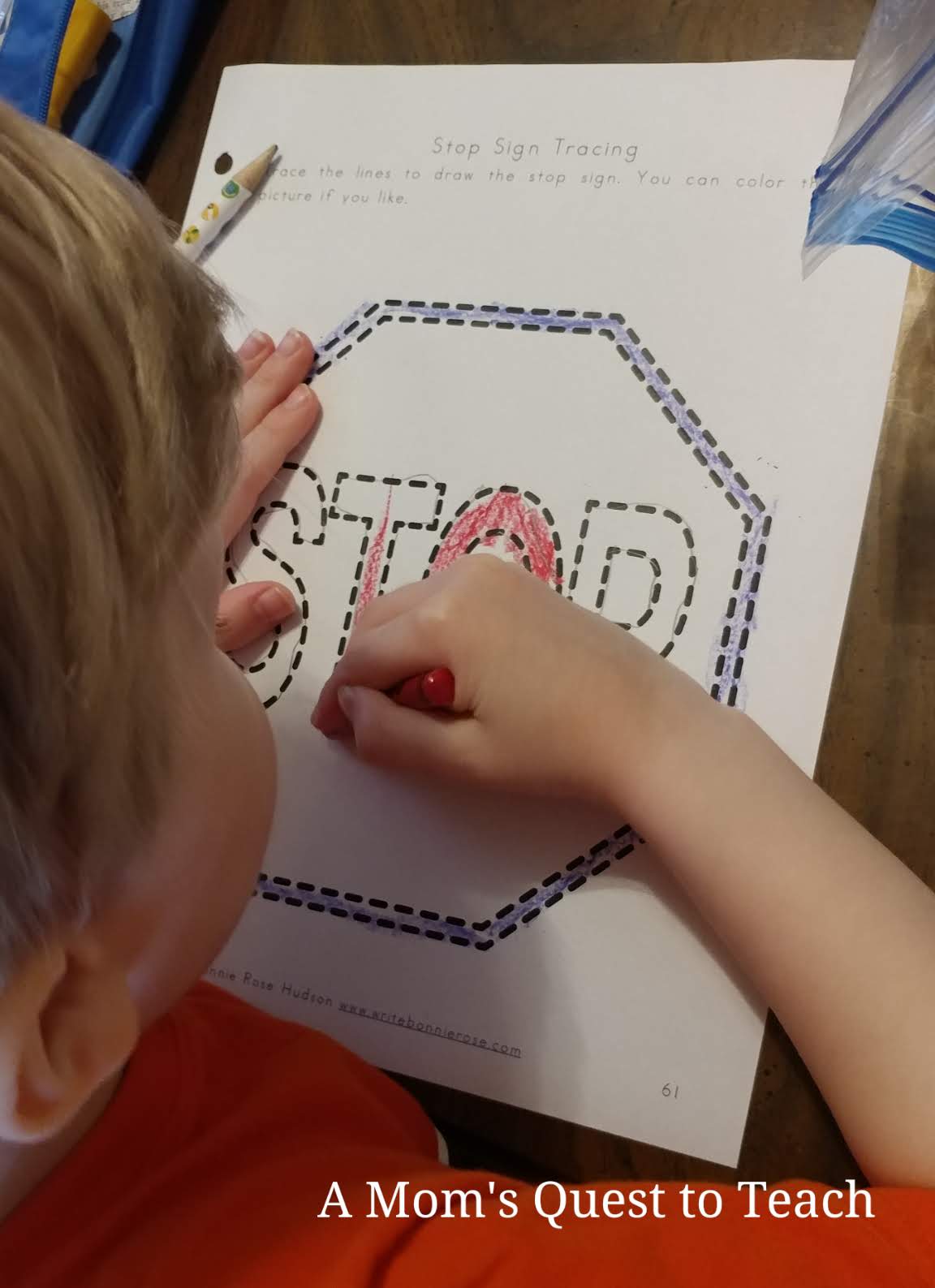
Our three-year-old usually needs more guidance as she doesn't read yet but she can work on the color by number, shape, and animal worksheets, the dauber painting pictures, counting, and tracing worksheets by herself. Our five-year-old son enjoys working on the color by rhyme sheets and the tracing pages. We have also found it useful as I had the Fun Book printed single-sided to use the back side of the worksheets to practice writing words, numbers, and a place to draw additional pictures. 


World War I 


Our teen son has always enjoyed studying World War II, so I was very hopeful that he might enjoy studying the first World War as well. Prior to using the two resources from WriteBonnieRose, he has watched a brief documentary, we discussed an overview of the war with a PowerPoint I created for my history classes, he watched All Quiet on the Western Front, and he has been reading a book about trench warfare. Adding in the 30 Days of History: World War I and the World War I Research and Notebooking Unit has rounded out our study of this time period quite nicely.


30 Days of History: World War I 


Since we have already discussed some of the events prior to World War I (assassination of Franz Ferdinand, the "blank check," and the alliances formed, I had our teen start using the four worksheets on Weapons and Equipment from the resource. I had originally planned to assign a different worksheet over four days but (as we are flexible in our homeschooling style) I instead let our teen decide if he wanted to complete them spread over four days or work on them all at once.

As the Weapons and Equipment worksheets state: "There were many developments that made World War I a more devastating war than any before it." This is part of the reason why I wanted our son to look more closely at the various weapons, equipment, and fighting styles that developed. By answering the questions he was able to study the military draft, machine gun, use of railroads, aircraft, chemical warfare, and submarine warfare.


World War I Research and Notebooking Unit 


If your family uses notebooking in your homeschool, this is a perfect resource for you and your children. It starts with an introduction that provides you with several ideas as to how to use the unit in your homeschool. There is also a list of 168 World War I battles and engagements, maps, and notebooking templates to use as your children study the different topics.

I printed out the World War I battles by year and asked our son to pick one from 1914 to start his research. Each week I will ask him to pick a battle from the next year to study in more detail. The goal is that he will be able to compare and contrast the troop movements, weapons utilized, and other events of the battles when he is done his research.

Our son also filled out the maps of Europe, the Middle East, and Africa so he could have a visual understanding of the events of the Great War. There is also a map of Australia included in the Unit.


What We Like 


I really like that the Preschool Skills Fun Book is arranged in such a manner as we can pick and choose what we need for our family. So many preschool workbooks or curriculum are too regimented which make it difficult when a child is not ready to practice a certain skill. Our children love being able to flip through the binder and pick fun worksheets to complete. They often don't even realize they are learning! 

Our son loves getting creative with the tracing pages.

Our three-year-old daughter really likes the counting pages.

As this is our first year homeschooling our teen, we are using a variety of resources for this journey. I love that we can include resources from WriteBonnieRose to help us study World War I. I look forward to seeing what else we will be able to use as we move forward in our study of U.S. History. 

I recommend WriteBonnieRose products to homeschooling families who are more flexible and might not use a boxed curriculum. The resources would also be helpful for families who might use a boxed curriculum but are looking to supplement topics with their children and for families where children attend public school.


Do you want to learn more about WriteBonnieRose? Please check out the following sites.

Website – Pinterest – Twitter – Facebook 

Friday, October 5, 2018

U is for Unrestricted Submarine Warfare (Blogging through the Alphabet)


This post contains affiliate links. For more information please see my Terms of Use and Disclosure Policy page. Thank you.

So why did the United States enter World War I when Woodrow Wilson seemed so adamant in the early years that America remain neutral? Wilson even went so far as to request citizens remain neutral in thought as well as deed.

There were a number of reasons why the United States was tied more closely with the Allies than with the Central Powers including:
  • US government officials were pro-British 
  • Propaganda was Pro-Allies 
  • American companies were tied to the Allies through loans 
  • Anti-German sentiment due to the leaked Zimmerman Telegram 
  • Sinking of British ships with American citizens on them 
Prior to World War I, the Royal Navy of Great Britain had ruled the seas but the German Kaiser Wilhelm II wished his own German High Seas Fleet to be as strong. Both sides continued to increase their Naval programs and build new ships (such as the Dreadnought). 

After World War I started, the Royal Navy instituted a blockade to not only keep German ships in port but also confiscated food and raw materials that were going to Germany. After almost a year, the Germans struck back by using submarine warfare. Their nation was suffering shortages and introducing rationing so they needed to find a way to counter the British blockade. The German submarines, known as U-Boats (short for Unterseeboot or undersea boat), began attacking enemy ships and sinking them.


Unfortunately, a U-boat torpedoed the Lusitania on May 7, 1915. The British ship was carrying 1,200 men, women, and children and 128 American passengers drowned. Even though the Germans stated the Lusitania was carrying war material, this action led to protest in the United States and very nearly a declaration of war by President Wilson. Because Germany did not want the United States to join the war with the Allies, they stopped using unrestricted submarine warfare. 

Following the change in how the Germans used the U-boats, shortages continued to worsen in their nation due to the British Naval blockade. On January 31, 1917, Germany returned to the policy of unrestricted submarine warfare. They hoped to break the blockade and eventually knock Britain out of the war entirely. They were willing to risk the entrance of the United States into the war. The Germans also had over 200 more U-boats than they did in 1915. This seemed like a more plausible plan. 

Wilson broke off diplomatic relations with Germany but he still wanted to continue a policy of neutrality. During 1916, Wilson promoted the idea of "peace without victory." Yet, the sinking of any ships in the Atlantic war zone (neutral or Allied) and the release of the Zimmerman telegram, led to the nation turning against Germany. On April 6, 1917, the United States declared war on Germany. 

So while unrestricted submarine warfare was not the only reason why the Untied States entered World War I, it was one of the decisive factors in deciding upon declaring war.